From the very beginning of their investigation of human reasoning, philosophers have identified two other forms of reasoning, besides deduction, which we now call abduction and induction.
In this book we develop various mathematical models of information dynamics, I -dynamics (including the process of thinking), based on methods of classical and quantum physics.
It is generally acknowledged that deterministic formulations of dy- namical phenomena in the social sciences need to be treated differently from similar formulations in the natural sciences.
There are many problems in nonlinear partial differential equations with delay which arise from, for example, physical models, biochemical models, and social models.
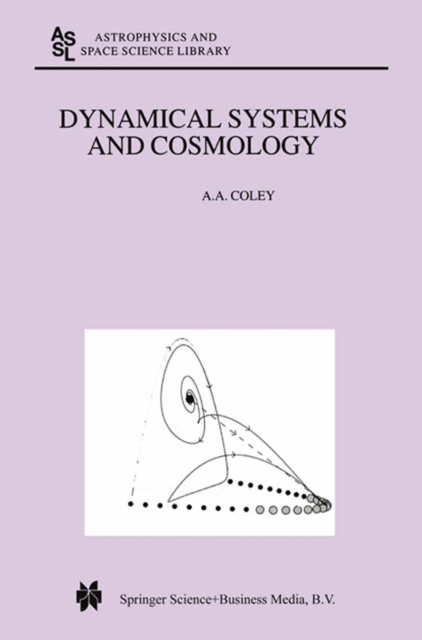
Dynamical systems theory is especially well-suited for determining the possible asymptotic states (at both early and late times) of cosmological models, particularly when the governing equations are a finite system of autonomous ordinary differential equations.
The already broad range of applications of ring theory has been enhanced in the eighties by the increasing interest in algebraic structures of considerable complexity, the so-called class of quantum groups.
These proceedings comprise a large part of the papers presented at the In- ternational Conference Factorization, Singular Operators and related problems, which was held from January 28 to February 1, 2002, at the University of th Madeira, Funchal, Portugal, to mark Professor Georgii Litvinchuk's 70 birth- day.
Functional Equations, Inequalities and Applications provides an extensive study of several important equations and inequalities, useful in a number of problems in mathematical analysis.
Functional Analysis is primarily concerned with the structure of infinite dimensional vector spaces and the transformations, which are frequently called operators, between such spaces.
Infinitesimal analysis, once a synonym for calculus, is now viewed as a technique for studying the properties of an arbitrary mathematical object by discriminating between its standard and nonstandard constituents.
This monograph is intended to be a complete treatment of the metrical the- ory of the (regular) continued fraction expansion and related representations of real numbers.
After the pioneering works by Robbins {1944, 1945) and Choquet (1955), the notation of a set-valued random variable (called a random closed set in literatures) was systematically introduced by Kendall {1974) and Matheron {1975).
The monograph presents some of the authors' recent and original results concerning boundedness and compactness problems in Banach function spaces both for classical operators and integral transforms defined, generally speaking, on nonhomogeneous spaces.
Two-and three-level difference schemes for discretisation in time, in conjunction with finite difference or finite element approximations with respect to the space variables, are often used to solve numerically non- stationary problems of mathematical physics.
Along with the traditional material concerning linear programming (the simplex method, the theory of duality, the dual simplex method), In-Depth Analysis of Linear Programming contains new results of research carried out by the authors.
At first glance, Robinson's original form of nonstandard analysis appears nonconstructive in essence, because it makes a rather unrestricted use of classical logic and set theory and, in particular, of the axiom of choice.
This monograph on quantum wires and quantum devices is a companion vol- ume to the author's Quantum Chaos and Mesoscopic Systems (Kluwer, Dordrecht, 1997).
It seems hard to believe, but mathematicians were not interested in integration problems on infinite-dimensional nonlinear structures up to 70s of our century.
The International Symposium on History of Machines and Mechanisms is a new initiative to promote explicitly researches and publications in the field of the History of TMM (Theory of Machines and Mechanisms).
In [Hardy and Williams, 1986] the authors exploited a very simple idea to obtain a linear congruence involving class numbers of imaginary quadratic fields modulo a certain power of 2.
Preface to the English Edition The present monograph is a revised and enlarged alternative of the author's monograph [19] which was devoted to the development of a unified approach to studying differential inclusions, whose values of the right hand sides are compact, not necessarily convex subsets of a Banach space.