This book contains a self-consistent treatment of a geometric averaging technique, induced by the Ricci flow, that allows comparing a given (generalized) Einstein initial data set with another distinct Einstein initial data set, both supported on a given closed n-dimensional manifold.
This textbook combines the history of synthetic geometry, centered on the years 1800-1855, with a theorem-proof exposition of the geometry developed in those years.
This work provides the first classification theory of matrix-valued symmetry breaking operators from principal series representations of a reductive group to those of its subgroup.
The ambitious program for the birational classification of higher-dimensional complex algebraic varieties initiated by Shigeru Iitaka around 1970 is usually called the Iitaka program.
This book contains a self-consistent treatment of a geometric averaging technique, induced by the Ricci flow, that allows comparing a given (generalized) Einstein initial data set with another distinct Einstein initial data set, both supported on a given closed n-dimensional manifold.
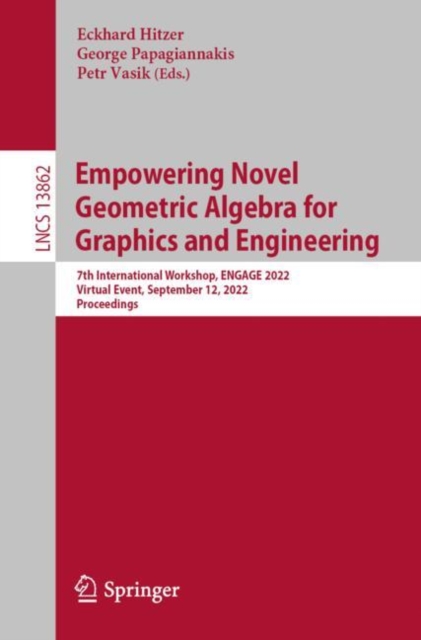
This book constitutes the proceedings of the Workshop Empowering Novel Geometric Algebra for Graphics and Engineering, ENGAGE 2022, held in conjunction with Computer Graphics International conference, CGI 2022, which took place virtually, in September 2022.
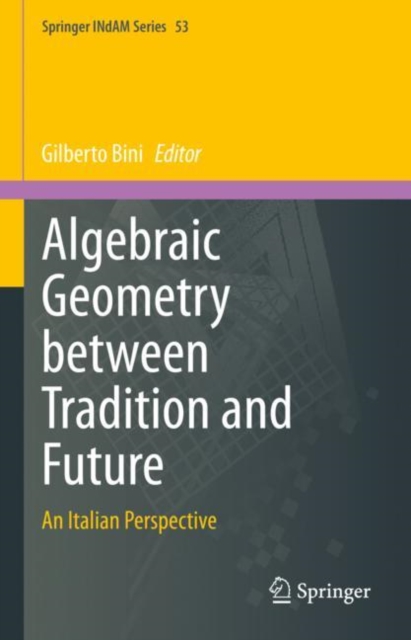
An incredible season for algebraic geometry flourished in Italy between 1860, when Luigi Cremona was assigned the chair of Geometria Superiore in Bologna, and 1959, when Francesco Severi published the last volume of the treatise on algebraic systems over a surface and an algebraic variety.
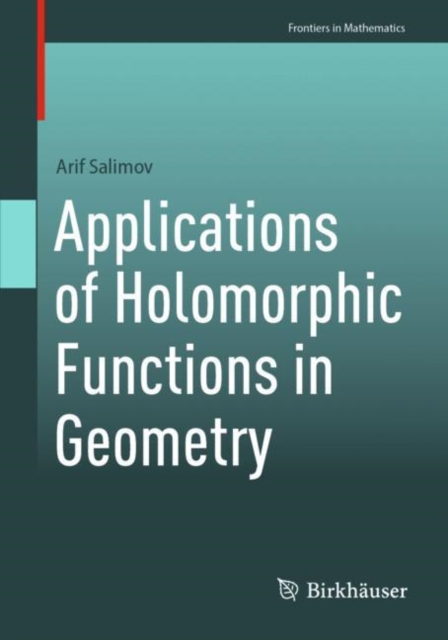
This book expounds on the recent developments in applications of holomorphic functions in the theory of hypercomplex and anti-Hermitian manifolds as well as in the geometry of bundles.
An incredible season for algebraic geometry flourished in Italy between 1860, when Luigi Cremona was assigned the chair of Geometria Superiore in Bologna, and 1959, when Francesco Severi published the last volume of the treatise on algebraic systems over a surface and an algebraic variety.
This book expounds on the recent developments in applications of holomorphic functions in the theory of hypercomplex and anti-Hermitian manifolds as well as in the geometry of bundles.
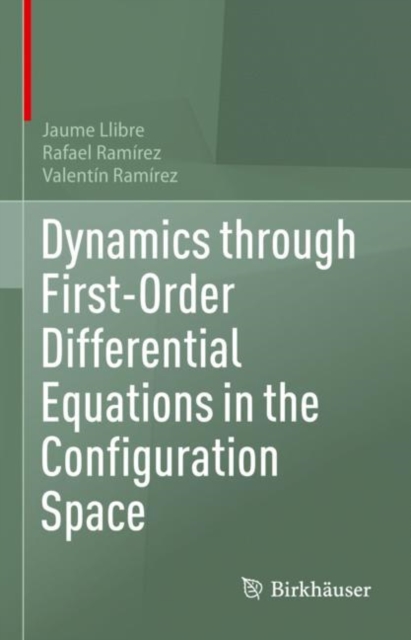
The goal of this monograph is to answer the question, is it possible to solve the dynamics problem inside the configuration space instead of the phase space?
This book constitutes the proceedings of the Workshop Empowering Novel Geometric Algebra for Graphics and Engineering, ENGAGE 2022, held in conjunction with Computer Graphics International conference, CGI 2022, which took place virtually, in September 2022.
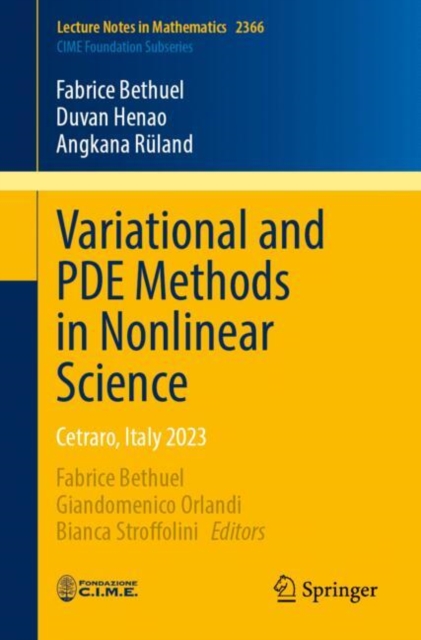
This book presents three short courses on topics at the intersection of Calculus of Variations, PDEs and Material Science, based on lectures given at the CIME summer school “Variational and PDE Methods in Nonlinear Science”, held in Cetraro (Italy), July 10–14, 2023.
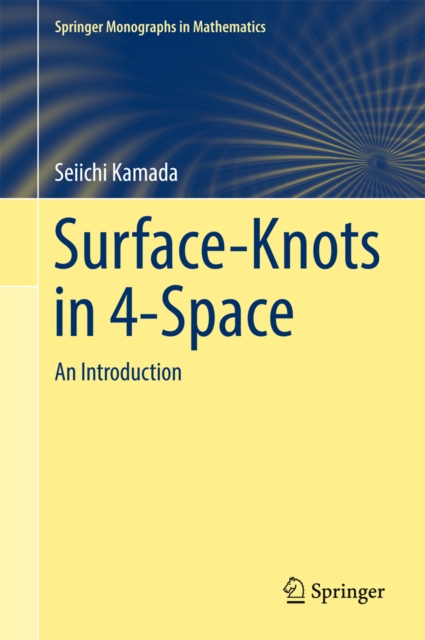
This introductory volume provides the basics of surface-knots and related topics, not only for researchers in these areas but also for graduate students and researchers who are not familiar with the field.
This book deals with the classical theory of Nevanlinna on the value distribution of meromorphic functions of one complex variable, based on minimum prerequisites for complex manifolds.
This book presents the proceedings of the 20th International Workshop on Hermitian Symmetric Spaces and Submanifolds, which was held at the Kyungpook National University from June 21 to 25, 2016.
The KSCV Symposium, the Korean Conference on Several Complex Variables, started in 1997 in an effort to promote the study of complex analysis and geometry.
This is an English translation of the book in Japanese, published as the volume 20 in the series of Seminar Notes from The University of Tokyo that grew out of a course of lectures by Professor Kunihiko Kodaira in 1967.
This book lays out the theory of Mordell-Weil lattices, a very powerful and influential tool at the crossroads of algebraic geometry and number theory, which offers many fruitful connections to other areas of mathematics.
The goal of this monograph is to answer the question, is it possible to solve the dynamics problem inside the configuration space instead of the phase space?
This textbook, based on a one-semester course taught several times by the authors, provides a self-contained, comprehensive yet concise introduction to the theory of pseudoholomorphic curves.
The package of Gromov's pseudo-holomorphic curves is a major tool in global symplectic geometry and its applications, including mirror symmetry and Hamiltonian dynamics.
This book is a collection of selected research papers, some of which were presented at the International Conference on Differential Geometry, Algebra and Analysis (ICDGAA 2016), held at the Department of Mathematics, Jamia Millia Islamia, New Delhi, from 15-17 November 2016.
This book gathers problems based on over twenty years of the Indiana College Mathematics Competition, a regional problem-solving contest for teams of undergraduates.
This book lays out the theory of Mordell-Weil lattices, a very powerful and influential tool at the crossroads of algebraic geometry and number theory, which offers many fruitful connections to other areas of mathematics.
The present monograph further develops the study, via the techniques of combinatorial anabelian geometry, of the profinite fundamental groups of configuration spaces associated to hyperbolic curves over algebraically closed fields of characteristic zero.
In this book, the optimal transportation problem (OT) is described as a variational problem for absolutely continuous stochastic processes with fixed initial and terminal distributions.
This is an English translation of the book in Japanese, published as the volume 20 in the series of Seminar Notes from The University of Tokyo that grew out of a course of lectures by Professor Kunihiko Kodaira in 1967.
The package of Gromov's pseudo-holomorphic curves is a major tool in global symplectic geometry and its applications, including mirror symmetry and Hamiltonian dynamics.
This book is a collection of selected research papers, some of which were presented at the International Conference on Differential Geometry, Algebra and Analysis (ICDGAA 2016), held at the Department of Mathematics, Jamia Millia Islamia, New Delhi, from 15-17 November 2016.
The ambitious program for the birational classification of higher-dimensional complex algebraic varieties initiated by Shigeru Iitaka around 1970 is usually called the Iitaka program.