This book can be seen as a continuation of Equations and Inequalities: El- ementary Problems and Theorems in Algebra and Number Theory by the same authors, and published as the first volume in this book series.
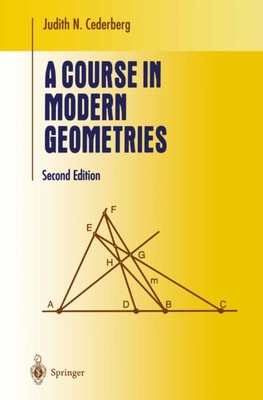
A Course in Modern Geometries is designed for a junior-senior level course for mathematics majors, including those who plan to teach in secondary school.
Originally written in Russian and used in the Gelfand Correspondence School, "e;Lines and Curves"e; has since become a classic: the exposition maintains mathematical rigor while balancing creative storytelling and unusual examples of geometric properties.
The author's lectures, "e;Contact Manifolds in Riemannian Geometry,"e; volume 509 (1976), in the Springer-Verlag Lecture Notes in Mathematics series have been out of print for some time and it seems appropriate that an expanded version of this material should become available.
The aim of this book is to present certain fundamental facts in the theory of algebraic surfaces, defined over an algebraically closed field lk of arbitrary characteristic.
A Course in Modern Geometries is designed for a junior-senior level course for mathematics majors, including those who plan to teach in secondary school.
Mathematics is playing an ever more important role in the physical and biological sciences, provoking a blurring of boundaries between scientific disciplines and a resurgence of interest in the modern as well as the clas- sical techniques of applied mathematics.
Written as a supplement to Marcel Berger's popular two-volume set, Geometry I and II (Universitext), this book offers a comprehensive range of exercises, problems, and full solutions.
From the reviews: "e;A prominent research mathematician and a high school teacher have combined their efforts in order to produce a high school geometry course.
In the early years of the 1980s, while I was visiting the Institute for Ad- vanced Study (lAS) at Princeton as a postdoctoral member, I got a fascinating view, studying congruence modulo a prime among elliptic modular forms, that an automorphic L-function of a given algebraic group G should have a canon- ical p-adic counterpart of several variables.
This IMA Volume in Mathematics and its Applications GEOMETRIC METHODS IN INVERSE PROBLEMS AND PDE CONTROL contains a selection of articles presented at 2001 IMA Summer Program with the same title.
After several decades of reduced contact, the interaction between physicists and mathematicians in the front-line research of both fields recently became deep and fruit- ful again.
Foliation theory has its origins in the global analysis of solutions of ordinary differential equations: on an n-dimensional manifold M, an [autonomous] differential equation is defined by a vector field X ; if this vector field has no singularities, then its trajectories form a par- tition of M into curves, i.