Train your brain with these fiendishly difficult puzzles, the perfect companion for anyone wanting to keep their mind busy'Fiendishly tricky' Daily MailWith their first bestselling book, The GCHQ Puzzle Book, the UK's intelligence and security experts tested us with puzzles, codes and real-life entrance tests from their archives.
There has been a common perception that computational complexity is a theory of "e;bad news"e; because its most typical results assert that various real-world and innocent-looking tasks are infeasible.
These two volumes collect thirty-eight selected papers from the scientific contributions presented at the Fourth European Workshop on Quantum Systems in Chemistry and Physics (QSCP-IV), held in Marly-le-Roi (France) in April 22-27, 1999, A total ofone hundred and fifteen scientists attended the workshop, 99 from Europe and 16 from the rest ofthe world.
These two volumes collect thirty-eight selected papers from the scientific contributions presented at the Fourth European Workshop on Quantum Systems in Chemistry and Physics (QSCP-IV), held in Marly-le-Roi (France) in April 22-27, 1999.
An introduction to natural language semantics that offers an overview of the empirical domain and an explanation of the mathematical concepts that underpin the discipline.
An introduction to applying predicate logic to testing and verification of software and digital circuits that focuses on applications rather than theory.
Basic Category Theory for Computer Scientists provides a straightforward presentation of the basic constructions and terminology of category theory, including limits, functors, natural transformations, adjoints, and cartesian closed categories.
The Complete Idiot's Guide to Speed Math provides easy-to-understand methods, tips, and tricks to do math in one's head, on paper, and on a calculator at a faster rate and with more accuracy for anyone who is intimidated by math and for whom such calculations would otherwise require paper or calculator.
Number Systems: A Path into Rigorous Mathematics aims to introduce number systems to an undergraduate audience in a way that emphasises the importance of rigour, and with a focus on providing detailed but accessible explanations of theorems and their proofs.
An understanding of the theory and application of logic is fundamental both to successful software and hardware development, and to gain a thorough grasp of modern computing.
Books on information theory and coding have proliferated over the last few years, but few succeed in covering the fundamentals without losing students in mathematical abstraction.
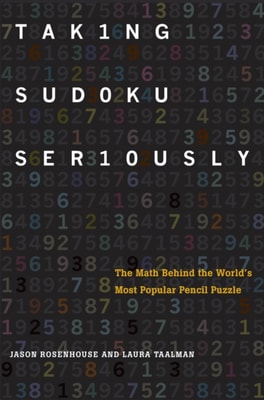
Packed with more than a hundred color illustrations and a wide variety of puzzles and brainteasers, Taking Sudoku Seriously uses this popular craze as the starting point for a fun-filled introduction to higher mathematics.
Packed with more than a hundred color illustrations and a wide variety of puzzles and brainteasers, Taking Sudoku Seriously uses this popular craze as the starting point for a fun-filled introduction to higher mathematics.
This is a charming and insightful contribution to an understanding of the "e;Science Wars"e; between postmodernist humanism and science, driving toward a resolution of the mutual misunderstanding that has driven the controversy.
This volume brings together many of Terence Horgan's essays on paradoxes: Newcomb's problem, the Monty Hall problem, the two-envelope paradox, the sorites paradox, and the Sleeping Beauty problem.
A Transition to Advanced Mathematics: A Survey Course promotes the goals of a "e;bridge' course in mathematics, helping to lead students from courses in the calculus sequence (and other courses where they solve problems that involve mathematical calculations) to theoretical upper-level mathematics courses (where they will have to prove theorems and grapple with mathematical abstractions).
In this text, a variety of modal logics at the sentential, first-order, and second-order levels are developed with clarity, precision and philosophical insight.
Fourier analysis has many scientific applications - in physics, number theory, combinatorics, signal processing, probability theory, statistics, option pricing, cryptography, acoustics, oceanography, optics and diffraction, geometry, and other areas.
If we must take mathematical statements to be true, must we also believe in the existence of abstracta eternal invisible mathematical objects accessible only by the power of pure thought?
The Quine-Putnam indispensability argument in the philosophy of mathematics urges us to place mathematical entities on the same ontological footing as other theoretical entities essential to our best scientific theories.
The underlying theme of this book is that a widespread, taxonomically diverse group of animals, important both from ecological and human resource perspectives, remains poorly understood and in delcine, while receiving scant attention from the ecological and conservation community.
When Archimedes, while bathing, suddenly hit upon the principle of buoyancy, he ran wildly through the streets of Syracuse, stark naked, crying "e;eureka!
Kurt Godel, the greatest logician of our time, startled the world of mathematics in 1931 with his Theorem of Undecidability, which showed that some statements in mathematics are inherently "e;undecidable.
In this collection of essays written over a period of twenty years, Solomon Feferman explains advanced results in modern logic and employs them to cast light on significant problems in the foundations of mathematics.
There are many proposed aims for scientific inquiry--to explain or predict events, to confirm or falsify hypotheses, or to find hypotheses that cohere with our other beliefs in some logical or probabilistic sense.
This book explores an important central thread that unifies Russell's thoughts on logic in two works previously considered at odds with each other, the Principles of Mathematics and the later Principia Mathematica.
This is a charming and insightful contribution to an understanding of the "e;Science Wars"e; between postmodernist humanism and science, driving toward a resolution of the mutual misunderstanding that has driven the controversy.
With a never-before published paper by Lord Henry Cavendish, as well as a biography on him, this book offers a fascinating discourse on the rise of scientific attitudes and ways of knowing.
This work is a sequel to the author's Godel's Incompleteness Theorems, though it can be read independently by anyone familiar with Godel's incompleteness theorem for Peano arithmetic.