This volume brings together fourteen essays authored by distinguished mathematicians from India, offering a panoramic view of current research directions as well as recent historical developments in mathematics in India.
This volume brings together fourteen essays authored by distinguished mathematicians from India, offering a panoramic view of current research directions as well as recent historical developments in mathematics in India.
This book aims at presenting and exploring an experiential learning techniques for Discrete Mathematics along with the new paradigm shift of various educational policies across the globe.
This book aims at presenting and exploring an experiential learning techniques for Discrete Mathematics along with the new paradigm shift of various educational policies across the globe.
Sums of Squares of Integers covers topics in combinatorial number theory as they relate to counting representations of integers as sums of a certain number of squares.
Puzzle and Proof: A Decade of Problems from the Utah Math Olympiad is a compilation of the problems and solutions for the first 10 years of the Utah Math Olympiad.
This book is an introduction to the algorithmic aspects of number theory and its applications to cryptography, with special emphasis on the RSA cryptosys-tem.
Puzzle and Proof: A Decade of Problems from the Utah Math Olympiad is a compilation of the problems and solutions for the first 10 years of the Utah Math Olympiad.
This book contains 23 contributions presented at the "e;International Conference on Coding Theory, Cryptography and Related Areas (ICCC)"e;, held in Guanajuato, Mexico, in April 1998.
"e;Number Theory in Science and Communication"e; is a well-known introduction for non-mathematicians to this fascinating and useful branch of applied mathematics .
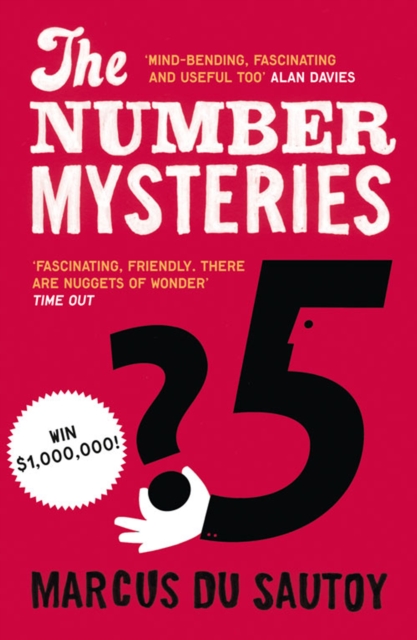
From the author of The Music of the Primes and Finding Moonshine comes a short, lively book on five mathematical problems that just refuse be solved - and on how many everyday problems can be solved by maths.
Estas notas de clase son el resultado de la experiencia de los autores, tanto estudiantes como profesores, en el curso de Teoria de la medida o Medida e integracion.
Preface Among the various branches of mathematics, number theory is characterized to a lesser degree by its primary subject ("e;integers"e;) than by a psychologi- cal attitude.
In 1992, when Paul Erdos was awarded a Doctor Honoris Causa by Charles University in Prague, a small conference was held, bringing together a distin- guished group of researchers with interests spanning a variety of fields related to Erdos' own work.
In 1992, when Paul Erdos was awarded a Doctor Honoris Causa by Charles University in Prague, a small conference was held, bringing together a distin- guished group of researchers with interests spanning a variety of fields related to Erdos' own work.
Discrete Mathematics and theoretical computer science are closely linked research areas with strong impacts on applications and various other scientific disciplines.
Cuts and metrics are well-known objects that arise - independently, but with many deep and fascinating connections - in diverse fields: in graph theory, combinatorial optimization, geometry of numbers, combinatorial matrix theory, statistical physics, VLSI design etc.
This book grew out of three series of lectures given at the summer school on "e;Modular Forms and their Applications"e; at the Sophus Lie Conference Center in Nordfjordeid in June 2004.
The book is an introduction to the theory of cubic metaplectic forms on the 3-dimensional hyperbolic space and the author's research on cubic metaplectic forms on special linear and symplectic groups of rank 2.
The book gives a survey of some recent developments in the theory of bundles on curves arising out of the work of Drinfeld and from insights coming from Theoretical Physics.
This is a book aimed at researchers and advanced graduate students in algebraic geometry, interested in learning about a promising direction of research in algebraic geometry.