This Handbook explores the history of mathematics under a series of themes which raise new questions about what mathematics has been and what it has meant to practice it.
In the follow-up to his acclaimed Science in the Looking Glass, Brian Davies discusses deep problems about our place in the world, using a minimum of technical jargon.
Grounding Concepts tackles the issue of arithmetical knowledge, developing a new position which respects three intuitions which have appeared impossible to satisfy simultaneously: a priorism, mind-independence realism, and empiricism.
The interplay between computability and randomness has been an active area of research in recent years, reflected by ample funding in the USA, numerous workshops, and publications on the subject.
This Handbook explores the history of mathematics under a series of themes which raise new questions about what mathematics has been and what it has meant to practice it.
A History of Mathematics: From Mesopotamia to Modernity covers the evolution of mathematics through time and across the major Eastern and Western civilizations.
The Cambridge philosopher Frank Ramsey (1903-1930) died tragically young, but had already established himself as one of the most brilliant minds of the twentieth century.
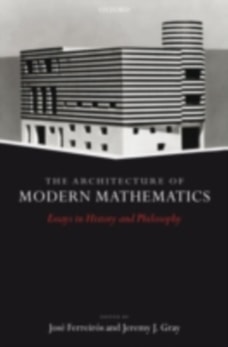
This edited volume, aimed at both students and researchers in philosophy, mathematics and history of science, highlights leading developments in the overlapping areas of philosophy and the history of modern mathematics.
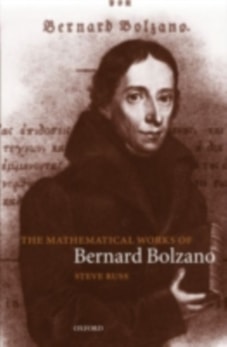
Bernard Bolzano (1781-1848, Prague) was a remarkable thinker and reformer far ahead of his time in many areas, including philosophy, theology, ethics, politics, logic, and mathematics.
Model theory, a major branch of mathematical logic, plays a key role connecting logic and other areas of mathematics such as algebra, geometry, analysis, and combinatorics.
This volume aims to provide the elements for a systematic exploration of certain fundamental notions of Peirce and Husserl in respect with foundations of science by means of drawing a parallelism between their works.
This book is focused on the first three parts of Bolzano's Theory of Sciene and introduces a more systematic reconsideration of Bolzano's logial thought.
This book is focused on the first three parts of Bolzano's Theory of Sciene and introduces a more systematic reconsideration of Bolzano's logial thought.
Many significant problems in metaphysics are tied to ontological questions, but ontology and its relation to larger questions in metaphysics give rise to a series of puzzles that suggest that we don't fully understand what ontology is supposed to do, nor what ambitions metaphysics can have for finding out about what reality is like.
Science Without Numbers caused a stir in philosophy on its original publication in 1980, with its bold nominalist approach to the ontology of mathematics and science.
Many significant problems in metaphysics are tied to ontological questions, but ontology and its relation to larger questions in metaphysics give rise to a series of puzzles that suggest that we don't fully understand what ontology is supposed to do, nor what ambitions metaphysics can have for finding out about what reality is like.
The logician Kurt Godel in 1951 established a disjunctive thesis about the scope and limits of mathematical knowledge: either the mathematical mind is not equivalent to a Turing machine (i.
The logician Kurt Godel in 1951 established a disjunctive thesis about the scope and limits of mathematical knowledge: either the mathematical mind is not equivalent to a Turing machine (i.
Roy T Cook examines the Yablo paradox--a paradoxical, infinite sequence of sentences, each of which entails the falsity of all others later than it in the sequence--with special attention paid to the idea that this paradox provides us with a semantic paradox that involves no circularity.
While we are commonly told that the distinctive method of mathematics is rigorous proof, and that the special topic of mathematics is abstract structure, there has been no agreement among mathematicians, logicians, or philosophers as to just what either of these assertions means.
While we are commonly told that the distinctive method of mathematics is rigorous proof, and that the special topic of mathematics is abstract structure, there has been no agreement among mathematicians, logicians, or philosophers as to just what either of these assertions means.
Gottfried Wilhelm Leibniz (1646-1716) was a man of extraordinary intellectual creativity who lived an exceptionally rich and varied intellectual life in troubled times.
Gottfried Wilhelm Leibniz (1646-1716) was a man of extraordinary intellectual creativity who lived an exceptionally rich and varied intellectual life in troubled times.
Paolo Mancosu presents a series of innovative studies in the history and the philosophy of logic and mathematics in the first half of the twentieth century.
The volume is the first collection of essays that focuses on Gottlob Frege's Basic Laws of Arithmetic (1893/1903), highlighting both the technical and the philosophical richness of Frege's magnum opus.
To open a newspaper or turn on the television it would appear that science and religion are polar opposites - mutually exclusive bedfellows competing for hearts and minds.
To open a newspaper or turn on the television it would appear that science and religion are polar opposites - mutually exclusive bedfellows competing for hearts and minds.