This book, the third book in the four-volume series in algebra, deals with important topics in homological algebra, including abstract theory of derived functors, sheaf co-homology, and an introduction to etale and l-adic co-homology.
This research monograph is a detailed account with complete proofs of rational homotopy theory for general non-simply connected spaces, based on the minimal models introduced by Sullivan in his original seminal article.
This book is about new topological invariants of real- and angle-valued maps inspired by Morse-Novikov theory, a chapter of topology, which has recently raised interest outside of mathematics; for example, in data analysis, shape recognition, computer science and physics.
The aim of the textbook is two-fold: first to serve as an introductory graduate course in Algebraic Topology and then to provide an application-oriented presentation of some fundamental concepts in Algebraic Topology to the fixed point theory.
This unique book offers an introductory course on category theory, which became a working language in algebraic geometry and number theory in the 1950s and began to spread to logic and computer science soon after it was created.
This research monograph is a detailed account with complete proofs of rational homotopy theory for general non-simply connected spaces, based on the minimal models introduced by Sullivan in his original seminal article.
This book is about new topological invariants of real- and angle-valued maps inspired by Morse-Novikov theory, a chapter of topology, which has recently raised interest outside of mathematics; for example, in data analysis, shape recognition, computer science and physics.
This book aims to fill the gap in the available literature on supermanifolds, describing the different approaches to supermanifolds together with various applications to physics, including some which rely on the more mathematical aspects of supermanifold theory.
In this second edition, the following recent papers have been added: "e;Gauss Codes, Quantum Groups and Ribbon Hopf Algebras"e;, "e;Spin Networks, Topology and Discrete Physics"e;, "e;Link Polynomials and a Graphical Calculus"e; and "e;Knots Tangles and Electrical Networks"e;.
This volume is a collection of research papers devoted to the study of relationships between knot theory and the foundations of mathematics, physics, chemistry, biology and psychology.
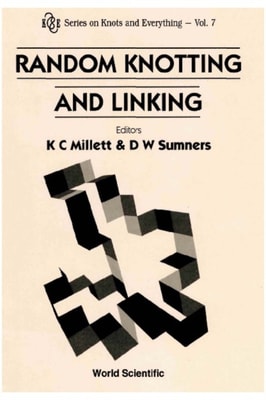
This volume includes both rigorous asymptotic results on the inevitability of random knotting and linking, and Monte Carlo simulations of knot probability at small lengths.
This volume consists of ten lectures given at an international workshop/conference on knot theory held in July 1996 at Waseda University Conference Center.
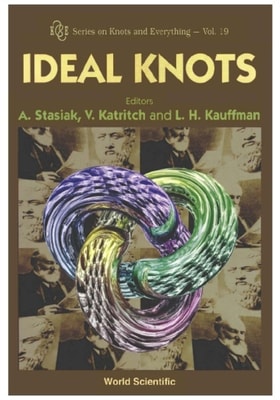
In this book, experts in different fields of mathematics, physics, chemistry and biology present unique forms of knots which satisfy certain preassigned criteria relevant to a given field.
This book deals with nonlinear boundary value problems for semilinear elliptic equations on unbounded domains with nonlinearities involving the subcritical Sobolev exponent.
This volume gathers the contributions from the international conference "e;Intelligence of Low Dimensional Topology 2006,"e; which took place in Hiroshima in 2006.
LinKnot - Knot Theory by Computer provides a unique view of selected topics in knot theory suitable for students, research mathematicians, and readers with backgrounds in other exact sciences, including chemistry, molecular biology and physics.
This book is an indispensable guide for anyone seeking to familarize themselves with research in braid groups, configuration spaces and their applications.
This volume consists primarily of survey papers that evolved from the lectures given in the school portion of the meeting and selected papers from the conference.
The aim of this book is to give as detailed a description as is possible of one of the most beautiful and complicated examples in low-dimensional topology.
This book, the third book in the four-volume series in algebra, deals with important topics in homological algebra, including abstract theory of derived functors, sheaf co-homology, and an introduction to etale and l-adic co-homology.