This book contains the key themes and insights from the presentations and posters presented at the Seventh International Workshop on the TianQin Science Mission (TQ7).
This book contains the key themes and insights from the presentations and posters presented at the Seventh International Workshop on the TianQin Science Mission (TQ7).
With over 150 alphabetically arranged entries about key scientists, concepts, discoveries, technological innovations, and learned institutions, the Oxford Guide to Physics and Astronomy traces the history of physics and astronomy from the Renaissance to the present.
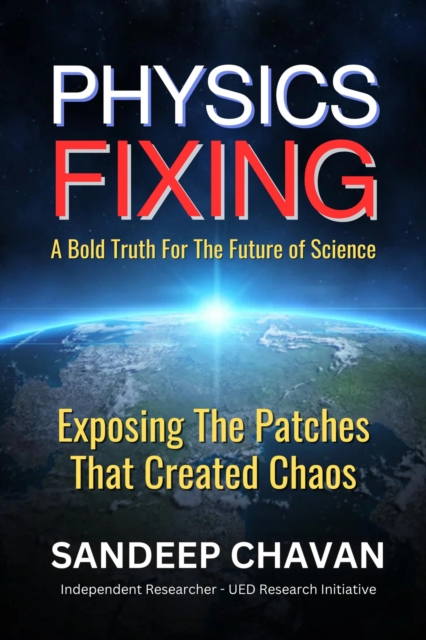
In Physics Fixing: A Bold Truth for the Future of Science, Sandeep Chavan presents a groundbreaking critique of modern physics, exposing its reliance on mathematical patches and theoretical constructs that often contradict physical intuition.
Targeting advanced students of astronomy and physics, as well as astronomers and physicists contemplating research on supernovae or related fields, David Branch and J.
Based on the author's own work and results obtained by international teams he coordinated, this SpringerBrief offers a concise discussion of the origin and early evolution of atmospheres of terrestrial planets during the active phase of their host stars, as well as of the environmental conditions which are necessary in order for planets like the Earth to obtain N_2-rich atmospheres.
Targeting advanced students of astronomy and physics, as well as astronomers and physicists contemplating research on supernovae or related fields, David Branch and J.
This book is a record of the complete proceedings of the first International Symposium on Recent Developments in Relativistic Astrophysics (ISRA 2023), convened on December 11 – 13 at Shri Ramasamy Memorial (SRM) University Sikkim, Gangtok, India.
This book is a record of the complete proceedings of the first International Symposium on Recent Developments in Relativistic Astrophysics (ISRA 2023), convened on December 11 – 13 at Shri Ramasamy Memorial (SRM) University Sikkim, Gangtok, India.
The Oscillating Universe: Einsteinian Cosmology of Black Holes and Gravitational Waves introduces the concept of cyclic cosmology within the framework of General Relativity.
The Oscillating Universe: Einsteinian Cosmology of Black Holes and Gravitational Waves introduces the concept of cyclic cosmology within the framework of General Relativity.
Exciting results are blooming, thanks to a convergence between unprecedented asteroseismic data obtained by the satellites CoRoT and KEPLER, and state-of-the-art models of the internal structure of red giants and of galactic evolution.
An outgrowth of the first Asia-Pacific Regional School on the International Heliophysical Year (IHY), this volume contains a collection of review articles describing the universal physical processes in the heliospace influenced by solar electromagnetic and mass emissions.
This book represents Volume II of the Proceedings of the UN/ESA/NASA Workshop on the International Heliophysical Year 2007 and Basic Space Science, hosted by the National Astronomical Observatory of Japan, Tokyo, 18 - 22 June, 2007.
In a wide variety of applications, accurate simulation of particle transport is necessary whether those particles be photons, neutrinos, or charged par- cles.
The 2007 ESO Instrument Calibration workshop brought together more than 120 participants with the objective to a) foster the sharing of information, experience and techniques between observers, instrument developers and instrument operation teams, b) review the actual precision and limitations of the applied instrument calibration plans, and c) collect the current and future requirements by the ESO users.
In the context of the NASA Deep Impact space mission, comet 9P/Tempel1 has been at the focus of an unprecedented worldwide long-term multi-wavelength observation campaign.
For the fourth time, the Leibniz Supercomputing Centre (LRZ) and the Com- tence Network for Technical, Scienti c High Performance Computing in Bavaria (KONWIHR) publishes the results from scienti c projects conducted on the c- puter systems HLRB I and II (High Performance Computer in Bavaria).
Launched in 2004, "e;Nuclear Physics in Astrophysics"e; has established itself in a successful topical conference series addressing the forefront of research in the field.
TheFifthHEIDELBERGInternationalConferenceonDarkMatterinAst- and Particle Physics, DARK 2004, took place at Texas A&M University, College Station Texas, USA, October 3-9, 2004.