The Sun, as our nearest star, is of enormous importance for life on Earth - providing the warm radiation and light which allowed complex life to evolve.
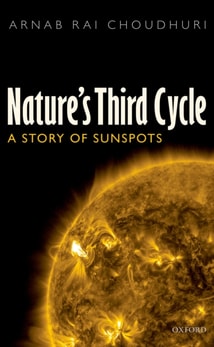
The Sun, as our nearest star, is of enormous importance for life on Earth - providing the warm radiation and light which allowed complex life to evolve.
The Cosmic Mystery Tour takes us on a lightning tour of the mysteries of the universe enlivened by brief stories of the colourful characters who created modern science.
Since humans first looked up at the stars, astronomy has had a particular ability to stir the imagination and challenge the thinking of scientists and non-scientists alike.
Scientific and popular literature on modern cosmology is very extensive; however, scholarly works on the historical development of cosmology are few and scattered.
Einstein's general theory of relativity -- currently our best theory of gravity -- is important not only to specialists, but to a much wider group of physicists.
This graduate textbook on optimal spacecraft trajectories demonstrates the theory and applications of using the minimum amount of propellant possible to reach a target destination.
This book introduces quantum field theory, together with its most important applications to cosmology and astroparticle physics, in a coherent framework.
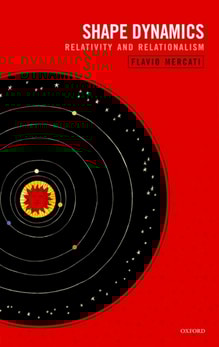
This textbook on the nature of space and time explains the new theory of Space Dynamics, which describes the dynamics of gravity as the evolution of conformal 3-dimensional geometry.
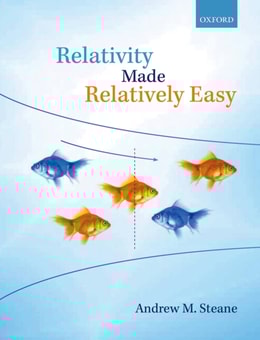
Relativity Made Relatively Easy presents an extensive study of Special Relativity and a gentle (but exact) introduction to General Relativity for undergraduate students of physics.
Relativity Made Relatively Easy presents an extensive study of Special Relativity and a gentle (but exact) introduction to General Relativity for undergraduate students of physics.
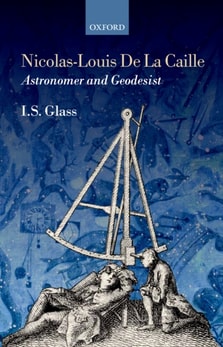
La Caille was one of the observational astronomers and geodesists who followed Newton in developing ideas about celestial mechanics and the shape of the earth.
La Caille was one of the observational astronomers and geodesists who followed Newton in developing ideas about celestial mechanics and the shape of the earth.
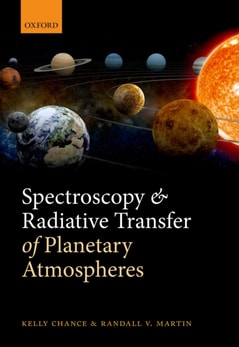
Spectroscopy and radiative transfer are rapidly growing fields within atmospheric and planetary science with implications for weather, climate, biogeochemical cycles, air quality on Earth, as well as the physics and evolution of planetary atmospheres in our solar system and beyond.
Ongoing studies in mathematical depth, and inferences from `helioseismological' observations of the internal solar rotation have shown up the limitations in our knowledge of the solar interior and of our understanding of the solar dynamo, manifested in particular by the sunspot cycle, the Maunder minimum, and solar flares.
Ongoing studies in mathematical depth, and inferences from `helioseismological' observations of the internal solar rotation have shown up the limitations in our knowledge of the solar interior and of our understanding of the solar dynamo, manifested in particular by the sunspot cycle, the Maunder minimum, and solar flares.
Galaxies are the building blocks of the Universe: standing like islands in space, each is made up of many hundreds of millions of stars in which the chemical elements are made, around which planets form, and where on at least one of those planets intelligent life has emerged.
This book provides an up-to-date, self-contained account of deep inelastic scattering in high-energy physics, intended for graduate students and physicists new to the subject.
This book provides an up-to-date, self-contained account of deep inelastic scattering in high-energy physics, intended for graduate students and physicists new to the subject.
The subject of this book is the Casimir effect, a manifestation of zero-point oscillations of the quantum vacuum resulting in forces acting between closely spaced bodies.
Will we ever discover a single scientific theory that tells us everything that has happened, and everything that will happen, on every level in the Universe?
General Relativity has passed all experimental and observational tests to model the motion of isolated bodies with strong gravitational fields, though the mathematical and numerical study of these motions is still in its infancy.
Fred Hoyle was one of the most widely acclaimed and colourful scientists of the twentieth century, a down-to-earth Yorkshireman who combined a brilliant scientific mind with a relish for communication and controversy.
"e;Kinetic Theory of Granular Gases"e; provides an introduction to the rapidly developing theory of dissipative gas dynamics - a theory which has mainly evolved over the last decade.