Microphone arrays have attracted a lot of interest over the last few decades since they have the potential to solve many important problems such as noise reduction/speech enhancement, source separation, dereverberation, spatial sound recording, and source localization/tracking, to name a few.
Noise is everywhere and in most applications that are related to audio and speech, such as human-machine interfaces, hands-free communications, voice over IP (VoIP), hearing aids, teleconferencing/telepresence/telecollaboration systems, and so many others, the signal of interest (usually speech) that is picked up by a microphone is generally contaminated by noise.
Non Destructive Testing and Non Destructive Evaluation using Ultrasounds covers an important field of applications and requires a wide range of fundamental theoretical, numerical and experimental investigations.
Blauert's and Xiang's "e;Acoustics for Engineers"e; provides the material for an introductory course in engineering acoustics for students with basic knowledge in mathematics.
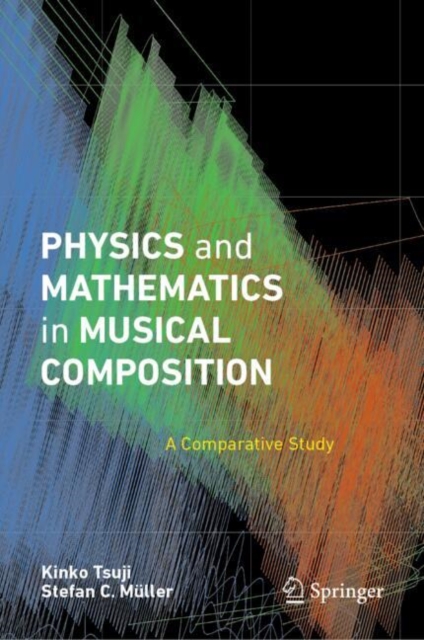
Offering a groundbreaking interdisciplinary perspective, this book explores the fundamental mechanisms behind music perception by bridging music psychology with computational neuroscience.
Offering a groundbreaking interdisciplinary perspective, this book explores the fundamental mechanisms behind music perception by bridging music psychology with computational neuroscience.
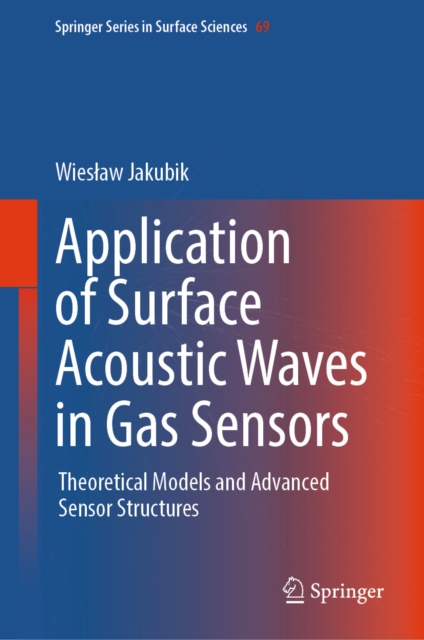
This textbook covers key aspects of applying surface acoustic waves (SAW) in gas sensors, presenting fundamental operating principles, theoretical models, research methodologies, and sensor structures in a clear and accessible manner.
This textbook covers key aspects of applying surface acoustic waves (SAW) in gas sensors, presenting fundamental operating principles, theoretical models, research methodologies, and sensor structures in a clear and accessible manner.
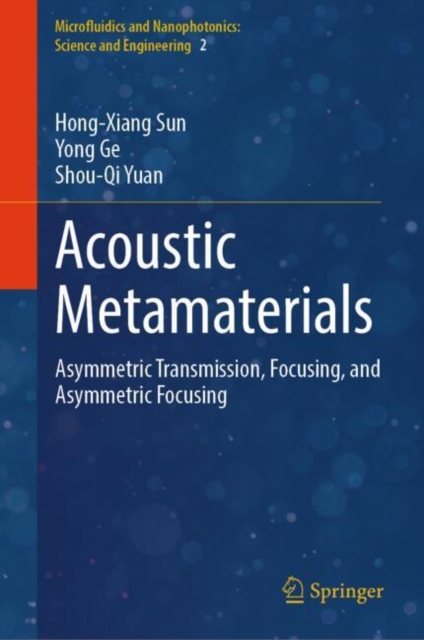
This book explores the rapidly evolving field of acoustic metamaterials, focusing on their ability to manipulate sound waves through asymmetric transmission, acoustic focusing, and acoustic asymmetric focusing.
This book presents the state of the art of asymptotic and related mathematical methods, and how to apply them, as the means of choice, to representative building blocks of interfacial-flow phenomena.
This book presents the state of the art of asymptotic and related mathematical methods, and how to apply them, as the means of choice, to representative building blocks of interfacial-flow phenomena.
This book gathers the latest advances and innovations in the field of flow-induced vibration and noise, as presented by leading international researchers at the 4th International Symposium on Flow-Induced Noise and Vibration Issues and Aspects (FLINOVIA), which was held in Sydney, Australia, in May 2023.
Photoacoustic imaging (also called optoacoustic imaging) is a hybrid modality based on the generation and detection of ultrasound in response to optical absorption of tissue.
Photoacoustic imaging (also called optoacoustic imaging) is a hybrid modality based on the generation and detection of ultrasound in response to optical absorption of tissue.
This book covers the latest ideas and approaches in strongly nonlinear dynamical and acoustical systems and discusses appropriate modelling tools and practical examples highlighting the non-standard and non-stationary aspects of this challenging, yet so promising area.
This book describes recent studies of soil behaviour in strong ground motion - one of the most important and problematic issues in engineering seismology.
This book describes recent studies of soil behaviour in strong ground motion - one of the most important and problematic issues in engineering seismology.
This book focuses on two related topics in fluid mechanics, that is, speed of sound through various media and critical flow associated with gas-liquid flows.
This book focuses on two related topics in fluid mechanics, that is, speed of sound through various media and critical flow associated with gas-liquid flows.
This book presents peer-reviewed and selected papers from the 17th Conference on Acoustics and Vibration of Mechanical Structures (AVMS) held in Timisoara, Romania, on 26-27 May 2023.