This book contemplates the structure, dynamics and physics of virus particles: From the moment they come into existence by self-assembly from viral components produced in the infected cell, through their extracellular stage, until they recognise and infect a new host cell and cease to exist by losing their physical integrity to start a new infectious cycle.
This text addresses the modeling of vibrating systems with the perspective of finding the model of minimum complexity which accounts for the physics of the phenomena at play.
This publication is aimed at students, teachers, and researchers of Continuum Mechanics and focused extensively on stating and developing Initial Boundary Value equations used to solve physical problems.
The 22nd International Congress of Theoretical and Applied Mechanics (ICTAM) of the International Union of Theoretical and Applied Mechanics was hosted by the Australasian mechanics community in the city of Adelaide during the last week of August 2008.
This book contains selected papers from the Fourth International Conference on Computational Methods in Marine Engineering, held at Instituto Superior Tecnico, Technical University of Lisbon, Portugal in September 2011.
'Gravity, a Geometrical Course' presents general relativity (GR) in a systematic and exhaustive way, covering three aspects that are homogenized into a single texture: i) the mathematical, geometrical foundations, exposed in a self consistent contemporary formalism, ii) the main physical, astrophysical and cosmological applications, updated to the issues of contemporary research and observations, with glimpses on supergravity and superstring theory, iii) the historical development of scientific ideas underlying both the birth of general relativity and its subsequent evolution.
With regard to both the environmental sustainability and operating efficiency demands, modern combustion research has to face two main objectives, the optimization of combustion efficiency and the reduction of pollutants.
This book presents a broad view of the current state of the art regarding the dynamic response of composite and sandwich structures subjected to impacts and explosions.
Starting from an undergraduate level, this book systematically develops the basics of* Calculus on manifolds, vector bundles, vector fields and differential forms,* Lie groups and Lie group actions,* Linear symplectic algebra and symplectic geometry,* Hamiltonian systems, symmetries and reduction, integrable systems and Hamilton-Jacobi theory.
'Gravity, a Geometrical Course' presents general relativity (GR) in a systematic and exhaustive way, covering three aspects that are homogenized into a single texture: i) the mathematical, geometrical foundations, exposed in a self consistent contemporary formalism, ii) the main physical, astrophysical and cosmological applications, updated to the issues of contemporary research and observations, with glimpses on supergravity and superstring theory, iii) the historical development of scientific ideas underlying both the birth of general relativity and its subsequent evolution.
Designing new structural materials, extending lifetimes and guarding against fracture in service are among the preoccupations of engineers, and to deal with these they need to have command of the mechanics of material behaviour.
This volume constitutes the proceedings of the IUTAM Symposium on Surface Effects in the Mechanics of Nanomaterials and Heterostructures, held in Beijing, 8-12 August, 2010.
About the book: This book is the first comprehensive review on acoustic metamaterials; novel materials which can manipulate sound waves in surprising ways, which include collimation, focusing, cloaking, sonic screening and extraordinary transmission.
The International Symposium on Acoustical Imaging is a unique forum for advanced research, covering new technologies, developments, methods and theories in all areas of acoustics.
Deformable solids have a particularly complex character; mathematical modeling is not always simple and often leads to inextricable difficulties of computation.
Advances in technology are demanding ever-increasing mastery over the materials being used: the challenge is to gain a better understanding of their behaviour, and more particularly of the relations between their microstructure and their macroscopic properties.
Addressing students and researchers as well as Computational Fluid Dynamics practitioners, this book is the most comprehensive review of high-resolution schemes based on the principle of Flux-Corrected Transport (FCT).
The book presents a collection of articles devoted to atmospheric and ionospheric science reported during the Conference "e;Atmosphere, Ionosphere, Safety"e; held in Kaliningrad, Russia in July 2010.
This book presents a broad exposition of analytical and numerical methods for modeling composite materials, laminates, polycrystals and other heterogeneous solids, with emphasis on connections between material properties and responses on several length scales, ranging from the nano and microscales to the macroscale.
This book is a complete revision of the part of Monin & Yaglom's famous two-volume work "e;Statistical Fluid Mechanics: Mechanics of Turbulence"e; that deals with the theory of laminar-flow instability and transition to turbulence.
Fatigue of the pressurized fuselages of transport aircraft is a significant problem all builders and users of aircraft have to cope with for reasons associated with assuring a sufficient lifetime and safety, and formulating adequate inspection procedures.
This book contains a collection of the main contributions from the first five workshops held by Ercoftac Special Interest Group on Synthetic Turbulence Models (SIG42.
Vibration and structural acoustics analysis has become an essential requirement for high-quality structural and mechanical design in order to assure acoustic comfort and the integrity, reliability and fail-safe behavior of structures and machines.
Higher dimensional theories have attracted much attention because they make it possible to reduce much of physics in a concise, elegant fashion that unifies the two great theories of the 20th century: Quantum Theory and Relativity.
The concept of moving machine members during a thermodynamic cycle and the variation ofdisplacements, velocities and accelerations forms the subject of kinematics.
PREFACE The theory of differential-operator equations has been described in various monographs, but the initial physical problem which leads to these equations is often hidden.
This volume consists of the state-of-the-art reports on new developments in micromechanics and the modeling of nanoscale effects, and is a companion book to the recent Kluwer volume on nanomechanics and mul- scale modeling (it is entitled Trends in Nanoscale Mechanics).
This volume presents selected papers from the IUTAM Symposium on Reynolds Number Scaling in Turbulent Flow, convened in Princeton, NJ, USA, September I1-13, 2002.
This plenary paper and the accompanying presentation have highlighted field problems involving fluid-structure interaction over a wide span of Navy operations.
I express my sincere gratitude to NATO Science Committee for granting me the financial award to organize and direct the Advanced Research Workshop on "e;MULTILAYERED and FIBRE-REINFORCED COMPOSITES: PROBLEMS AND PROSPECTS"e; that was held in Kiev, Ukraine, during the period of June 2 - 6, 1997, in collaboration with Professor S.
Non-linear stochastic systems are at the center of many engineering disciplines and progress in theoretical research had led to a better understanding of non-linear phenomena.
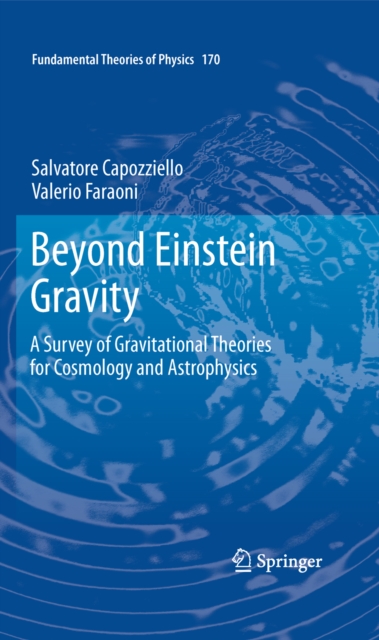
Beyond Einstein's Gravity is a graduate level introduction to extended theories of gravity and cosmology, including variational principles, the weak-field limit, gravitational waves, mathematical tools, exact solutions, as well as cosmological and astrophysical applications.