During the past fifteen years there has been a dramatic increase in the number of different surfaces whose structures have been determined experimentally.
Since 1965, Advances in Magnetic and Optical Resonance has provided researchers with timely expositions of fundamental new developments in the theory of, experimentation with, and application of magnetic and optical resonance.
The aim of this book is to provide a timely collection that highlights advances in current research of crystal growth ranging from fundamental aspects to current applications involving a wide range of materials.
This book deals with the electronic and optical properties of two low-dimensional systems: quantum dots and quantum antidots and is divided into two parts.
This book presents a consistent mathematical theory of the non-electronic physical properties of disordered and amorphous solids, starting from the atomic-level dynamics and leading to experimentally verifiable descriptions of macroscopic properties such as elastic and viscoelastic moduli, plasticity, phonons and vibrational spectra, and thermal properties.
Since its inception in 1966, the series of numbered volumes known as Semiconductors and Semimetals has distinguished itself through the careful selection of well-known authors, editors, and contributors.
Each chapter presents a detailed background of the described method, its theoretical foundations, and its applicability to different biomedical material.
This text explains how hard disk drives operate, how billions of bytes of digital information are stored and accessed, and where the technology is going.
This Third Edition of ELECTRONS IN SOLIDS: AN INTRODUCTORY SURVEY, is the result of a thorough re-examination of the entire text, incorporating suggestions and corrections by students and professors who have used the text.
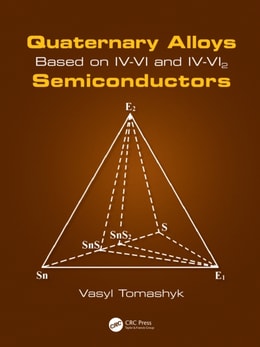
IV-VI and IV-VI2 semiconductors have attracted considerable attention due to their applications in the fabrication of electronic and optoelectronic devices as light-emitting diodes and solar cells.
The fifth edition of this well-established, highly regarded two-volume set continues to provide a fundamental introduction to advanced particle physics while incorporating substantial new experimental results, especially in the areas of Higgs and top sector physics, as well as CP violation and neutrino oscillations.
This book describes the computational methods most frequently used to deal with the interaction of charged particles, notably electrons, with condensed matter.
Although there are many books published in solid state physics, there is a wide gap between the active field of research and the conceptstraditionally taught in solid state courses.
Our current concept of matter, one of scientific research's greatest successes, represents a long journey, from questions posed during the birth of philosophy in Ancient Greece to recent advances in physics and chemistry, including Quantum Physics.
Since its inception in 1966, the series of numbered volumes known as Semiconductors and Semimetals has distinguished itself through the careful selection of well-known authors, editors, and contributors.
This textbook provides an accessible and self-contained introduction to the physics behind fluid dynamics; exploring the laws of nature describing three out of four fundamental states of matter (liquids, gases, and plasmas).
Since the first date of publication of this book in 1991, the subject of phosphors and luminescence has assumed even more importance in the overall scheme of technological development.
Current developments in optical technologies are being directed toward nanoscale devices with subwavelength dimensions, in which photons are manipulated on the nanoscale.
The goal of this Volume "e;Conceptual Foundations of Materials: A standard model for ground- and excited-state properties"e; is to present the fundamentals of electronic structure theory that are central to the understanding and prediction of materials phenomena and properties.
This updated/augmented second edition retains it class-tested content and pedagogy as a core text for graduate courses in advanced fluid mechanics and applied science.
This second volume in the Handai Nanophotonics book series covers the area of Nanoplasmonics, a recent hot topic in the field of nanophotonics, impacting a diverse range of research disciplines from information technology and nanotechnology to the bio- and medical sciences.
This book introduces the ideas and concepts of nonlinear dielectric spectroscopy, outlines its history, and provides insight into the present state of the art of the experimental technology and understanding of nonlinear dielectric effects.
Macroscopic objects made of magnetic materials have been known to mankind for several thousand years and are widely used in various fields of human activity.
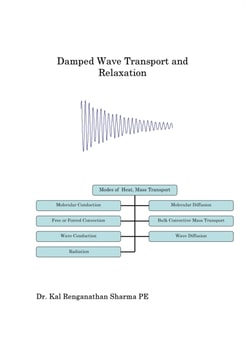
Transient problems in transport phenomena have a variety of applications, ranging from drug delivery systems in chemotherapy in bioengineering to heat transfer to surfaces in fluidized bed combustion (FBC) boilers in mechanical engineering.
The corresponding-states principle helps the understanding and calculating of thermodynamic, transport, and surface properties of substances in various states, required by our modern lifestyle.
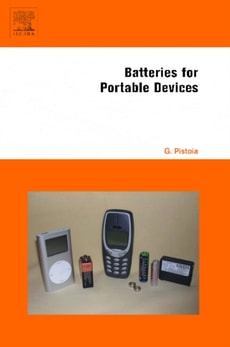
Batteries for Portable Devices provides a comprehensive overview of all batteries used in portable electric and electronic, as well as medical devices.
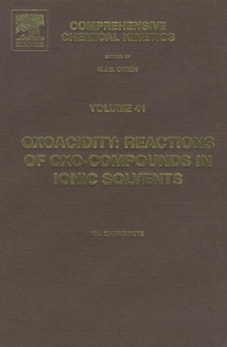
The generally accepted definitions of acids and bases together with the generalized definition for the solvent system introduced by the author for the description of both molecular and ionic solvents are discussed.
This volume is another in the series of IUPAC sponsored monographs that summarize the state of knowledge with respect to experimental techniques in thermochemistry and thermodynamics.
This book provides an overview of electrodeposition of nanomaterials from principles to modern concepts for advanced materials in science and technology.
This book is a collection of contributions presented at the 16th annual international symposium "e;Frontiers of Fundamental Physics"e; (FFP16), supported by Istanbul University.
Publisher's Note: Products purchased from Third Party sellers are not guaranteed by the publisher for quality, authenticity, or access to any online entitlements included with the product.
This book provides for the first time an insider's view into ITER, the biggest fusion reactor in the world, which is currently being constructed in southern France.
Granular forms of common materials such as metals and ceramics, sands and soils, porous energetic materials (explosives, reactive mixtures), and foams exhibit interesting behaviors due to their heterogeneity and critical length scale, typically commensurate with the grain or pore size.
This comprehensive book explores fluid-particle interaction processes in environmental engineering, combining theoretical foundations with advanced numerical simulation techniques.