Fourteen years is a long time, and especially in the field of cosmology new observational results and new theoretical ideas seem to appear at a steadily increasing rate.
The warm reception of the first edition, as well as the tumultuous development of the field of quantum chaos have tempted me to rewrite this book and include some of the important progress made during the past decade.
These book grew out of a course entitled "e;Physikalische Modelle in der Fi- nanzwirtschaft"e; which I have taught at the University of Freiburg during the winter term 1998/1999, building on a similar course a year before at the University of Bayreuth.
This book is a collection of part of the written versions of the Physics Courses given at the Winter School "e;Order, Chance and Risk: Aperiodic Phenomena from Solid State to Finance"e; held at the Les Houches Center for Physics, between February 23 and March 6, 1998.
Concepts, methods and techniques of statistical physics in the study of correlated, as well as uncorrelated, phenomena are being applied ever increasingly in the natural sciences, biology and economics in an attempt to understand and model the large variability and risks of phenomena.
In recent years approximation theory and the theory of orthogonal polynomials have witnessed a dramatic increase in the number of solutions of difficult and previously untouchable problems.
This two-volume work gives the first detailed coherent treatment of a relatively young branch of statistical physics - nonlinear nonequilibrium and fluctuational- dissipative thermodynamics.
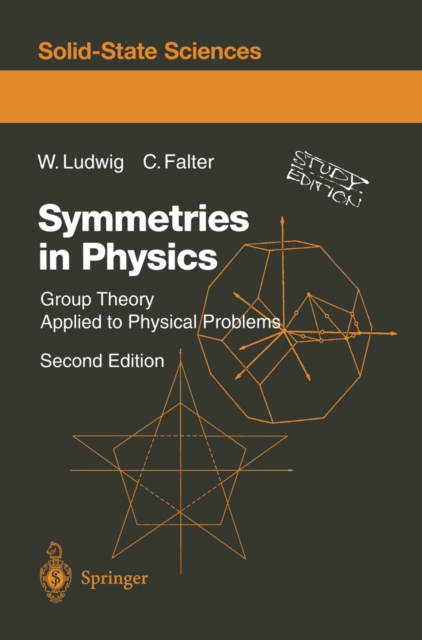
Symmetries in Physics presents the fundamental theories of symmetry, together with many examples of applications taken from several different branches of physics.
John Hornstein has written about the author's theorem on nonintegrability of geodesic flows on closed surfaces of genus greater than one: "e;Here is an example of how differential geometry, differential and algebraic topology, and Newton's laws make music together"e; (Amer.
Ambiguity in Mind and Nature is the result of cognitive multistability, the phenomenon in which an unchanging stimulus, usually visual, gives rise in the subject to an oscillating perceptual interpretation.
Tbis book is intended to provide a few asymptotic methods which can be applied to the dynamics of self-oscillating fields of the reaction-diffusion type and of some related systems.
This book contains all invited contributions of an interdisciplinary workshop of the UNESCO working group on systems analysis of the European and North American region entitled "e;Stochastic Phenomena and Chaotic Behaviour in Complex Systems"e;.
The scope ofthis book is to discuss recent numerical and algorithmic tools for the solution of certain flow problems arising in Computational Fluid Dynam- ics (CFD).
During the last half century, the development and testing of prediction models of combustion chamber performance have been an ongoing task at the International Flame Research Foundation (IFRF) in IJmuiden in the Netherlands and at many other research organizations.
Since the second edition of this book came out in early 1997, the number of scientific papers published on the Self-Organizing Map (SOM) has increased from about 1500 to some 4000.
The first fifteen chapters of these lectures (omitting four to six chapters each year) cover a one term course taken by a mixed group of senior undergraduate and junior graduate students specializing either in mathematics or physics.
This concise tutorial provides the bachelor student and the practitioner with a short text on quantum physics that allows them to understand a wealth of quantum phenomena based on a compact, well readable, yet still concise and accurate description of nonrelativistic quantum theory.
Materials sciences relate the macroscopic properties of materials to their microscopic structure and postulate the need for holistic multiscale research.
This monograph introduces an exact model for a critical spin chain with arbitrary spin S, which includes the Haldane--Shastry model as the special case S=1/2.
This concise primer (based on lectures given at summer schools on complex systems and on a masters degree course in complex systems modeling) will provide graduate students and newcomers to the field with the basic knowledge of the concepts and methods of statistical physics and its potential for application to interdisciplinary topics.
"e;Basic Concepts in Physics: From the Cosmos to Quarks"e; is the outcome of the authors' long and varied teaching experience in different countries and for different audiences, and gives an accessible and eminently readable introduction to all the main ideas of modern physics.
Atomistic simulations of metals under irradiation are indispensable for understanding damage processes at time- and length-scales beyond the reach of experiment.