This Problem Book is based on the exercises and lectures which I have given to undergraduate and graduate students of the Faculty of Physics, University of Belgrade over many years.
This concise and readable book addresses primarily readers with a background in classical statistical physics and introduces quantum mechanical notions as required.
The main motivation for such lecture notes is the importance of the concept and mechanism of spontaneous symmetry breaking in modern theoretical physics and the relevance of a textbook exposition at the graduate student level beyond the oversimpli?
Statistical Methods in Quantum Optics 2 - Non-Classical Fields continues the development of the methods used in quantum optics to treat open quantum systems and their fluctuations.
The investigation ofmost problems of quantum physics leads to the solution of the Schrodinger equation with an appropriate interaction Hamiltonian or potential.
At the time I learned quantum field theory it was considered a folk theo- rem that it is easy to construct field theories fulfilling either the locality or the spectrum condition.
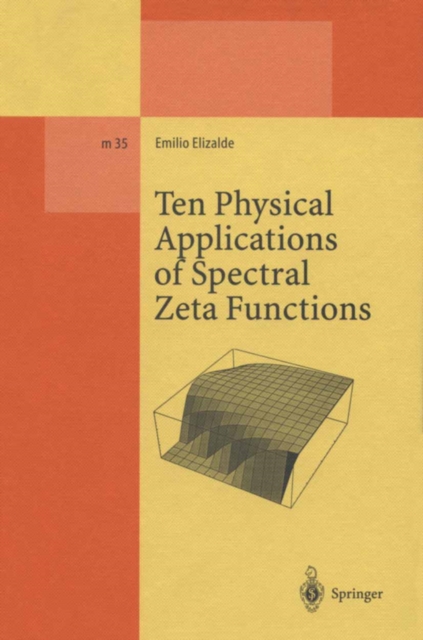
This monography is, in the first place, a commented guide that invites the reader to plunge into the thrilling world ofzeta functions and their appli- cations in physics.
To cope with modern developments, especially in nuclear physics research, this textbook presents nuclear and particle physics from a unifying point of view.
Lost Causes in and Beyond Physics deals with a selection of research topics mostly from theoretical physics that have been shown to be a dead-end or continue at least to be highly controversial.
In this book, quantum mechanics is developed from the outset on a relativistic basis, using the superposition principle, Lorentz invariance and gauge invariance.
This Problem Book is based on the exercises and lectures which I have given to undergraduate and graduate students of the Faculty of Physics, University of Belgrade over many years.
BOOK DESCRIPTIONIn October 2025, the Nobel Committee announced what many consider the most remarkable collection of laureates in the prize's 124-year history.
This book examines the fundamentals of quantum computing and its applications in codebreaking and hacking, as well as strategies and technologies for defending systems against quantum attacks.
Since the invention of the laser in 1960 there has been an enormous increase in the number of applications of this newly available light and its spectacular properties, and there is no end to this development in sight.
This book examines the fundamentals of quantum computing and its applications in codebreaking and hacking, as well as strategies and technologies for defending systems against quantum attacks.
With its groundbreaking approach to financial management under dynamic conditions, this book equips readers with a new perspective on financial systems, moving beyond classical models to embrace the inherent uncertainties of markets.
With its groundbreaking approach to financial management under dynamic conditions, this book equips readers with a new perspective on financial systems, moving beyond classical models to embrace the inherent uncertainties of markets.
Die beiden Säulen der modernen Physik sind die Quantenmechanik zur Beschreibung der subatomaren Welt sowie die allgemeine Relativitätstheorie zum Verständnis der Gravitation und des Universums.
Die beiden Säulen der modernen Physik sind die Quantenmechanik zur Beschreibung der subatomaren Welt sowie die allgemeine Relativitätstheorie zum Verständnis der Gravitation und des Universums.
Seines Heuschnupfens wegen verbrachte Werner Heisenberg im Juni 1925, vor nun bald hundert Jahren, zehn Tage auf der Insel Helgoland, wo er einen Artikel schrieb, der als der Beginn der Geschichte der modernen Quantentheorie angesehen werden kann.
Seines Heuschnupfens wegen verbrachte Werner Heisenberg im Juni 1925, vor nun bald hundert Jahren, zehn Tage auf der Insel Helgoland, wo er einen Artikel schrieb, der als der Beginn der Geschichte der modernen Quantentheorie angesehen werden kann.
This volume describes mesoscopic systems with classically chaotic dynamics using semiclassical methods which combine elements of classical dynamics and quantum interference effects.
Electroweak and Strong Interaction: Phenomenology, Concepts, Models, begins with relativistic quantum mechanics and some quantum field theory which lay the foundation for the rest of the text.
This thesis investigates the structure and behaviour of entanglement, the purely quantum mechanical part of correlations, in many-body systems, employing both numerical and analytical techniques at the interface of condensed matter theory and quantum information theory.
This book is intended as a textbook for an entry-level university course in Newtonian mechanics for students of physics, astronomy, and the engineering sciences.
Optical solitons in fibers are a beautiful example of how an abstract mathematical concept has had an impact on new information transmission technologies.