This text presents a concise and thorough introduction to the main concepts and practical applications of thermodynamics and kinetics in materials science.
This text provides a uniform and consistent approach to diversified problems encountered in the study of dynamical processes in condensed phase molecular systems.
Starting from first principles, this book introduces the closely related phenomena of Bose condensation and Cooper pairing, in which a very large number of single particles or pairs of particles are forced to behave in exactly the same way, and explores their consequences in condensed matter systems.
The importance and the beauty of modern quantum field theory resides in the power and variety of its methods and ideas, which find application in domains as different as particle physics, cosmology, condensed matter, statistical mechanics and critical phenomena.
This book discusses the computational approach in modern statistical physics in a clear and accessible way and demonstrates its close relation to other approaches in theoretical physics.
This is the first book in a four-part series designed to give a comprehensive and coherent description of Fluid Dynamics, starting with chapters on classical theory suitable for an introductory undergraduate lecture course, and then progressing through more advanced material up to the level of modern research in the field.
Fundamental concepts of phase transitions, such as order parameters, spontaneous symmetry breaking, scaling transformations, conformal symmetry and anomalous dimensions, have deeply changed the modern vision of many areas of physics, leading to remarkable developments in statistical mechanics, elementary particle theory, condensed matter physics and string theory.
Nonlinear Time Series Analysis with R provides a practical guide to emerging empirical techniques allowing practitioners to diagnose whether highly fluctuating and random appearing data are most likely driven by random or deterministic dynamic forces.
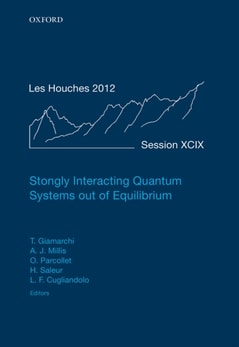
Over the last decade new experimental tools and theoretical concepts are providing new insights into collective nonequilibrium behavior of quantum systems.
Over the last decade new experimental tools and theoretical concepts are providing new insights into collective nonequilibrium behavior of quantum systems.
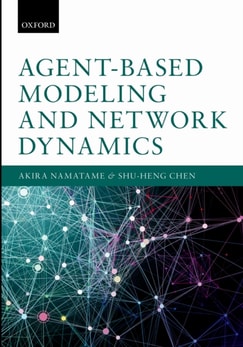
While the significance of networks in various human behavior and activities has a history as long as human's existence, network awareness is a recent scientific phenomenon.
Multilayer networks is a rising topic in Network Science which characterizes the structure and the function of complex systems formed by several interacting networks.
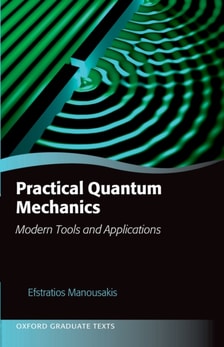
Quantum mechanics forms the foundation of all modern physics, including atomic, nuclear, and molecular physics, the physics of the elementary particles, condensed matter physics.
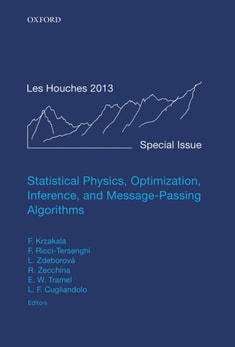
In the last decade, there have been an increasing convergence of interest and methods between theoretical physics and fields as diverse as probability, machine learning, optimization and compressed sensing.
The study of network theory is a highly interdisciplinary field, which has emerged as a major topic of interest in various disciplines ranging from physics and mathematics, to biology and sociology.
This book provides an in-depth study of the foundations of statistical energy analysis, with a focus on examining the statistical theory of sound and vibration.
Starting from first principles, this book introduces the closely related phenomena of Bose condensation and Cooper pairing, in which a very large number of single particles or pairs of particles are forced to behave in exactly the same way, and explores their consequences in condensed matter systems.
The importance and the beauty of modern quantum field theory resides in the power and variety of its methods and ideas, which find application in domains as different as particle physics, cosmology, condensed matter, statistical mechanics and critical phenomena.
Volume 2 of Novel Superfluids continues the presentation of recent results on superfluids, including novel metallic systems, superfluid liquids, and atomic/molecular gases of bosons and fermions, particularly when trapped in optical lattices.
As an introductory account of the theory of phase transitions and critical phenomena, this book reflects lectures given by the authors to graduate students at their departments and is thus classroom-tested to help beginners enter the field.
This book deals with an important class of many-body systems: those where the interaction potential decays slowly for large inter-particle distances; in particular, systems where the decay is slower than the inverse inter-particle distance raised to the dimension of the embedding space.
This book describes in detail the fundamental mathematics and algorithms of machine learning (an example of artificial intelligence) and signal processing, two of the most important and exciting technologies in the modern information economy.
Generating random networks efficiently and accurately is an important challenge for practical applications, and an interesting question for theoretical study.
While the significance of networks in various human behavior and activities has a history as long as human's existence, network awareness is a recent scientific phenomenon.
This book highlights the importance of Electron Statistics (ES), which occupies a singular position in the arena of solid state sciences, in heavily doped (HD) nanostructures by applying Heisenberg's Uncertainty Principle directly without using the complicated Density-of-States function approach as given in the literature.
Application of New Cybernetics in Physics describes the application of new cybernetics to physical problems and the resolution of basic physical paradoxes by considering external observer influence.
This book provides a graduate-level introduction to three powerful and closely related techniques in condensed matter physics: memory functions, projection operators, and the defect technique.
Application of New Cybernetics in Physics describes the application of new cybernetics to physical problems and the resolution of basic physical paradoxes by considering external observer influence.
Introductory Statistical Thermodynamics is a text for an introductory one-semester course in statistical thermodynamics for upper-level undergraduate and graduate students in physics and engineering.