This book describes the latest research on nanopolysaccharides in the development of functional materials, from their preparation, properties and functional modifications to the architecture of diverse functional materials.
This book highlights the theoretical foundations of and experimental techniques in photothermal heating and applications involving nanoscale heat generation using gold nanostructures embedded in various media.
This book focuses on in-situ transmission electron microscopy (TEM), an investigatory technique used to observe a sample's response to a given stimulus (including electron irradiation, thermal excitation, mechanical force, optical excitation, electric and magnetic fields) at the nanoscale in real time.
This book highlights recent developments related to fabrication and utilization of nanoparticle-engineered metal matrices and their composites linked to the heavy industries, temperature fasteners, high-pressure vessels, and heavy turbines, etc.
This thesis describes improvements to and control of the electrical conductance in single-molecule junctions (SMJs), which have potential applications in molecular electronics, with a focus on the bonding between the metal and molecule.
This thesis investigates the tribological viability of bio-based base stock to which different nanoparticles were incorporated for engine piston-ring-cylinder-liner interaction.
This thesis combines advanced femtosecond laser micro/nanofabrication technologies and frontier bionic design principles to prepare diverse biomimetic micro/nanostructures to realize their functions.
This book provides a comprehensive overview of the fundamental properties, preparation routes and applications of a novel class of organic-inorganic nanocomposites known as periodic mesoporous organosilicas (PMOs).
This book presents the first experiment revealing several unexplored non-equilibrium properties of quantum many-body states, and addresses the interplay between the Kondo effect and superconductivity by probing shot noise.
This thesis details the novel preparation methods and the improved properties of two-dimentional (2D) black phosphorene (BP) and the polymer nanocomposites.
This book highlights the evolution of, and novel challenges currently facing, nanomaterials science, nanoengineering, and nanotechnology, and their applications and development in the biological and biomedical fields.
This book features selected works presented in the 28th National Conference on Condensed Matter Physics, "e;Condensed Matter Days (CMDAYS) 2020"e;, which was held from December 11th to 13th December 2020.
This book focuses on the latest advances in the field of nanomaterials and their applications, and provides a comprehensive overview of the state-of-the-art of research in this rapidly developing field.
This brief introduces the classification and mechanism of density gradient ultracentrifugation (DGUC) method with rich examples showing the versatility of such an efficient separation technique.
This book presents methodological and application research in detecting cellular and molecular biophysical properties based on atomic force microscopy (AFM) nanorobotics.
This thesis focuses on the transport and magneto-transport properties of graphene p-n-p junctions, such as the pronounced quantum Hall effect, a well-defined plateau-plateau transition point, and scaling behavior.
This book focuses on in-situ transmission electron microscopy (TEM), an investigatory technique used to observe a sample's response to a given stimulus (including electron irradiation, thermal excitation, mechanical force, optical excitation, electric and magnetic fields) at the nanoscale in real time.
This book encourages optoelectronic researchers and engineers to exploit innovative nano-photonic applications in next-generation information and communications systems.
This book comprehensively explores the fascinating intersection of deep eutectic solvents (DES) and nanocellulose, focusing specifically on their extraction methods and textile applications.
This book presents recent developments and fascinating attributes of electronic-nose (E-nose) technology based on advanced nanostructured materials that are compatible with modern semiconductor fabrication technology.
This thesis describes the controlled immobilization of molecules between two cuboidal metal nanoparticles by means of a self-assembly method to control the quantum plasmon resonances.
This Brief will focus on the functional uses and applications of FRET, starting with the derivation of FRET in the assemblies of nanostructures and subsequently giving application cases for biologists, physicists, chemists, material scientists, engineers, and those in many other fields whoever would like to FRET as a tool.
This book gathers a collection of papers by international experts that were presented at the International Conference on NextGen Electronic Technologies (ICNETS2-2016).
This book focuses on the latest advances in the field of nanomaterials synthesis and processes, and provides a comprehensive overview of the state of art of research in this rapidly developing field.
This book gathers selected peer-reviewed papers presented at the Second International Conference on Infectious Diseases and Nanomedicine (ICIDN), held in Kathmandu, Nepal on December 15-18, 2015.
This book explains the basic and fundamental aspects of nanotechnology and the potential use of nanostructured photocatalysts in various applications, especially in the context of the environment and energy harvesting.
This book highlights the various types of nanomaterials currently available and their applications in three major sectors: energy, health, and the environment.
This book addresses several important issues concerning the nanomechanics of graphene, an area that is vital to a fundamental understanding of graphene deformation, and to the design of graphene-related materials.
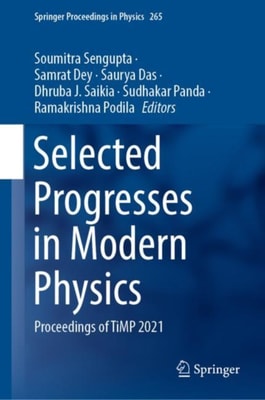
This book presents peer-reviewed articles from the 1st International Conference on Trends in Modern Physics (TiMP 2021) held at Assam Don Bosco University in Guwahati, India, between February 26 and 27, 2021.