This book gives a voice to debates surrounding social science research ethics in Africa and brings them together in a coherent form to assist readers in being at the forefront of the discussions.
It is commonly held that there is no place for the 'now' in physics, and also that the passing of time is something subjective, having to do with the way reality is experienced but not with the way reality is.
The stated subject of these lecture courses given by Husserlbetween 1910 and 1918is 'reason, the word for the mental activities and accomplishments that govern knowledge, give it form and supply it with norms.
This book provides keys to decrypt current political debates on the environment in light of the theories that support them, and provides tools to better understand and manage environmental conflicts and promote environmentally friendly behaviour.
This book explores the potential of geoethics, as designed within the operational criteria of addressing the deeds and values of the human agent as part of the Earth system.
This book explores the potential of geoethics, as designed within the operational criteria of addressing the deeds and values of the human agent as part of the Earth system.
This is the first book to outline a basic philosophy of ecology using the standard categories of academic philosophy: metaphysics, axiology, epistemology, aesthetics, ethics, and political philosophy.
This book is a provocative and invigorating real-time exploration of the future of human evolution by two of the world's leading interdisciplinary ecologists - Michael Charles Tobias and Jane Gray Morrison.
We live in an age where language and screens continue to collide for creative purposes, giving rise to new forms of digital literatures and literary video games.
This book offers the first systematic study of how elite conservation schemes and policies define once customary and vernacular forms of managing common resources as banditry-and how the 'bandits' fight back.
In this small book, theoretical physicist Gerard 't Hooft (Nobel prize 1999), philosopher Emanuele Severino (Lincei Academician), and theologian Piero Coda (Pontifical Lateran University) confront one another on a topic that lies at the roots of quantum mechanics and at the origin of Western thought: Determinism and Free Will.
This is a fascinating account of two great scientists of the 20th century: Einstein and Heisenberg, discoverers, respectively, of the theory of relativity and quantum mechanics.
This book gives an account of work that I have done over a period of decades that sets out to solve two fundamental problems of philosophy: the mind-body problem and the problem of induction.
This monograph develops a new way of justifying the claims made by science about phenomenon not directly observable by humans, such as atoms and black holes.
Science fiction explores the wonderful, baffling and wildly entertaining aspects of a universe unimaginably old and vast, and with a future even more immense.
Vous êtes convaincu qu’on ne bronze pas derrière une vitre, que le chocolat est un antidépresseur, que le palmier est un arbre, que la reine du jeu d’échecs est une femme et que manger des carottes améliore la vision?
This anthology aims to present the fundamental philosophical issues and tools required by the reflection within and upon geography and Geographic Information Systems (GIS) .
The book offers a collection of essays on various aspects of Leibniz's scientific thought, written by historians of science and world-leading experts on Leibniz.
Personnages étranges, intrigues et énigmes, fascination et rivalités, enthousiasme, désespoir, et puis coup de théâtre : la recherche scientifique est romanesque.
Pour quelle raison Homo sapiens s’apprête-t-il, après avoir visité les moindres recoins de la Terre, à poursuivre son expansion en explorant puis en occupant l’espace, de plus en plus loin ?
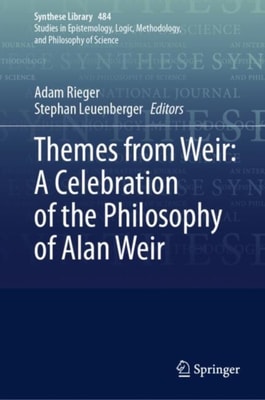
This book celebrates and explores some philosophical issues raised by the work of Alan Weir, who is Professor Emeritus at the University of Glasgow, having previously held positions at the Universities of Oxford, Edinburgh and Queen's, Belfast.