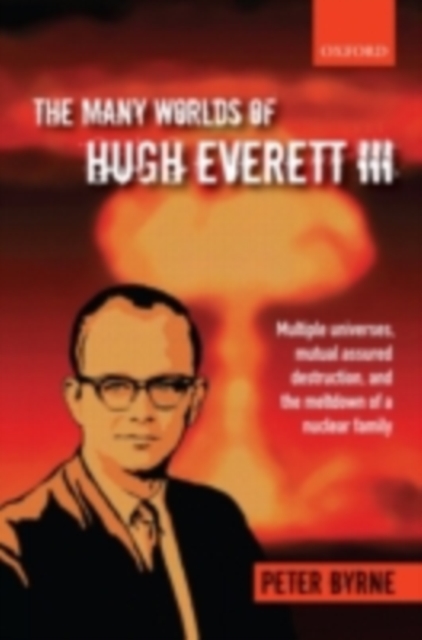
Peter Byrne tells the story of Hugh Everett III (1930-1982), whose "e;many worlds"e; theory of multiple universes has had a profound impact on physics and philosophy.
At this very moment the most ambitious scientific experiment of all time is beginning, and yet its precise aims are little understood by the general public.
The editors utilize their 50 years of combined experience in professional engagement with the behaviour and ecology of wild felids to draw together a unique network of the world's most respected and knowledgeable experts.
For 150 years, Down's Syndrome has constituted the archetypal mental disability, easily recognisable by distinct facial anomalies and physical stigmata.
Asthma is a familiar and growing disease today, but its story goes back to the ancient world, as we know from accounts in ancient texts from China, India, Greece and Rome.
Gray's Anatomy is probably one of the most iconic scientific books ever published: an illustrated textbook of anatomy that is still a household name 150 years since its first edition, known for its rigorously scientific text, and masterful illustrations as beautiful as they are detailed.
The extent to which human activity has influenced species extinctions during the recent prehistoric past remains controversial due to other factors such as climatic fluctuations and a general lack of data.
From the sheep, dog, and cockerel that were sent aloft in Montgolfier's balloon, to Galvani's frog's legs, Dolly the Sheep, the finches of the Galapagos, and even imaginary cats and simulated life forms, Pavlov's Dogs and Schrodinger's Cat explores the fascinating history of the role of living things in science.
The History of British Birds reviews our knowledge of avifaunal history over the last 15,000 years, setting it in its wider historical and European context.
Selected and introduced by Richard Dawkins, The Oxford Book of Modern Science Writing is a celebration of the finest writing by scientists for a wider audience - revealing that many of the best scientists have displayed as much imagination and skill with the pen as they have in the laboratory.
Our lives, states of health, relationships, behaviour, experiences of the natural world, and the technologies that shape our contemporary existence are subject to a superfluity of competing, multi-faceted and sometimes incompatible explanations.