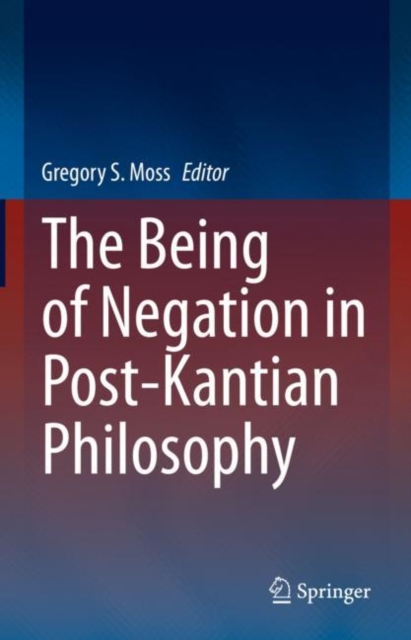
By drawing on the insights of diverse scholars from around the globe, this volume systematically investigates the meaning and reality of the concept of negation in Post-Kantian Philosophy-German Idealism, Early German Romanticism, and Neo-Kantianism.
Analytic Philosophy began in the first decades of the 20th century at Cambridge with Bertrand Russell, in Vienna with the Vienna Circle of Logical Positivists, and in Berlin with Hans Reichenbach's Society for Empirical Philosophy.
Using both Father Kevin Wall's eidetic matrix of "e;the relational unity of being"e; and Edith Stein's remarkable synoptic view of intentionality in both Aquinas and Husserl, this book uncovers purely logical ground for a subalternate eidetic science called "e;convergent phenomenology,"e; itself located at the inmost depths of Husserlian phenomenology.
Building on the thriving discussion on the role of attention within the phenomenological tradition, from Aron Gurwitsch and Merleau-Ponty to Bernhard Waldenfels, this book investigates the enigmatic role of attention as a faculty that enables change within subjective and intersubjective experience.
With a focus on phenomenological methods, this new edition of Shaun Gallagher's highly regarded textbook provides a comprehensive introduction to phenomenology considered as a philosophical and interdisciplinary practice.
Many philosophical accounts of reason are geared toward providing rational justifications ex post facto rather than accounting for the role reason plays in actu in the process of creative work.
This volume investigates the intersection of phenomenology and posthumanism by rethinking the human and nonhuman specifically with regard to boredom, isolation, loneliness, and solitude.
This book draws on existential theory and original research to present the conceptual framework for an understanding of existential authenticity and demonstrates how this approach might be adopted in practice.
This volume presents eco-phenomenology's role in pandemics and post-pandemics and takes up the task of eco-phenomenology as a unified project by not focusing on naturalizing phenomenology but rather exploring the full range of possibilities - such as creative acts and self-individualization - in dealing with ecological threats.
This collection of essays brings together a selection of some of the most important studies of Professor Ivo Assad Ibri about the work of Charles Sanders Peirce.
In each connection with new cultural contexts a new hybrid state of cultural adaptation is constructed enabling people to adjust to new conditions by creating innovative solutions for the self.
This book examines the best available empirical evidence regarding one of the most challenging and pervasive questions throughout ages, cultures, and religions: the survival of human consciousness after death.
This book presents both a historical overview of the absorption of Heidegger's thought into English-language philosophical schools as well as a philosophical discussion of his thought provided by contemporary scholars.
This is the first monograph to deal with medicine as a form of hermeneutics, now in a thoroughly revised and updated edition, including a whole new chapter on medical ethics.
In the last decade, a great variety and volume of scholarly work has appeared on mind-wandering, a mental process involving a vast range of human life, connected with "e;first-person perspective"e; and "e;personhood"e;, submental thinking, mental autonomy, etc.
This book examines Husserl's approach to the question concerning meaning in life and demonstrates that his philosophy includes a phenomenology of existence.
This book seeks to provide new perspectives, to broaden the field of philosophy of science, or to renew themes that have had a great impact on the profession.
This book argues that global crises such as the present Covid-19 pandemic are correlates of the contemporary thought regime that it calls technohumanism.
This book is a unique contribution to scholarship of the poetics of Wallace Stevens, offering an analysis of the entire oeuvre of Stevens's poetry using the philosophical framework of Martin Heidegger.
A paradox lies at the heart of modernity: the simultaneous demand to create ideas to make us better humans and communities, along with the contrary imperative that we criticize all ideals, especially the ones we have created.