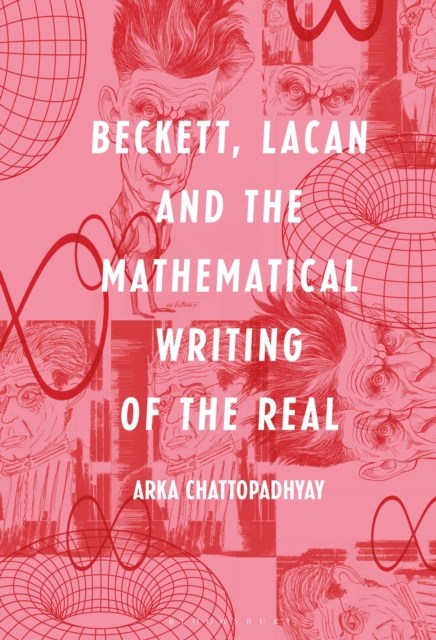
Beckett, Lacan and the Mathematical Writing of the Real proposes writing as a mathematical and logical operation to build a bridge between Lacanian psychoanalysis and Samuel Beckett's prose works.
The contemporary philosopher Jacques Ranciere has become over the last two decades one of the most influential voices in philosophy, political theory, and literary, art historical, and film criticism.
The contemporary philosopher Jacques Ranciere has become over the last two decades one of the most influential voices in philosophy, political theory, and literary, art historical, and film criticism.
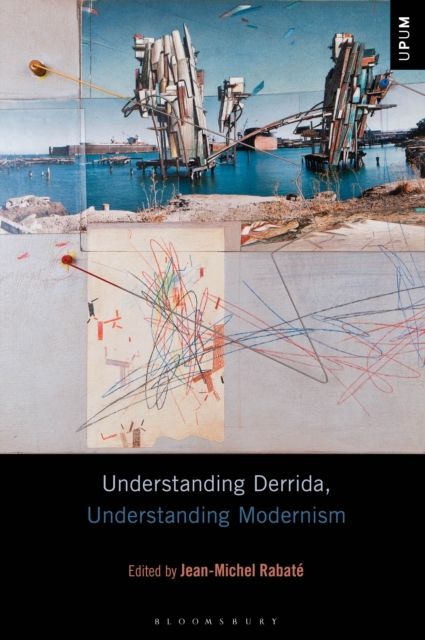
Jean-Michel Rabate uses Nietzsche's image of a "e;pathos of distance,"e; the notion that values are created by a few gifted and lofty individuals, as the basis for a wide-ranging investigation into the ethics of the moderns.
Jean-Michel Rabate uses Nietzsche's image of a "e;pathos of distance,"e; the notion that values are created by a few gifted and lofty individuals, as the basis for a wide-ranging investigation into the ethics of the moderns.
In the last half-century Ludwig Wittgenstein's relevance beyond analytic philosophy, to continental philosophy, to cultural studies, and to the arts has been widely acknowledged.
In the last half-century Ludwig Wittgenstein's relevance beyond analytic philosophy, to continental philosophy, to cultural studies, and to the arts has been widely acknowledged.
This book offers a philosophical inquiry into the idea of curriculum as confession and considers how it can help us answer questions of justice, selfhood, and truth.
In the tidal wave of intellectual argument that followed the 2006 release of Richard Dawkinss God Delusion book, a fierce debate has raged between atheism and religion over the existence of God, leaving the worlds scientists and laymen largely undecided in their opinion.
While life can be a montage of confusion, the concept of the Golden Dialetik can provide a unifying theory of the universe out of this disorder, and it is a concept that clarifies a hazy world vision.
Of all the philosophers in the vast and varied history of philosophy, Soren Kierkegaard alone concentrated on describing how it was that one became a self.
Herbert Marcuse (1898-1979) was a member of the Frankfurt School, a leading figure of 1960s counterculture, and a fundamental character for the New Left.
This fine new book, the third in a series, brings psychologists up to date on the advances of phenomenological research methods in illuminating the nature of human awareness and ex- periences.
Bernard Lonergan's theological writings have influenced religious scholars ever since the first publication in the 1940s of the series of five articles which make up Verbum: Word and Idea in Aquinas.
The period during which Bernard Lonergan delivered the eleven lectures in this volume was one of important transition for him: he was moving rapidly toward a new conception of theology and its method; and he was on the verge of what is now recognized as a major breakthrough in his thought on method, the idea that came to him in February 1965 of the eight functional specialities.
Collected here for the first time, this series of lectures delivered by Lonergan at Boston College in 1957 illustrates a pivotal time in Lonergan's intellectual history, marking both the transition from the faculty psychology still present in his work Insight to intentionality analysis and his initial differentiation of the existential level of consciousness.
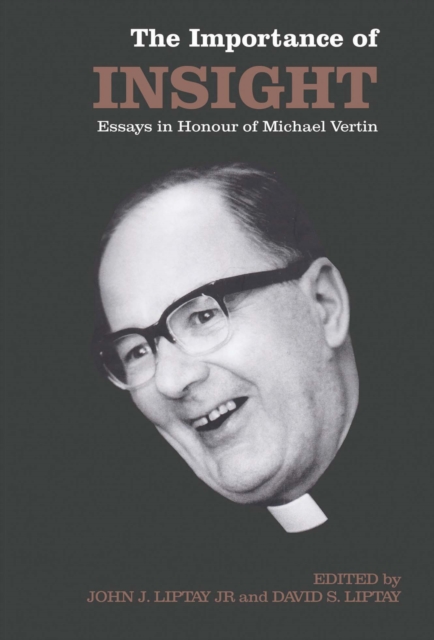
Written in honour of Michael Vertin the distinguished philosopher and Lonergan scholar at the University of Toronto, The Importance of Insight brings together a number of thoughtful essays by leading Lonergan scholars.
For nineteenth-century thinkers, the central problem of religious consciousness in the modern West was the tension between prevailing concepts of individual autonomy and the traditional Judaeo-Christian claim for divine revelation.
This volume contains the proceedings of the first annual Philosophy Colloquium at the University of Western Ontario, which have been revised for publication.
In the intensity of current theoretical debates, critics and students of literature are sometimes in danger of losing sight of the most basic principles and presuppositions of their discipline, of the underlying connections between attitudes to truth and the study of literature.
Wilhelm Dilthey (1833-1911), a philosopher who has influenced twentieth-century intellectual history via such thinkers as Heidegger, Jaspers, Ortega y Gasset, and Max Scheler, is subjected to careful analysis in this book.
These papers on key issues in intellectual history derive from those delivered at a conference held at the University of Toronto in May 1973 to honour the bicentenary of James Mill's birth and the centenary of John Stuart Mill's death.
Bentham on Liberty focuses on the crucial formative years, when the English social philosopher Jeremy Bentham was in his twenties and thirties between 1770 and 1790, and draws on the unpublished manuscripts held at University College, London, to throw a new light on his early intellectual development.
This probing study of the career, works, and influence of Ernst Cassirer -- a German-Jewish neo-Kantian who taught at the University of Hamburg until Hitler came to power -- analyses his thoughts on human culture as they developed during the turbulent political and cultural conditions in the Germany of his time.
In this new and original book, Claire Armon-Jones examines the concept of affect and various philosophical positions which attempt to define and characterize it: the standard view, the neo-cognitivist view, and the objectual thesis.
In Heidegger's Being: The Shimmering Unfolding, the eminent Heidegger scholar Richard Capobianco draws on many new texts and sources to highlight in fresh ways the beauty and spiritual resonance of Martin Heidegger's thinking about Being.