Arguing that Brecht's aesthetic theories are still highly relevant today, and that an appreciation of his theory and theatre is essential to an understanding of modern critical theory, this book examines the influence of Brecht's aesthetic on the pre-eminent materialist critics of the twentieth century: Louis Althusser, Walter Benjamin, Roland Barthes, Frederic Jameson, Theodor W.
Featuring contributions from Matthew Kieran, Aaron Ridley, Roger Scruton and Mary Mothersill to name but a few, this collection of groundbreaking new papers on aesthetics and ethics, highlights the link between the two subjects.
This book develops a theory of picture perception and aesthetic response, arguing that images can generate in us a complex pattern of mental changes, or transformations.
This book expounds Kant's Critique of Judgement by interpreting all the details in the light of what Kant himself declares to be his fundamental problem.
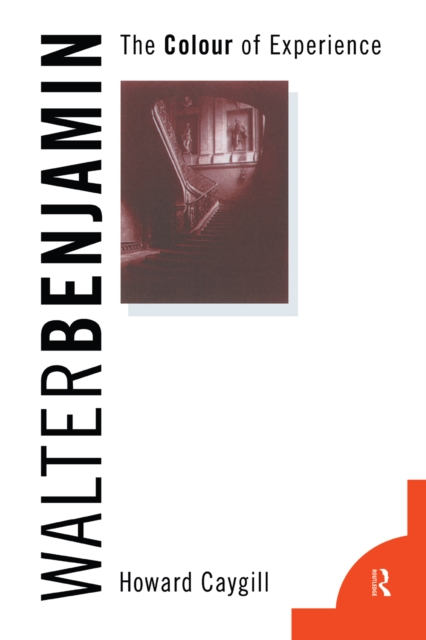
This book analyzes the development of Walter Benjamin's concept of experience in his early writings showing that it emerges from an engagement with visual experience, and in particular the experience of colour.
Arguing that Brecht's aesthetic theories are still highly relevant today, and that an appreciation of his theory and theatre is essential to an understanding of modern critical theory, this book examines the influence of Brecht's aesthetic on the pre-eminent materialist critics of the twentieth century: Louis Althusser, Walter Benjamin, Roland Barthes, Frederic Jameson, Theodor W.
Featuring contributions from Matthew Kieran, Aaron Ridley, Roger Scruton and Mary Mothersill to name but a few, this collection of groundbreaking new papers on aesthetics and ethics, highlights the link between the two subjects.
Exploring the rhetorical and phenomenological links between shame and reticence, this book examines the psychology of Shelley's anguished poet-Subject.
Exploring the rhetorical and phenomenological links between shame and reticence, this book examines the psychology of Shelley's anguished poet-Subject.
The Routledge Companion to Performance Philosophy is a volume of especially commissioned critical essays, conversations, collaborative, creative and performative writing mapping the key contexts, debates, methods, discourses and practices in this developing field.
The Routledge Companion to Performance Philosophy is a volume of especially commissioned critical essays, conversations, collaborative, creative and performative writing mapping the key contexts, debates, methods, discourses and practices in this developing field.
Originally published in 1926, this book develops the Socratic thesis that morality is intelligence, that morality is not a matter of standards, laws and principles but in knowing what we do - in living self-consciously.
The Paradox of Transgression in Games looks at transgressive games as an aesthetic experience, tackling how players respond to game content that shocks, disturbs, and distresses, and how contemporary video games can evoke intense emotional reactions.
The Paradox of Transgression in Games looks at transgressive games as an aesthetic experience, tackling how players respond to game content that shocks, disturbs, and distresses, and how contemporary video games can evoke intense emotional reactions.
A rigorous new thinking of the photograph in its relation to science, philosophy, and art, so as to discover an essence of photography that precedes its historical, technological, and aesthetic conditions.
In this lovely meditation on ikebana - the Japanese art of flower arranging - Joan Stamm shows us how her twin paths of Buddhist practice and artistic endeavor converge and indeed become thoroughly intertwined.
From a major mind of Buddhism today comes this unique philosophical work, which hearkens back to the classical verse-form, but in a modern voice that speaks directly to the twenty-first century reader and practitioner.
In 1945, French political prisoners returning from the concentration camps of Germany coined the phrase 'the concentrationary universe' to describe the camps as a terrible political experiment in the destruction of the human.
From the 'Monster of Ravenna' to the 'Elephant Man', Myra Hindley and Ted Bundy, the visualisation of 'real', human monsters has always played a part in how society sees itself.
What if modernism had been characterised by evolving, interconnected and multi-sensory images rather than by the monolithic objects often described by its artists and theorists?