In its pursuit to equip the reader with a basic knowledge of Islamic economics, this book divulges the micro-foundations of the discipline, and highlights the predominant schools of thought that exist in the field.
Islam, Populism and Regime Change in Turkey explores the role of religion (Sunni, Hanefi Islam) in the transformation of Turkey under the reign of President Recep Tayyip Erdogan and his Justice and Development Party (Adalet ve Kalkinma Partisi, AKP).
Islam, Populism and Regime Change in Turkey explores the role of religion (Sunni, Hanefi Islam) in the transformation of Turkey under the reign of President Recep Tayyip Erdogan and his Justice and Development Party (Adalet ve Kalkinma Partisi, AKP).
This book discusses the evolution of state governance of Islam and the nature and forms of local Muslims' rediscovery of their 'Muslimness' across post-communist Eurasia.
This book discusses the evolution of state governance of Islam and the nature and forms of local Muslims' rediscovery of their 'Muslimness' across post-communist Eurasia.
Changes in Jihadi Discourse in the Wake of the "e;Islamic State"e; explores how the transnational jihadi discourse changed with the development of the "e;Islamic State"e; terrorist group and resulted in the fragmentation of the jihadi movement.
Changes in Jihadi Discourse in the Wake of the "e;Islamic State"e; explores how the transnational jihadi discourse changed with the development of the "e;Islamic State"e; terrorist group and resulted in the fragmentation of the jihadi movement.
The first volume to explore Muslim piety as a form of economy, this book examines specific forms of production, trade, regulation, consumption, entrepreneurship and science that condition - and are themselves conditioned by - Islamic values, logics and politics.
The first volume to explore Muslim piety as a form of economy, this book examines specific forms of production, trade, regulation, consumption, entrepreneurship and science that condition - and are themselves conditioned by - Islamic values, logics and politics.
Investigating the appeal of the group Hizb ut-Tahrir (HT), the study expands on why non-violent radical forms of Islam still attract segments of Muslim communities in the West.
Investigating the appeal of the group Hizb ut-Tahrir (HT), the study expands on why non-violent radical forms of Islam still attract segments of Muslim communities in the West.
This book explores the significance of Ibn Khaldun's magnum opus, the Book of Examples, to our understanding of human history and the disciplines of anthropology, history, and sociology.
This title, first published in 1923, examines the historical development of the Islamic faith from its origins through to its position in the early twentieth century.
This book looks at contemporary political violence, in the form of jihadism, through the lens of a philosophical polemic between Hannah Arendt and Frantz Fanon: intellectual representatives of the global north and global south.
This timely volume brings together various issues in Muslim consumer cultures and provides a comprehensive account of Muslim tourism and tourist behaviour.
This timely volume brings together various issues in Muslim consumer cultures and provides a comprehensive account of Muslim tourism and tourist behaviour.
This book explores some of the political and methodological directions that collectively lead to the repositioning of Islam in social science research as both an epistemic/ontological category and as a method.
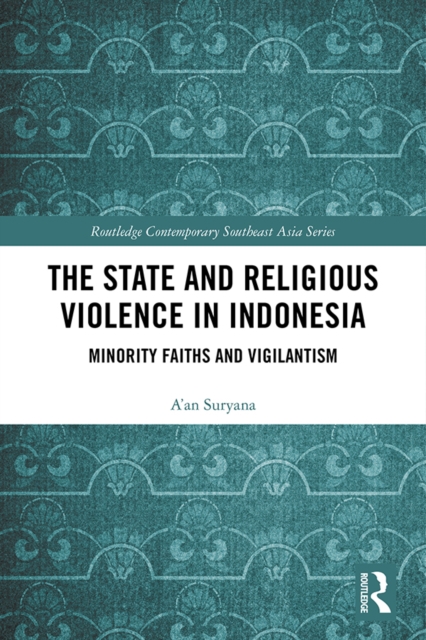
This book analyses the response of the Indonesian state to violence against Ahmadiyah and Shi'a minority communities by foregrounding the close connections between state officials and vigilante groups, which influenced the way the post-Soeharto democratic Indonesian governments addressed the problem of violence against religious minorities.
In contrast to the gradual formation of the high cultures of most of the world, the process by which Islamic civilisation emerged and took on its classical form between the 7th and 9th centuries was unusually sudden.
This second selection of articles by George Makdisi concentrates on the schools of religious thought and legal learning in the medieval Islamic world and their defence of 'orthodoxy'.
This book deals with the history of pre-Islamic Arab society and the emergence of Islam, as reflected in hadith, adab, historical, genealogical and exegetical literature.