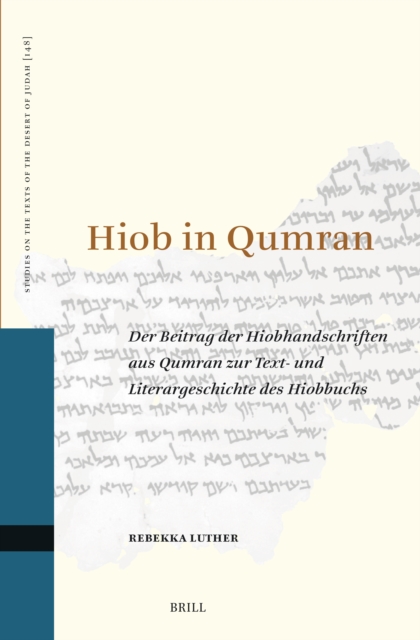
This volume draws readers into the exciting world of the Dead Sea Scrolls - around 930 manuscripts which were discovered in caves near the ancient settlement of Qumran between 1947 and 1956, and which transformed scholarship of the Bible, Judaism and Christianity.
An examination of MT Esther's relationship to the Joseph story, this study employs recent advances in author-oriented biblical intertextuality to address the debate concerning the religious purpose of the Scroll.
This book examines the development of institutionalized prayer in ancient Israel at a crucial time in the history of Western civilization: from the period of the Qumran writings, in the last three centuries BCE, through to the rabbinic period, after 70 CE.
Israel's God and Rebecca's Children is a collection of essays written as a tribute to the lasting scholarship and friendship of Larry Hurtado (University of Edinburgh) and Alan Segal (Barnard College), two scholars who have contributed significantly to the contemporary understanding of Second Temple and Rabbinic Judaism and early Christianity.
Reading the books of the Law, the Pentateuch, in their original context is the crucial prerequisite for reading their citation and use in later interpretation, including the New Testament writings, argues Ben Witherington III.
This volume studies concrete examples of how female monastic spirituality acquires allegorical-symbolic connotations when representing itself, the world or life in the monasteries of the Hispanic area.
This set of varied and stimulating papers, by an international group of younger as well as senior scholars, examines the manner in which peoplehood was understood by the Jewish communities of the Second Temple period and by the religious traditions that emerged from those communities and later flourished in Christianity and Rabbinic Judaism.
Darwin provoked Jewish as well as Christian thinkers so that many felt obliged to establish oppositional, alternative, synthetic, or complimentary models relating Jewish religion to his theory of natural selection.
The heroes of Beyond the Glory are not the famous rabbis, the heads of the yeshivas, or Hasidic righteous, but rather the "e;second circle"e; rabbis - the community rabbis in 19th century Eastern Europe, the backbone of the rabbinical world of the time,those who knew the world of their community members closely and were required to answer a wide range of questions, both daily and existential.
This volume contributes to the growing interest in understanding the phenomenon of prayer and praying in the Hebrew Bible, Early Judaism, and nascent Christianity.
Isaak Alfasis Kodifikationswerk, das Sefer ha-Halakhot, wird als bedeutendes Werk innerhalb des jüdischen Rechts geschätzt, ist jedoch bisher kaum wissenschaftlich untersucht worden.
The concept of 'Ruakh Ra'ah' (Evil Spirit), is extremely rare in the Tanach, but is found much more frequently in post-Biblical rabbinic literature and even more in publications by rabbis of the last two centuries.
Mit scharfer Beobachtungskraft und talentierter Erzählkunst verarbeitet Gronemann in „Hawdoloh und Zapfenstreich" seine an der Ostfront des Ersten Weltkrieges gemachten Erfahrungen.
In dieser Studie werden die sogenannten Fassbinder-Kontroversen der 1970er- und 1980er-Jahre in ihrem zeitgeschichtlichen Zusammenhang umfassend dargestellt und analysiert.
Als der Papststuhl 1309 von Rom nach Avignon verlegt wurde, bedeutete dies das Ende einer erstaunlichen wirtschaftlichen Kooperation zwischen päpstlicher Kurie und jüdischen Händlern.
Thinking in Translation posits the Hebrew Bible as the fulcrum of the thought of Franz Rosenzweig (1886-1929), underpinning a unique synthesis between systematic thinking and biblical interpretation.
Als der Papststuhl 1309 von Rom nach Avignon verlegt wurde, bedeutete dies das Ende einer erstaunlichen wirtschaftlichen Kooperation zwischen päpstlicher Kurie und jüdischen Händlern.