"e;It is my expectation that respect for the critical importance of seed sovereignty will in due course be recognised by member states of the United Nations to be as critical to global peace and security as the UN Charter demands in respect of State sovereign equality, justice, human rights and economic and social wellbeing for all peoples.
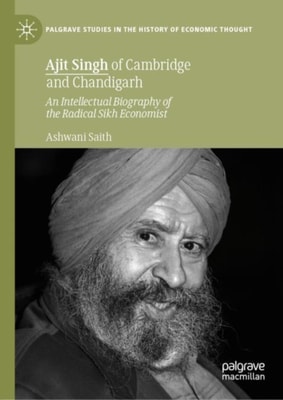
This book examines the life and work of Ajit Singh (1940-2015), a leading radical post-Keynesian applied economist who made major contributions to the policy-oriented study of both developed and developing economies, and was a key figure in the life and evolution of the Cambridge Faculty of Economics.
This book explores the dynamics of health system decentralization and recentralization, investigating why and how the territorial organization of health systems changes or remains stable over time.
This book discusses the fundamental issues regarding the effect of real estate regulation on housing, urban development, and considerations of justice and efficiency.
This book examines the patterns, characteristics, causes and coping mechanisms of the poor in Afghanistan applying econometric and statistical techniques.
This book provides a comprehensive search for the basic political drivers of international development cooperation, based on the policy and performance of the OECD countries from the early 1960s to the present.
This book provides a detailed insight into how space and its applications are embedded, and can be further embedded, into African society in support of the SDGs, while taking into account the specific features, needs, and diversity of that society.
This book examines the history of nation-building in Kosova as a model of how the theories behind nation-building, state-building and peace-building can succeed or fail.
This book presents a new theory explaining underdevelopment in the global South and tests whether financial inputs, the government-business-media (GBM) complex and spatiotemporal influences drive human development.
This book promotes the well-being of the commons through representation and accountability through monitoring from below in order to operationalize engagement.
From the Great Depression in the twentieth century to the Great Recession in the twenty-first, systemic banking crises have been a recurring problem for both developing and developed countries.
This book introduces an analytic framework constructed upon the iterated Prisoners' Dilemma game to model and analyze transboundary water interactions along the Nile River.
This book documents and analyses spatial planning in Ghana, providing a comprehensive and critical discussion of the evolving institutional and legal arrangements that have shaped and defined Ghana's spatial planning system for more than seven decades; the contemporary policy instruments and mechanisms for articulating and implementing policies and proposals at multiple scales; and the formally established procedures for development management.
This book explores how humanitarian interventions for children in difficult circumstances engage in affective commodification of disadvantaged childhoods.
"e;An excellent collection of essays that illustrate how EU member states' wish to implement normatively inspired policies is confronted with the geopolitical realities of today's world.
"e;Lopes brings his rigour, insight, and experience to this timely new book, presenting a compelling rethink of traditional development models in Africa and the need to seize on transformational change to build a sustainable future for the continent.
This edited volume studies the complex interrelation of poverty, work, and different stages in the life course, and how it contributes to the permanent existence of poverty and inequality in vulnerable groups in society.
Aimed at those at the forefront of social ecological thinking, this book presents a practice-oriented process to navigate the complex, interdisciplinary challenges of our time.
This book presents five critical dimensions on relationships, institutions, produc-tion, organisation, and governance from design and systems perspectives for thesystematic transition of unstable and vulnerable communities across the world tosustainable community systems.
Contributions collected here discuss the experiences of the citizens of Angola, Cape Verde, Guinea-Bissau, Mozambique and Sao Tome and Principe, and suggest some answers to the challenges they face.
This book brings together contributions on the challenges of the environment, agriculture and cross-border migrations in Africa; key areas that have become critical for the continent,s development.