El número de personas afectadas por desastres va en aumento, y con él las expectativas que los donantes, el público general y las poblaciones afectadas tienen puestas en las organizaciones humanitarias.
El número de personas afectadas por desastres va en aumento, y con él las expectativas que los donantes, el público general y las poblaciones afectadas tienen puestas en las organizaciones humanitarias.
Alors que le nombre de personnes touchées par des catastrophes augmente, il en va de même pour les attentes placées dans les organisations humanitaires par les bailleurs de fonds, le public et les populations touchées.
Alors que le nombre de personnes touchées par des catastrophes augmente, il en va de même pour les attentes placées dans les organisations humanitaires par les bailleurs de fonds, le public et les populations touchées.
Training for Transformation is an approach to community organization encompassed in three books which enables people to 'read their reality and write their own history' using a combination of group processes, socio-economic analysis and organizational development processes.
Development is about change, and lives immersed in researching international development should be prepared for exploration, for discovering the unexpected, and for questioning the direction that 'development' is taking.
This book provides new empirical evidence on access to and use of ICTs and their effect on poor households in East African and Southern African countries.
From Infrastructure to Services reveals important breakthroughs in country-led and country-wide monitoring of rural and small towns water supplies; ICT for monitoring sustainable service delivery; monitoring the finance needed for service delivery; monitoring for sanitation and hygiene; and building coherence in global-regional-national monitoring.
Feminists in Development Organizations arises from a collaborative project of feminists working inside the head offices of multilateral organizations, government aid agencies and international NGOs.
As climate becomes less predictable and extreme weather events become more frequent, there is an urgent need for support that will help communities to prepare and adapt to changing conditions.
In many countries poor people's energy access is yet to be given sufficient priority and fails to be acknowledged as a key enabler in improving health, education, and other community services.
Global climate change disproportionately affects rural people and indigenous groups, but their rights, knowledge, and interests concerning it are generally unacknowledged.
Enthusiasm amongst international development agencies about harnessing the potential of information and communications technologies (ICTs) for development has generated questionning of the impact and sustainability of such interventions.
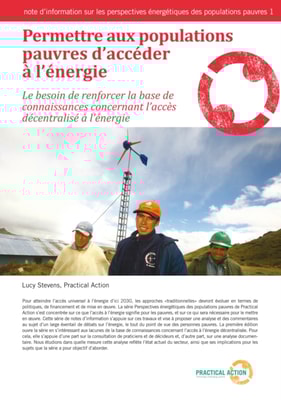
Pour atteindre l’accès universel à l’énergie d’ici 2030, les approches «traditionnelles» devront évoluer en termes de politiques, de financement et de mise en oeuvre.
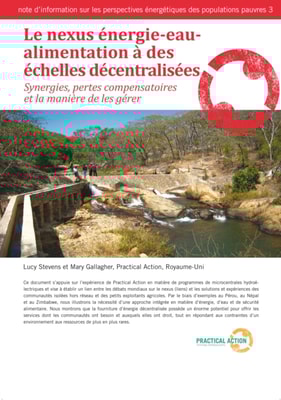
Ce document s’appuie sur l’expérience de Practical Action en matière de programmes de microcentrales hydroélectriques et vise à établir un lien entre les débats mondiaux sur le nexus (liens) et les solutions et expériences des communautés isolées hors réseau et des petits exploitants agricoles.
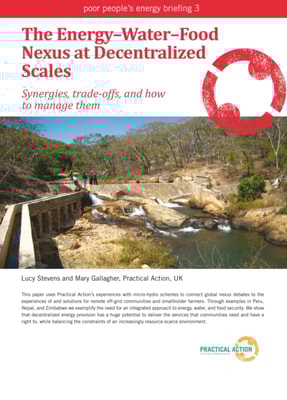
The Energy-Water-Food Nexus at Decentralized Scales uses Practical Action's experiences with micro-hydro schemes to connect global nexus debates to the experiences of and solutions for remote off-grid communities and smallholder farmers.
As the number of people affected by disasters has risen, so have the expectations placed on humanitarian agencies by donors, the public and the affected populations themselves.
Collectively, billions of dollars have been invested in the provision of rural water supply systems in developing countries over the past three decades.
This ground-breaking collection investigates the relationship between feminist activism and legal reform as a pathway to gender justice and social change.
This ground-breaking collection investigates the relationship between feminist activism and legal reform as a pathway to gender justice and social change.
The last two years have seen a huge amount of academic, policy-making and media interest in the increasingly contentious issue of land grabbing - the large-scale acquisition of land in the global South.
The last two years have seen a huge amount of academic, policy-making and media interest in the increasingly contentious issue of land grabbing - the large-scale acquisition of land in the global South.
The Zapatistas of Chiapas and the Landless Rural Workers' Movement (MST) of Brazil are often celebrated as shining examples in the global struggle against neoliberalism.
The Zapatistas of Chiapas and the Landless Rural Workers' Movement (MST) of Brazil are often celebrated as shining examples in the global struggle against neoliberalism.
In this highly original work, Mary Njeri Kinyanjui explores the trajectory of women's movement from the margins of urbanization into the centres of business activities in Nairobi and its accompanying implications for urban planning.
Drawing on in-depth empirical research spanning a number of countries in Africa, Booth and Cammack's path-breaking book offers both an accessible overview of issues surrounding governance for development on the continent, whilst also offering a bold new alternative.
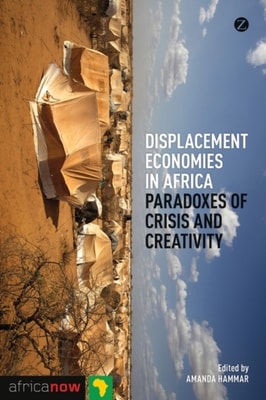
Large-scale displacement - whether caused by war, state-related political or development projects, different forms of political violence, structural crisis, or even natural disasters - evokes many stereotyped assumptions about those forcibly displaced or emplaced.
Large-scale displacement - whether caused by war, state-related political or development projects, different forms of political violence, structural crisis, or even natural disasters - evokes many stereotyped assumptions about those forcibly displaced or emplaced.
In a primary commodities boom spurred on by the rise of China, countries the world over are turning to the extraction of natural resources and the export of primary commodities as an antidote to the global recession.
In a primary commodities boom spurred on by the rise of China, countries the world over are turning to the extraction of natural resources and the export of primary commodities as an antidote to the global recession.
Samir Amin remains one of the world's most influential thinkers about the changing nature of North-South relations in the development of contemporary capitalism.