Soon after Russia invaded Ukraine in February 2022, Vladimir Putin expressed Russia's commitment for the reconstruction of the war-devasted Eastern regions of Ukraine.
This book addresses a longstanding issue that emerged fifty years ago and continues to persist- the lack of an accounting and reporting system for financial sustainability.
A human-centered society creatively balances investments in sources of innovation, while also governing in a manner that eventually limits exploitation by originators once innovations have proven their value in the marketplace, broadly defined to include both private and public constituencies.
This book looks at migrant landing spaces, exploring the processes and infrastructures which people encounter as they navigate urban spaces along the central Mediterranean route.
Impact Investing for a Sustainable Planet guides investors in supporting entrepreneurs to scale business models which maximize positive impact outcomes, including climate- and nature-based solutions.
This book explores the transformative role of networks within the European Union (EU) over the past three decades, particularly in relation to the cultural and creative sectors, examining how informal collaborations evolved into structured entities that have reshaped EU cultural governance and fostered cross-border cooperation among cultural professionals.
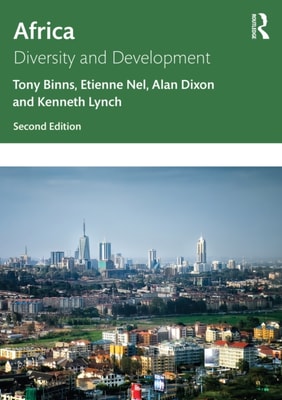
Africa: Diversity and Development introduces and de-mystifies Africa's diversity and dynamism, and considers how its peoples and environments have interacted through time and space.
To meet the challenge of global environmental degradation activists have tackled clear and concrete problems such as carbon emissions and climate change, the ruination of ecosystems and habitat, the precipitous loss of biodiversity, and many other unhappy consequences of irresponsible human behaviour.
This book presents specific case studies of climate finance in the Arctic and examines how the green revolution could be a game changer in this sensitive region.
This book brings together world-renowned experts and rising scholars to provide a collection of chapters examining the long-term impact of historical events on modern-day economic and political developments in Latin America.
This book presents specific case studies of climate finance in the Arctic and examines how the green revolution could be a game changer in this sensitive region.
This book brings together world-renowned experts and rising scholars to provide a collection of chapters examining the long-term impact of historical events on modern-day economic and political developments in Latin America.
This book examines the important role which civil society organisations in South Africa play in challenging poor corporate governance in state-owned enterprises and demanding better government accountability, transparency and citizen participation.
This book introduces readers to the rich and fascinating history of West Africa, stretching all the way back to the stone age, and right up to the modern day.
First published in 1985, Quaternary Environments represents the culmination of Quaternary research in the region of Baffin Island, Baffin Bay and West Greenland over a period of twenty years and it will serve as a timely and complementary balance to the paleo- oceanographic studies in the NE North Atlantic.
Africa: Diversity and Development introduces and de-mystifies Africa's diversity and dynamism, and considers how its peoples and environments have interacted through time and space.
Whilst there is an extensive body of research exploring the barriers to gender equality and female empowerment in high-income states, there are far fewer systematic analyses within lower-income settings.
Drawing on debates about intangible cultural heritage (ICH) safeguarding at the local and international levels, Intangible Cultural Heritage and Sustainable Development: Inside a UNESCO Convention, explores the theoretical and practical implications of the intertwinement between these policy fields.
Multi-Stakeholder Contribution in Asian Environmental Communication focuses on how diverse actors can come together to promote sustainable environmental practices.
Green Finance and Renewable Energy in ASEAN and East Asia edited by Phoumin, Taghizadeh-Hesary and Kimura provides several empirical policy-oriented studies with new data on ASEAN member states and East Asian economies that deal with innovative and market-based solutions for unlocking private investments in renewable energy projects.
This book presents a progressive effort in enhancing scientific research pertaining to sustainable development, with particular emphasis on the Western Balkans region.
This book presents a progressive effort in enhancing scientific research pertaining to sustainable development, with particular emphasis on the Western Balkans region.
This book introduces readers to the rich and fascinating history of West Africa, stretching all the way back to the stone age, and right up to the modern day.
Green Finance and Renewable Energy in ASEAN and East Asia edited by Phoumin, Taghizadeh-Hesary and Kimura provides several empirical policy-oriented studies with new data on ASEAN member states and East Asian economies that deal with innovative and market-based solutions for unlocking private investments in renewable energy projects.
This book sketches an institutional political economy framework to discuss the interaction between development and foreign policy in the global South with reference to Turkey.
First published in 1985, Quaternary Environments represents the culmination of Quaternary research in the region of Baffin Island, Baffin Bay and West Greenland over a period of twenty years and it will serve as a timely and complementary balance to the paleo- oceanographic studies in the NE North Atlantic.