Grounded in nine years of ethnographic research on the al Muhajiroun/Ahlus Sunnah Wal Jamaah movement (ALM/ASWJ), Douglas Weeks mixes ethnography and traditional research methods to tell the complete story of al Muhajiroun.
This book's leading goal is to explain why some states in the Americas have been markedly more effective than others at forming stable democratic regimes.
Interrogating Modernity returns to Hans Blumenberg's epochal The Legitimacy of the Modern Age as a springboard to interrogate questions of modernity, secularisation, technology and political legitimacy in the fields of political theology, history of ideas, political theory, art theory, history of philosophy, theology and sociology.
This book analyses the contribution of the new forms of reporting adopted by Public Sector Organisations in the provision of information on value creation processes to their various stakeholders.
This work provides an innovative new look at police ethics, including results from an updated version of the classic Police Integrity Questionnaire, including new social and technological advances.
This edited volume engages a long-standing religious power, the Holy See, to discuss the impact of the structural and postsecular transformations of international relations through the emergence of a global and digital public sphere.
This book discusses the evolution of three philosophical foundations from the twelfth through the eighteenth centuries that converged to form the basis of liberal democracy's approach to the place and role of religion in society and politics.
This book analyzes whistleblowing worldwide publicly known cases from Belguim, Brazil, Finland, Japan and The Philippines to ascertain factors that make for effective whistleblowing.
This textbook presents political sociology as a connective social science that studies political phenomena by creating fruitful connections with other perspectives.
This book explores the consequences of lowering the voting age to 16 from a global perspective, bringing together empirical research from countries where at least some 16-year-olds are able to vote.
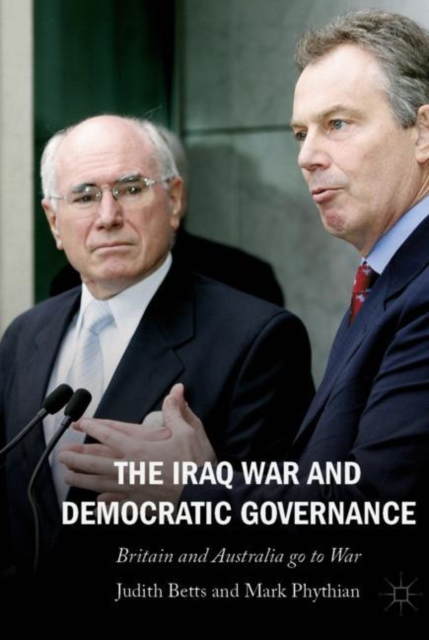
This book examines the decisions by Tony Blair and John Howard to take their nations into the 2003 Iraq War, and the questions these decisions raise about democratic governance.
Fifty years ago, academics and policymakers throughout the world agreed that it was impossible for certain sets of historically antagonistic groups to coexist peacefully on a long-term basis.
The Palgrave Handbook of Global Perspectives on Emotional Labor in Public Service challenges traditional public administration theory and its disavowal of the emotive component to public service delivery.
This book fleshes out activities and initiatives in the field of education from across areas of European Union competence in order to highlight the extent to which education and training have penetrated the European Community's policymaking since its creation.
Using yet untapped resources from moral and political philosophy, this book seeks to answer the question of whether an all good God who is presumed to be all powerful is logically compatible with the degree and amount of moral and natural evil that exists in our world.
Drawing on comparative politics and social network analysis, this book examines how the domestic institutional and organizational settings, as well as the network governance patterns, determine variation in administrative responses to EU's Common Agricultural Policy (CAP) in two European Union (EU) member states, Denmark and Greece.
This book explores the origins of nationalism and the ideal of nation/state congruency since early-modern European thought, their transformation over time and endurance in contemporary political thought and IR theory.
This book studies the relationship between British government and faith groups in its international development agenda within and beyond the context of Brexit.
Based on Catholic and Confucian social ethics, this book develops an ethic of solidarity and reciprocity with the migrants in Asia who are marginalized.
This book provides a practical guide to how groups of people, everywhere, from the local village council to the United Nations Security Council, can best make collective decisions.
This is a book about European integration and mainstream parties of the left, the main underlying question driving it being: Given that the communist left was fatally wounded by the collapse of the Berlin Wall; given that, since then, the terms 'left' and 'right' have not infrequently been attacked (especially by populists) as being no longer useful for making sense of politics; given that social democracy, understood as 'national Keynesianism' no longer appears to be viable (as reflected in its long-term electoral decline), what does it mean to be on the left in the early 21st century and what can be done to revive its fortunes?
This book guides the reader through the many complications and contradictions that characterize popular contestation today, focusing on its socio-political, cultural, and aesthetic dimensions.
This book examines gender- and integration-specific needs of women migrants by using a unique analytic framework, covering both qualitative and quantitative methods and techniques.