Demonstrating the importance of theory for effective clinical practice, this thought-provoking volume brings together leading experts on a range of contemporary cognitive and behavioral approaches.
This edited collection presents the latest work on the application of discursive psychology and conversation analysis to sensitive interactions and interventions in healthcare.
The aim of this book is to bring together social scientists, cognitive scientists, psychologists, neuroscientists, neuropsychologists and others to promote a dialogue about the variety of processes involved in social cognition, as well as the relevance of mirroring neural systems to those processes.
Cultural institutions must reimagine their roles as education facilities for their communities and address the public need for conversations in safe and fair places, thereby renewing their essential place in democratic society.
ENTHEOGENS, MYTH AND HUMAN CONSCIOUSNESS is a much needed accessible exploration into the role of psychoactive sacraments - entheogens - in religion, mythology, and history, and also includes most treatments of the subject focus on modern scientific research, psychotherapy, are auto-bibliographic accounts, or are agenda-driven or otherwise naive and myopic.
Thanks to the enormous progress of neuroscience over the past few decades, we can now monitor the passage of initial stimulations to certain points in the brain.
ENTHEOGENS, MYTH AND HUMAN CONSCIOUSNESS is a much needed accessible exploration into the role of psychoactive sacraments - entheogens - in religion, mythology, and history, and also includes most treatments of the subject focus on modern scientific research, psychotherapy, are auto-bibliographic accounts, or are agenda-driven or otherwise naive and myopic.
In ›Die Erfindung des ADHS-Syndroms‹ wird die faszinierende Geschichte dieser weit verbreiteten neurobiologischen Störung von ihren Anfängen bis zu den aktuellen Forschungsergebnissen beleuchtet.
In the updated third edition of this unique book, Catherine McBride looks at reading and writing development and impairment across a range of languages, scripts, and contexts.
Due to the phylogenetic relationship and close genetic and biological similarities with humans, non-human primates (NHP) are regularly used in biomedical and behavioural research.
Understanding Creativity: Past, Present and Future Perspectives explores the symbiotic relationship between culture and creativity, particularly exploring how resources and cultural values within a society can foster or hinder creativity.
This book brings together contributions from different researchers on the theme of facial expressions, with an emphasis on emotional expressions, which may be of interest to professionals in neuroscience, technology and psychopathology.
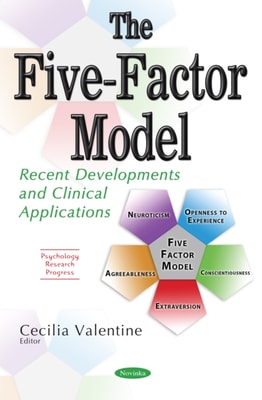
Personality traits are enduring dispositional tendencies commonly defined as "e;dimensions of individual differences in tendencies to show consistent patterns of thoughts, feelings, and actions"e; (McCrae and Costa, 2003, p.
A summary of author Masakazu Shoji's previous works, Self-Consciousness: Human Brain as Data Processor, explains self-consciousness by using a simple, mechanical model of the human brain, which reflects its past development of evolution by natural selection.
This highly practical book will guide students through the different levels of research within CBT by addressing the general principles, how to understand statistics and tackling with general principles.
This highly practical book will guide students through the different levels of research within CBT by addressing the general principles, how to understand statistics and tackling with general principles.
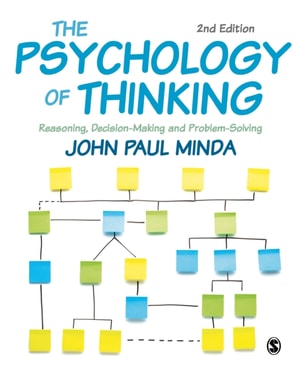
The Psychology of Thinking is an engaging, interesting and easy-to-follow guide into the essential concepts behind our reasoning, decision-making and problem-solving.
The Psychology of Thinking is an engaging, interesting and easy-to-follow guide into the essential concepts behind our reasoning, decision-making and problem-solving.
Forgetting is the most obvious feature of human memory, whether this is everyday forgetfulness, like leaving your keys at home, or more serious medical conditions, such as amnesia.
Forgetting is the most obvious feature of human memory, whether this is everyday forgetfulness, like leaving your keys at home, or more serious medical conditions, such as amnesia.
'An endlessly fascinating tour of the many different factors influencing our decision-making and reasoning' David Robson, author of The Expectation Effect'An eye-opening and engaging richness of information that gives us a detailed insight into the strengths and weaknesses of human behaviour' Melissa Hogenboom, author of The Motherhood ComplexDo emotions really cloud your thinking?