This study explores prospects for inclusive growth in the Central Asia and the South Caucasus region and highlights the central role played by the creation of good jobs.
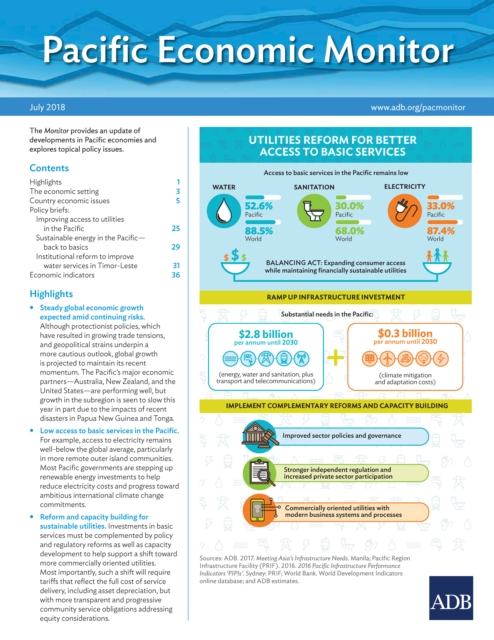
This issue highlights the economic prospects of the Pacific developing member countries (Pacific DMCs) and stresses the importance of improving the quality and access to basic and sustainable utilities in the Pacific DMCs.
This publication presents new case studies of recent Asian Development Bank projects in Bangladesh, the Cook Islands, India, Nepal, Pakistan, Papua New Guinea, and the People's Republic of China.
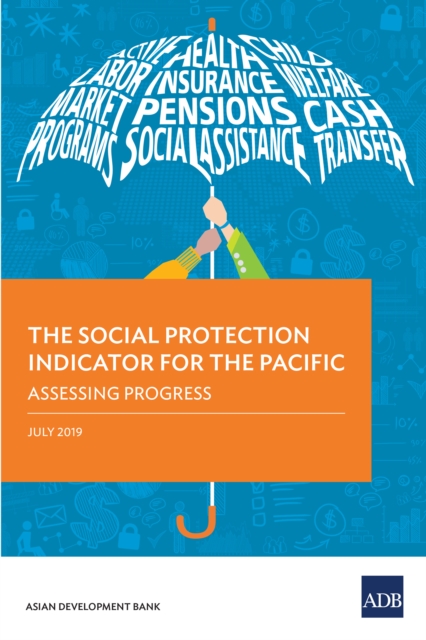
The "e;leave no one behind"e; principle of the 2030 Agenda for Sustainable Development requires appropriate indicators for different segments of a country's population.
This report presents nine case studies of recent Asian Development Bank projects in Mongolia, Nepal, the People's Republic of China, the Philippines, Sri Lanka, Uzbekistan, and Viet Nam.
Climate risk threatens Indonesia's socioeconomic development, and it is likely to exacerbate the plight of Indonesians living below and close to the poverty line.
The first edition of the Public-Private Partnership (PPP) Monitor tracks the development of the PPP business environment as well as the challenges of doing PPPs in nine of the developing member countries (DMCs) of the Asian Development Bank (ADB): Bangladesh, the People's Republic of China, India, Indonesia, Kazakhstan, Papua New Guinea, the Philippines, Thailand, and Viet Nam.
This publication provides a standard compilation of supply and use tables (SUTs) for 19 economies in Asia and the Pacific to help them comply with the United Nations 2008 System of National Accounts (SNA) recommendations.
The Pilot Program for Climate Resilience (PPCR) is a funding window of the Climate Investment Funds, of which the Asian Development Bank (ADB) is a major partner in Asia and the Pacific, delivering investments through six country programs (Bangladesh, Cambodia, Nepal, Papua New Guinea, Tajikistan, and Tonga) and one regional program for the Pacific.
Good corporate governance practices reduce vulnerability to financial crises, reinforce property rights, reduce the cost of capital, and lead to greater capital market development.
The Climate Change Operational Framework 2017-2030 is intended to provide broad direction and guidance for enhancing resilience and strengthening climate actions in the operations and business processes of the Asian Development Bank (ADB).
To help overcome remoteness, Pacific economies are looking to improve economic integration not only through ICT and transport network investments, but also by promoting greater competition and private investment.
Against the backdrop of the global financial crisis and rising food, fuel, and commodity prices, addressing poverty and inequality in the Philippines remains a challenge.
This joint publication from the Asian Development Bank and the Asian Development Bank Institute features selected papers from the September 2009 conference on the social and environmental impact of the global economic crisis on Asia and the Pacific, especially on the poor and vulnerable.
The Development Co-operation Report (DCR) 2013 explores what needs to be done to achieve rapid and sustainable progress in the global fight to reduce poverty.
This book demonstrates that in the case of very poor countries, policies aimed at universal provision of education and health services benefit the poor significantly more than more expensive targeted schemes.
Employment is clearly one of those fields of political activity that reveal the manifold problems and difficulties accompanying the process of European integration and supranational institutionalization.
Cuando un individuo causa un daño a otro sabiendo de antemano que las consecuencias van a ser mortales, está cometiendo un asesinato; en la presente obra, Friedrich Engels se propone demostrar que la naciente sociedad capitalista de la Inglaterra victoriana es culpable de asesinato, cada día, a cada minuto.
Según la ONU, más de mil millones de personas viven en ciudades miseria, en favelas, cerros, chabolas, cantegriles, campamentos y barriadas del Sur global.
Es prioritario continuar revisando el problema social de la pobreza infantil en sus propuestas conceptuales (definiciones) y metodológicas de medición porque persisten relevantes desafíos de construcción de conocimiento específico sobre esta categoría social que es la infancia en situación de pobreza, pero también de comparabilidad de las mediciones en el tiempo y entre diferentes dominios.
No hay dudas de que los mundos educativos y laborales constituyen dos espacios ampliamente debatidos cuando se hace referencia a la problemática de la desigualdad social.
The long history of the racial wealth gap in America told through the stories of seven Black families who struggled to build wealth over multiple generations Wealth is central to the American pursuit of happiness and is an overriding measure of well-being.
The book present the focal attention on the elimination of poverty and to reach to the purpose discusses various factors, plans and perspectives in details : various dimensions discussed by many different economist of world and the variations, analysis of the perspective in context of last five decades development experience of the other countries, Indian experience and its multiface in India.
Los autores refieren que los jóvenes mexicanos tienen varios desafíos al enfrentar una transición de una posición de dependencia que caracteriza la etapa de la niñez al tener responsabilidades y una relativa autonomía propias de la adultez, lo cual ocasiona dificultades como privaciones, falta de oportunidades y desigualdades sociales que experimentan durante esta etapa con una serie de consecuencias emocionales, políticas, económicas y sociales negativas tanto para ellos como para sus familias y comunidades.