The purpose of Advances in Soil Science is to provide a forum for leading scientists to analyze and summarize the available scientific information on a subject, assessing its importance and identifying additional research needs.
This series is dedicated to serving the growing community of scholars and practitioners concerned with the principles and applications of environmental management.
I think the reader will agree that we have attained a good balance in Volume 6 between human-or animal-host and plant-host-related topics from outstanding research scientists.
Until relatively recently the valuable tropical montane cloud forests (hereaf- ter usually referred to as TMCFs) of the world had scarcely come under the assaults experienced by the downslope montane and lowland forests.
This second edition was undertaken to update information which has become available since the first edition and to convert completely to the SI system.
In the early 1980s there were several published reports of recent, unexplained increases in mortality of red spruce in the Adirondack Mountains and the northern Appalachian Mountains of the eastern United States.
Advances in Soil Science was conceived in 1982 to provide a forum for leading international scientists to analyze and summarize the available scientific information on a subject, assessing its importance and ident- ifying additional research needs.
The Maize Handbook represents the collective efforts of the maize research community to enumerate the key steps of standard procedures and to disseminate these protocols for the common good.
Volume 10 of Advances in Disease Vector Research consists of seven chapters on vectors that affect human or animal health and six chapters on plant pathogens and their vectors.
John Sculley In the short history of personal computing, the task of the software programmer has been one of the least recognized-but one of the most significant-in the industry.
Soil is formed from the physical and chemical weathering of rocks-processes described historically becau'se they involve eons of time-by glaciation and by wind and water transport of soil materials, which are later deposited in deltas and loessial planes.
Since the 1950s, the pines native to the San Bernardino Mountains in Southern California have shown symptoms of decline that have proven to result from exposure to ozone, a major plant-damaging gas in photochemical oxidant air pollution.
In the Global Change Research Act of 1990, "e;global change"e; is defined as "e;changes in the global environment (including alterations in climate, land productivity, oceans or other water resources, atmospheric chemistry, and ecological systems) that may alter the capacity of the Earth to sustain life.
After the 1998 flood of the Yangtze River, one of the world's most important rivers, environmental experts realized that, to control flooding, much more attention must be paid to vegetation cover on bare lands, thin forest land, and shrub-covered land in mountain areas.
A Beginner's Guide to Microarrays addresses two audiences - the core facility manager who produces, hybridizes, and scans arrays, and the basic research scientist who will be performing the analysis and interpreting the results.
The majority of this book was written in 1983-84 while the senior author was a Visiting Scientist at Oak Ridge National Laboratory (ORNL) in Oak Ridge, Tennessee.
Numerical Ecology with R provides a long-awaited bridge between a textbook in Numerical Ecology and the implementation of this discipline in the R language.
Forest Analytics with R combines practical, down-to-earth forestry data analysis and solutions to real forest management challenges with state-of-the-art statistical and data-handling functionality.
Genetics and Genomics of Populus provides an indepth description of the genetic and genomic tools and approaches for Populus, examines the biology that has been elucidated using genomics, and looks to the future of this unique model plant.
The Southern Forest: Geography, Ecology, and Silviculture examines the forests of the South, providing a comprehensive description of the region from which most of the nation's wood for housing and paper will be grown and harvested in the future.
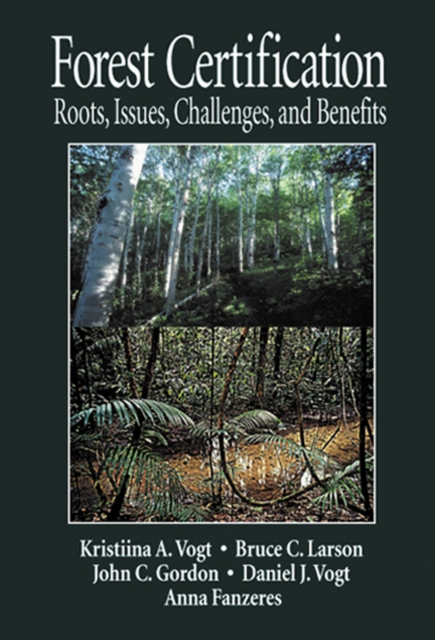
Forest Certification examines the historical roots of forest certification, the factors that guide the development of protocols, the players involved, the factors determining the customers to be certified, and the benefits of certification.