In today's world, services and data are integrated in ever new constellations, requiring the easy, flexible and scalable integration of autonomous, heterogeneous components into complex systems at any time.
The Medical Internet of Things (MIoT) has redefined healthcare by interconnecting devices, systems, and applications to monitor, analyze, and manage patient data in real time.
Diversity-Driven Evolutionary Algorithms For Solving Engineering Problems explores optimization algorithms and their applications across diverse engineering domains.
This book explores RSSI-based localization, device-free detection, and machine learning integration, providing practical insights into wireless sensing applications for navigation, security, healthcare, and intelligent IoT systems.
This reference text covers deep learning-based communication frameworks for multiuser detection and sparse channel estimation and engages in a discussion on deep learning-based ultra-dense cell communication and sensor networks and ad-hoc communication.
The Medical Internet of Things (MIoT) has redefined healthcare by interconnecting devices, systems, and applications to monitor, analyze, and manage patient data in real time.
Diversity-Driven Evolutionary Algorithms For Solving Engineering Problems explores optimization algorithms and their applications across diverse engineering domains.
Digitalizing Material Innovations for Net-Zero Applications navigates the critical intersection of advanced materials science, cutting-edge digital engineering, and global sustainability goals.
This book examines theoretical and applied aspects of wavelet analysis in neurophysics, describing in detail different practical applications of the wavelet theory in the areas of neurodynamics and neurophysiology and providing a review of fundamental work that has been carried out in these fields over the last decade.
This volume of the LNCS series contains the papers accepted for presentation at the Third IFIP international working conference on active networks (IWAN 2001).
This book constitutes the refereed proceedings of the Second International Workshop on Quality of Service in Multiservice IP Networks, QoS-IP 2003, held in Milano, Italy in February 2003.
This book focuses the recent progress in nanophotonics technology to be used to develop novel nano-optical devices, fabrication technology, and advanced systems.
These proceedings contain papers presented at the 8th Discrete Geometry for Computer Imagery conference, held 17-19, March 1999 at ESIEE, Marne-la- Vall ee.
The 1st Workshop on Service Assurance with Partial and Intermittent Resources (SAPIR 2004) was the first event in a series introducing the concept of pi-resources and bridging it with the emerging and important field of distributed and heavily shared resources.
Authored by the developer of dressed photon science and technology as well as nanophotonics, this book outlines concepts of the subject using a novel theoretical framework that differs from conventional wave optics.
In recent years, autonomous robots, including Xavier, Martha [1], Rhino [2,3], Minerva,and Remote Agent, have shown impressive performance in long-term demonstrations.
This book constitutes the refereed proceedings of the 8th International Symposium on Evolutionary Robotics, ER 2001, held in Tokyo, Japan, in October 2001.
Effective evacuation of people from closed spaces is an extremely important topic, since it can save real lives in emergency situations that can be brought about by natural and human made disasters.
In defining the state of the art of E-Government, EGOV 2002 was aimed at breaking new ground in the development of innovative solutions in this impor- tant field of the emerging Information Society.
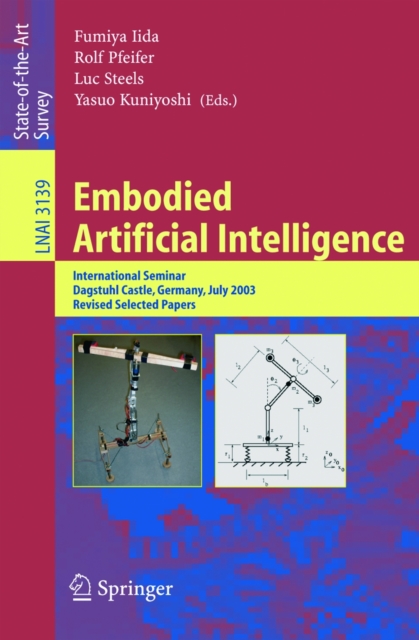
Originating from a Dagstuhl seminar, the collection of papers presented in this book constitutes on the one hand a representative state-of-the-art survey of embodied artificial intelligence, and on the other hand the papers identify the important research trends and directions in the field.
In this book for the first time two scientific fields - consensus formation and synchronization of communications - are presented together and examined through their interrelational aspects, of rapidly growing importance.