Engineering materials with desirable physical and technological properties requires understanding and predictive capability of materials behavior under varying external conditions, such as temperature and pressure.
These Proceedings, consisting of Parts A and B, contain the edited versions of most of the papers presented at the annual Review of Progress in Quantitative Nondestructive Evaluation held at the University of Washington, Seattle on July 30 to August 4, 1995.
IMA Volumes 135: Transport in Transition Regimes and 136: Dispersive Transport Equations and Multiscale Models focus on the modeling of processes for which transport is one of the most complicated components.
In the first comprehensive treatment of these technologically important materials, the authors provide theories linking the properties of semiconductor alloys to their constituent compounds.
Transformation electromagnetics is a systematic design technique for optical and electromagnetic devices that enables novel wave-material interaction properties.
Photophysics of Carbon Nanotubes Interfaced with Organic and Inorganic Materials describes physical, optical and spectroscopic properties of the emerging class of nanocomposites formed from carbon nanotubes (CNTs) interfacing with organic and inorganic materials.
Metal oxides and particularly their nanostructures have emerged as animportant class of materials with a rich spectrum of properties and greatpotential for device applications.
Studying and using light or "e;photons"e; to image and then to control and transmit molecular information is among the most challenging and significant research fields to emerge in recent years.
Microelectronic Test Structures for CMOS Technology and Products addresses the basic concepts of the design of test structures for incorporation within test-vehicles, scribe-lines, and CMOS products.
Good old Gutenberg could not have imagined that his revolutionary printing concept which so greatly contributed to dissemination of knowledge and thus today 's wealth, would have been a source of inspiration five hundred years later.
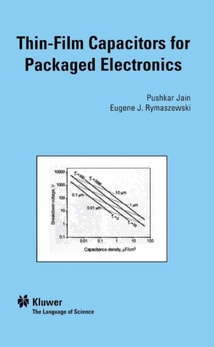
Thin-Film Capacitors for Packaged Electronics deals with the capacitors of a wanted kind, still needed and capable of keeping pace with the demands posed by ever greater levels of integration.
Silicon-on-Insulator Technology: Materials to VLSI, Third Edition, retraces the evolution of SOI materials, devices and circuits over a period of roughly twenty years.
Printed Organic And Molecular Electronics was compiled to create a reference that included existing knowledge from the most renowned industry, academic, and government experts in the fields of organic semiconductor technology, graphic arts printing, micro-contact printing, and molecular electronics.
IMA Volumes 135: Transport in Transition Regimes and 136: Dispersive Transport Equations and Multiscale Models focus on the modeling of processes for which transport is one of the most complicated components.
Terahertz science and technology is attracting great interest due to its application in a wide array of fields made possible by the development of new and improved terahertz radiation sources and detectors.
This book covers the recent progress in fiber-optic communication systems with a main focus on the impact of fiber nonlinearities on the system performance.
Advanced Quantum Mechanics: Materials and Photons is a textbook which emphasizes the importance of advanced quantum mechanics for materials science and all experimental techniques which employ photon absorption, emission, or scattering.
The intersection of nanostructured materials with photonics and electronics shows great potential for clinical diagnostics, sensors, ultrafast telecommunication devices, and a new generation of compact and fast computers.
Tutorial lectures given by world-renowned researchers have become one of the important traditions of the Nano and Giga Challenges (NGC) conference series.
This book will address the advances, applications, research results, and emerging areas of optics, photonics, computational approaches, nano-photonics, bio-photonics, with applications in information systems.
Advanced Flip Chip Packaging presents past, present and future advances and trends in areas such as substrate technology, material development, and assembly processes.
Reliability of Microtechnology discusses the reliability of microtechnology products from the bottom up, beginning with devices and extending to systems.
Dielectric Polymer Nanocomposites provides the first in-depth discussion of nano-dielectrics, an emerging and fast moving topic in electrical insulation.
Fundamentals of III-V Semiconductor MOSFETs presents the fundamentals and current status of research of compound semiconductor metal-oxide-semiconductor field-effect transistors (MOSFETs) that are envisioned as a future replacement of silicon in digital circuits.
Metamaterials-artificially structured materials with engineered electromagnetic properties-have enabled unprecedented flexibility in manipulating electromagnetic waves and producing new functionalities.
Narrow gap semiconductors obey the general rules of semiconductor science, but often exhibit extreme features of these rules because of the same properties that produce their narrow gaps.
Fiberglass and Glass Technology: Energy-Friendly Compositions and Applications provides a detailed overview of fiber, float and container glass technology with special emphasis on energy- and environmentally-friendly compositions, applications and manufacturing practices which have recently become available and continue to emerge.
Metamaterials:Theory, Design, and Applications goes beyond left-handed materials (LHM) or negative index materials (NIM) and focuses on recent research activity.
Strain Effect in Semiconductors: Theory and Device Applications presents the fundamentals and applications of strain in semiconductors and semiconductor devices that is relevant for strain-enhanced advanced CMOS technology and strain-based piezoresistive MEMS transducers.
Carbon nanotubes (CNTs) and Boron nitride nanotubes (BNNTs) are part of the so-called B-C-N material system, which includes novel nanostructures of carbon (C), doped-carbon, boron (B), boron nitride (BN), carbon nitride (CNx), boron-carbon nitride (BxCyNz), and boron carbide (BxCy).
Since overall circuit performance has depended primarily on transistor properties, previous efforts to enhance circuit and system speed were focused on transistors as well.