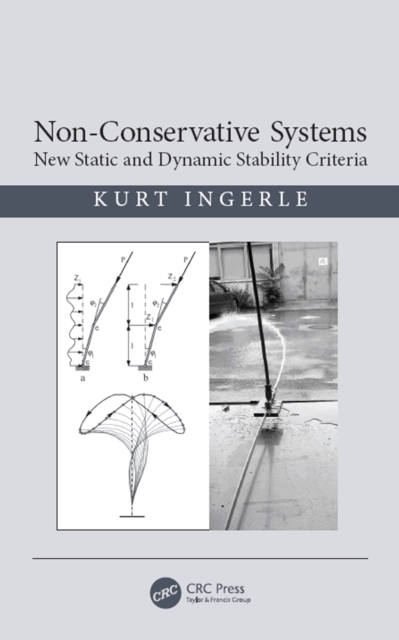
Non-Conservative Systems: New Static and Dynamic Stability Criteria summarizes the essential properties of non-conservative elastic systems (static stability and post-critical behavior), and the importance of novel stability criteria for such systems.
Amorphous-nanocrystalline alloys are a relatively new class of materials born from the rapid development of new technologies and different methods of producing amorphous and nanocrystalline powders and films, compacting, melt quenching, megaplastic deformation, implantation, laser, plasma, and other high-energy methods.
Amorphous-nanocrystalline alloys are a relatively new class of materials born from the rapid development of new technologies and different methods of producing amorphous and nanocrystalline powders and films, compacting, melt quenching, megaplastic deformation, implantation, laser, plasma, and other high-energy methods.
Vibration-based condition monitoring (VCM) is a well-accepted approach in industries for early detection of any defect, thereby triggering the maintenance process and ultimately reducing overheads and plant downtime.
Vibration-based condition monitoring (VCM) is a well-accepted approach in industries for early detection of any defect, thereby triggering the maintenance process and ultimately reducing overheads and plant downtime.
Nonlinear Analysis of Structures presents a complete evaluation of the nonlinear static and dynamic behavior of beams, rods, plates, trusses, frames, mechanisms, stiffened structures, sandwich plates, and shells.
Nonlinear Analysis of Structures presents a complete evaluation of the nonlinear static and dynamic behavior of beams, rods, plates, trusses, frames, mechanisms, stiffened structures, sandwich plates, and shells.
The monograph analyses the state of the art (problem) in using stone siftings and aspiration dust obtained in natural stone crushing for producing concrete aggregates and fillers for dry construction mixtures and mortars on their basis.
The monograph analyses the state of the art (problem) in using stone siftings and aspiration dust obtained in natural stone crushing for producing concrete aggregates and fillers for dry construction mixtures and mortars on their basis.
The effect of combined extreme transient loadings on a structure is not well understood-whether the source is man-made, such as an explosion and fire, or natural, such as an earthquake or extreme wind loading.
The effect of combined extreme transient loadings on a structure is not well understood-whether the source is man-made, such as an explosion and fire, or natural, such as an earthquake or extreme wind loading.
Advanced Mechanical Vibrations: Physics, Mathematics and Applications provides a concise and solid exposition of the fundamental concepts and ideas that pervade many specialised disciplines where linear engineering vibrations are involved.
Advanced Mechanical Vibrations: Physics, Mathematics and Applications provides a concise and solid exposition of the fundamental concepts and ideas that pervade many specialised disciplines where linear engineering vibrations are involved.
A comprehensive textbook that encompasses the full range of material covered in undergraduate courses in Structures in departments of Civil and Mechanical Engineering.
The second edition of this highly informative book retains much original material covering the principles of structural mechanics and the strength of materials, together with the underlying concepts requisite to the theory of structure and structural design.
The second edition of this highly informative book retains much original material covering the principles of structural mechanics and the strength of materials, together with the underlying concepts requisite to the theory of structure and structural design.
Fatigue failure of engineering materials and structures has long been a great challenge for structural integrity, reliability and safety in mechanical, civil and aerospace engineering.
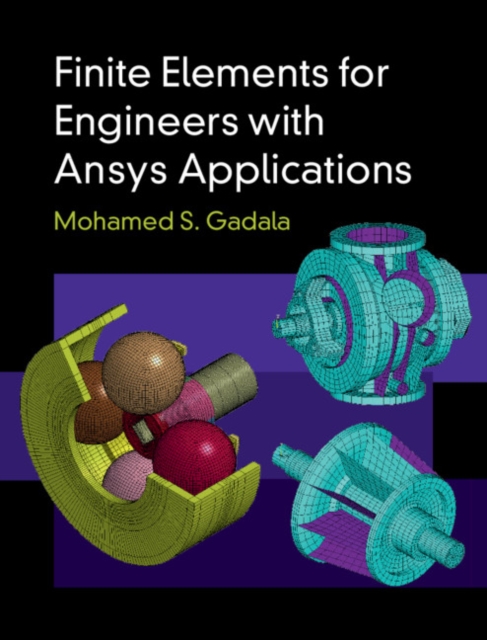
Covering theory and practical industry usage of the finite element method, this highly-illustrated step-by-step approach thoroughly introduces methods using ANSYS.
This illustrated reference work provides a comprehensive overview of the surface engineering discipline, focusing on automotive, machining, and biomedical fields.
Discusses polymer nanocomposites composed of a family of polymeric materials whose properties are capable of being tailored to meet specific applications.
Discusses polymer nanocomposites composed of a family of polymeric materials whose properties are capable of being tailored to meet specific applications.
Due to their unique properties, rubber materials are found in multiple engineering applications such as tires, engine mounts, shock absorbers, flexible joints, seals, etc.
Building on the author's Structural Mechanics Fundamentals, this text presents a complete and uniform treatment of the more advanced topics in structural mechanics, ranging from beam frames to shell structures, from dynamics to buckling analysis, from plasticity to fracture mechanics, from long-span to high-rise civil structures.
This book provides practicing engineers working in the field of design, construction and monitoring of rock structures such as tunnels and slopes with technical information on how to design, how to excavate and how to monitor the structures during their construction.
Elastic Waves: High Frequency Theory is concerned with mathematical aspects of the theory of high-frequency elastic waves, which is based on the ray method.