This updated/augmented second edition retains it class-tested content and pedagogy as a core text for graduate courses in advanced fluid mechanics and applied science.
This book presents an analytical framework for calculating the fracture toughness of generally layered beam structures with an elastically coupled response and hygrothermal stresses.
This textbook provides a coherent and structured overview of fluid mechanics, a discipline concerned with many natural phenomena and at the very heart of the most diversified industrial applications and human activities.
Now in an updated second edition, this classroom-tested textbook covers fundamental and advanced topics in orbital mechanics and astrodynamics designed to introduce readers to the basic dynamics of space flight.
This book consolidates the current knowledge of how short and long-duration spaceflight affects the anatomy and physiology of the central nervous system.
This book provides research results using computational methods for fluid dynamics and engineering problems in aeronautics and other scientific and industrial applications.
The present book describes the development history of turbojet engines, mainly in the web-type triangle Great Britain (USA) - Germany - Switzerland from early beginnings in the 1920s up to the first practical usage in the 1950s, before the still unbroken, grand impact of aero propulsion technology on global air traffic started.
This book surveys recent applications of inspection models, maintenance models and cumulative damage models, as well as discusses the policies involved with these models.
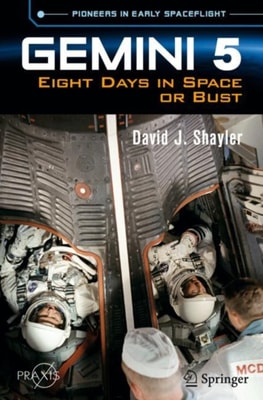
This third book of the Gemini mission series focuses on the flight that simulated in Earth orbit the duration of an eight-day Apollo mission to the Moon.
As spinning is still involved in around 60% of all aircraft accidents (BFU, 1985 and Belcastro, 2009), this aerodynamic phenomenon is still not fully understood.
This book presents the results of a European-Chinese collaborative research project, Manipulation of Reynolds Stress for Separation Control and Drag Reduction (MARS), including an analysis and discussion of the effects of a number of active flow control devices on the discrete dynamic components of the turbulent shear layers and Reynolds stress.
This brief presents a concise description of the existing spaceport market, the technologies being tested and developed at them, and the private companies that are making them possible.
This contributed volume addresses the future development of space law in light of our ever-growing space activities, the multiplicity of new space actors and the challenges posed by novel space technologies.
This book produces convincing evidence that exploiting the potential of space could help solve many environmental and social issues affecting our planet, such as pollution, overcrowding, resource depletion and conflicts, economic inequality, social unrest, economic instability and unemployment.
Resulting from the authors' deep research into these two pre-Shuttle astronaut groups, many intriguing and untold stories behind the selection process are revealed in the book.
This book includes a selection of 30 reviewed and enhanced manuscripts published during the 14th SpaceOps Conference held in May 2016 in Daejeon, South Korea.
The volume provides an exhaustive catalog of common standard day corrections for gas turbine gas path parameters, explores their history, and, most importantly, provides a mathematical framework for the derivation of these important normalization factors.
Canada's space efforts from its origins towards the end of the Second World War through to its participation in the ISS today are revealed in full in this complete and carefully researched history.
The book presents a unified and well-developed approach to the dynamics of angular motions of rigid bodies subjected to perturbation torques of different physical nature.
Rotating Machinery, Optical Methods & Scanning LDV Methods, Volume 6: Proceedings of the 38th IMAC, A Conference and Exposition on Structural Dynamics, 2020, the sixth volume of eight from the Conference brings together contributions to this important area of research and engineering.
This volume contains selected and expanded contributions presented at the 3rd Symposium on Space Optical Instruments and Applications in Beijing, China June 28 - 29, 2016.
This book explores the outcomes on flow control research activities carried out within the framework of two EU-funded projects focused on training-through-research of Marie Sklodowska-Curie doctoral students.
Dieses Buch beschreibt alle notwendigen Algorithmen, die die Lenkung und Regelung von Flächenflugzeugen bis hin zum vollautomatischen Flug ermöglichen.