Engine Testing is a unique, well-organized and comprehensive collection of the different aspects of engine and vehicle testing equipment and infrastructure for anyone involved in facility design and management, physical testing and the maintenance, upgrading and trouble shooting of testing equipment.
Terramechanics and Off-Road Vehicle Engineering will be of great interest to any professional engineer or automotive engineering student working on off-road vehicles.
This book describes how to carry out safely a range of basic servicing checks and replacements, such as they will be asked routinely to carry out in a general motor workshop.
Customer expectations and international competition are obliging car and commercial vehicle manufacturers to produce more efficient and cleaner products in shorter product cycle times.
Vehicle Tribology was chosen as the topic for the 17th Leeds-Lyon Symposium, as it was decided to be a timely opportunity to bring together experts of many disciplines connected with problems of emissions, particulates and energy efficiency associated with the automobile engine.
The vehicle for hire (VFH) market - broadly comprising taxis, limousines, and app-based transport - has faced multiple and significant changes over the years, with the period since 2010 a time of major upheaval.
This book describes different methods that are relevant to the development and testing of control algorithms for advanced driver assistance systems (ADAS) and automated driving functions (ADF).
Combustion Engineering, a topic generally taught at the upper undergraduate and graduate level in most mechanical engineering programs, and many chemical engineering programs, is the study of rapid energy and mass transfer usually through the common physical phenomena of flame oxidation.
Intelligent Control of Connected Plug-in Hybrid Electric Vehicles presents the development of real-time intelligent control systems for plug-in hybrid electric vehicles, which involves control-oriented modelling, controller design, and performance evaluation.
In recent years, the application of composites and nanocomposites has been increasing steadily in industries such as aerospace, automotive, marine, and civil engineering.
This comprehensive overview of chassis technology presents an up-to-date picture for vehicle construction and design engineers in education and industry.
This book brings together the large and scattered body of information on the theory and practice of engine testing, to which any engineer responsible for work of this kind must have access.
This third edition, in the same tradition as the second, is a vital servicing tool containing information covering virtually every motorcycle over 50cc sold in the UK since 1980.
This book covers diesel engine theory, technology, operation and maintenance for candidates for the Department of Transport's Certificates of Competency in Marine Engineering, Class One and Class Two.
Now in its second edition, Introduction to Finite Element Analysis for Engineers is an essential introduction to FEA as a method to solve differential equations.
The text comprehensively discusses computational models including artificial neural networks, agent-based models, and decision field theory for reliability engineering.
This book discusses the potential of the Internet of Unmanned Things (IoUT), which is considered a promising paradigm resulting in numerous applications including shipment of goods, home package delivery, crop monitoring, agricultural surveillance, and rescue operations.
The text comprehensively highlights the latest methodologies, models, techniques, and applications along with a description of modeling, optimization, and experimental works in the energy sector.
Upon the ongoing profound revolution in the automotive industry, this book is primarily intended to give guidance on the practical design of traction motor control for pure electric vehicles (EVs) and hybrid electric vehicles (HEVs).
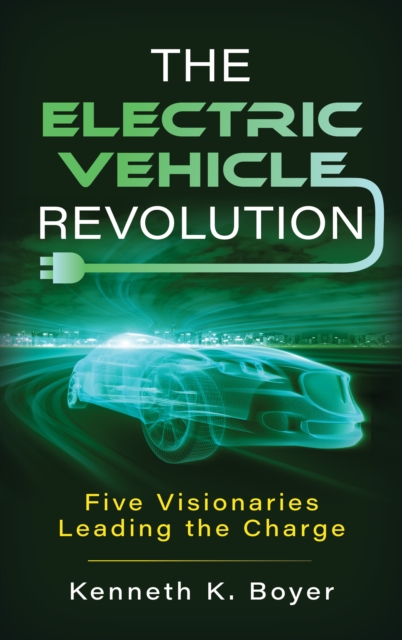
A Fascinating Look at the 5 Leading Personalities Driving the Transition to Electric Vehicles and Reinventing the Auto Industry The leading car manufacturing firms have all essentially pledged to transition from traditional carbon dioxide-emitting vehicles to battery-powered electric vehicles.
The selection of automobile body materials is fundamental to the choice of fabrication method, and the characteristics and performance of the final vehicle or component.
Multibody Systems Approach to Vehicle Dynamics aims to bridge a gap between the subject of classical vehicle dynamics and the general-purpose computer-based discipline known as multibody systems analysis (MBS).
ISO/TS 16949:2002 (TS2) will have a huge impact on the whole of the automobile industry as it formalises, under a single world-wide standard, the quality system that must be met by vehicle manufacturers and their suppliers.
Fluid Mechanics: An Intermediate Approach helps readers develop a physics-based understanding of complex flows and mathematically model them with accurate boundary conditions for numerical predictions.
Corrosion, Environmental Degradation, and Surface Engineering: Understanding, Mitigation, and Prevention offers an insightful exploration into the causes, mechanisms, and mitigation strategies of material degradation.