"e;The Secrets of Violin Playing"e; is a classic guide to playing the violin, dealing with every aspect from care and maintenance of the instrument to mastering the basics and avoiding common problems.
First published in 1890, this volume contains a detailed account of the history of the violin, exploring its fascinating history and evolution with reference to notable designers and makers from England, Ireland, and Scotland.
This book presents a unique view of the work of the great Italian violin-makers from the 17th to the 19th centuries, based on the collection of The Royal Academy of Music in London.
A 1959 New Yorker profile captured the inspired risk-taking and raw creative spark of a Budapest String Quartet rehearsal: "e;Sasha leaped from his chair and with violin held aloft, played the passage with exaggerated schmalz, like a street fiddler in Naples.
The last quarter of the twentieth-century saw a renewed interest in the hammered dulcimer in the United States at the grassroots level as well as from elements of the Folk Revival.
In the nineteenth century, use of the violone, a bass instrument with many sizes and variations, was nearly eliminated from musical repertoires, and its traditional parts were parceled out to other instruments such as the violoncello.
This book presents a unique view of the work of the great Italian violin-makers from the 17th to the 19th centuries, based on the collection of The Royal Academy of Music in London.
Written by a composer and a musician, The Contemporary Violin offers a unique menu of avant-garde musical possibilities that both performers and composers will enjoy exploring.
Exotic venues, sold-out concerts, and the companionship of the world's most powerful people have given classical guitarist Liona Boyd a lifestyle that, like her music, is one in a million.
Exotic venues, sold-out concerts, and the companionship of the world's most powerful people have given Liona Boyd a lifestyle that, like her music, is one in a million.
Exotic venues, sold-out concerts, and the companionship of the world's most powerful people have given Liona Boyd a lifestyle that, like her music, is one in a million.
Originally published in 1930, this little book is not an exposition of the art of violin-playing, nor does it claim to teach a system of technical study.
Originally published in 1921, this book was written in an attempt to, 'give the serious teacher and student the practical benefit of the knowledge acquired during a lifetime's playing the violin, including mechanical means and technical procedure as well as the ideas and ideals of art'.
While held hostage by fundamentalist Shi'ite militiamen in the suburbs of Beirut, Brian Keenan was visited and sustained by the presence of Turlough O'Carolan - the legendary blind Irish harper of the seventeenth century.
La escuela de la guitarra - Libro 3 forma parte de la reconocida metodología de Mario Rodríguez Arenas, un programa dividido en siete volúmenes que se ha convertido en referencia indispensable en la formación guitarrística en toda Hispanoamérica.
Narratives on famous guitarists and the extra details on guitar history are fine, but that's not what readers need or want when they are eager to master their new guitar.
In The Art of Listening, Anthony Arnone interviews 13 of the top cello teachers of our time, sharing valuable insights about performing, teaching, music, and life.
In The Art of Listening, Anthony Arnone interviews 13 of the top cello teachers of our time, sharing valuable insights about performing, teaching, music, and life.
These days the ukulele is experiencing a revolution-both as a valid instrument that can sweetly transform pop music and rock and roll, and as the focus of dozens of clubs springing up across the world.
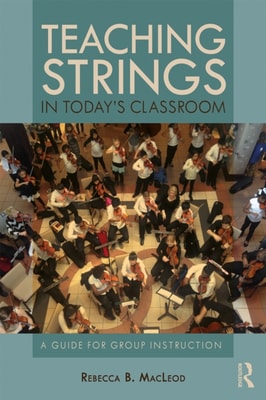
Teaching Strings in Today's Classroom: A Guide for Group Instruction assists music education students, in-service teachers, and performers to realize their goals of becoming effective string educators.
Teaching Strings in Today's Classroom: A Guide for Group Instruction assists music education students, in-service teachers, and performers to realize their goals of becoming effective string educators.
Tatjana Goldberg reveals the extent to which gender and socially constructed identity influenced female violinists' 'separate but unequal' status in a great male-dominated virtuoso lineage by focussing on the few that stood out: the American Maud Powell (1867-1920), Australian-born Alma Moodie (1898-1943), and the British Marie Hall (1884-1956).
Tatjana Goldberg reveals the extent to which gender and socially constructed identity influenced female violinists' 'separate but unequal' status in a great male-dominated virtuoso lineage by focussing on the few that stood out: the American Maud Powell (1867-1920), Australian-born Alma Moodie (1898-1943), and the British Marie Hall (1884-1956).
Ser requerido para versionar para cuarteto de cuerdas músicas del más destacado compositor de folklore argentino de los últimos 50 años es motivo de gran orgullo.