The Politics of Horror features contributions from scholars in a variety of fields-political science, English, communication studies, and others-that explore the connections between horror and politics.
This book addresses what a superhero body can do by developing several "e;x-rays"e; of the superbody's sensoria, anatomic structures, internal systems, cellular organizations, and orthotic, chemical, or technological enhancements.
This book presents close-readings of seven post-millennial comedic films: Up in the Air, Tropic Thunder, JCVD, Winnebago Man, The Trotsky, Be Kind Rewind, and Hamlet 2.
This book analyzes Walt Disney's impact on entertainment, new media, and consumer culture in terms of a materialist, psychoanalytic approach to fantasy.
In contrast to the main body of current Victorian detective criticism, which tends to concentrate on Conan Doyle's creation and only uses other detectives as a backdrop, the texts gathered in this volume examine various contemporary ways of (re)presenting real and fictional detectives that originated in or are otherwise associated with that era: Inspector Bucket, Sergeant Cuff, Inspector Reid, Tobias Gregson, Flaxman Low, and psychiatrists as detectives.
Japanese Horror and the Transnational Cinema of Sensations undertakes a critical reassessment of Japanese horror cinema by attending to its intermediality and transnational hybridity in relation to world horror cinema.
Despite the widely publicised prejudice faced by women in Hollywood, since around 1990 a significant minority of female directors have been making commercially and culturally impactful films there across the full range of genres.
The Formation of Chinese Art Cinema: 1990-2003 examines the development of Chinese art film in the People's Republic of China from 1990, when the first Sixth Generation film Mama was released, to 2003, when authorities acknowledged the legitimacy of underground filmmakers.
This book analyzes Hollywood storytelling that features an American crimefighter-whether cop, detective, or agent-who must safeguard society and the nation by any means necessary.
This edited book represents the first cohesive attempt to describe the literary genres of late-twentieth-century fiction in terms of lexico-grammatical patterns.
This book provides a corpus-led analysis of multi-word units (MWUs) in English, specifically fixed pairs of nouns which are linked by a conjunction, such as 'mum and dad', 'bride and groom' and 'law and order'.
Romantic comedy is an enduringly popular genre which has maintained its appeal by constantly evolving, from the screwball comedy to the recent emergence of the bromance.
A renowned movie critic on film’s treatment of one of mankind’s darkest behaviors: murder How many acts of murder have each of us followed on a screen?
Since the release in 1929 of a popular book series with bright yellow covers, the Italian word giallo (yellow) has come to define a whole spectrum of mystery and detective fiction and films.
This collection reads the science fiction genre and television medium as examples of heterotopia (and television as science fiction technology), in which forms, processes, and productions of space and time collide - a multiplicity of spaces produced and (re)configured.
This book studies American science fiction films depicting invasions of the USA and Earth by extra- terrestrials within the context of imperialism from 1950-2020.
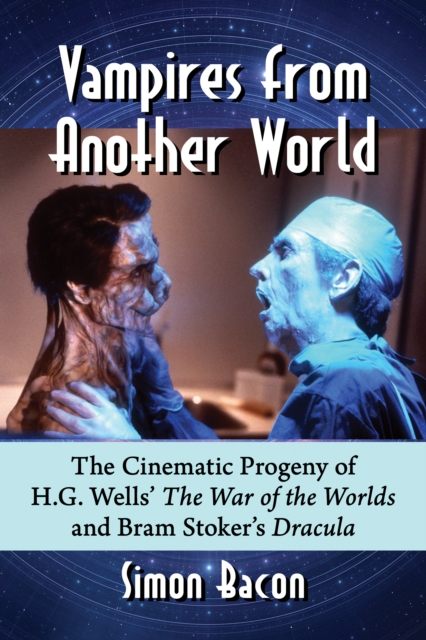
This book begins at the intersection of Dracula and War of the Worlds, both published in 1897 London, and describes the settings of Transylvania, Mars, and London as worlds linked by the body of the vampire.
The Science Fiction Film in Contemporary Hollywood focuses on the American science fiction (SF) film during the period 2001-2020, in order to provide a theoretical mapping of the genre in the context of Conglomerate Hollywood.
The Science Fiction Film in Contemporary Hollywood focuses on the American science fiction (SF) film during the period 2001-2020, in order to provide a theoretical mapping of the genre in the context of Conglomerate Hollywood.
This history of film noir explores the legacy and aesthetic roots of American filmmakers including Orson Welles, John Huston, Otto Preminger, and others.
This is a comprehensive overview of zombie movies in the first 11 years of the new millennium, the most dynamic and vital period yet in the history of the zombie genre.
With a new introduction, acclaimed director and screenwriter Paul Schrader revisits and updates his contemplation of slow cinema over the past fifty years.
This book features a cutting edge approach to the study of film adaptations of literature for children and young people, and the narratives about childhood those adaptations enact.
In this book, Simmons argues that class, as much as race and gender, played a significant role in the development of Gothic and Horror fiction in a national context.
With the recent release of spectacular blockbuster films from Gladiator to The Lord of the Rings trilogy, the epic has once again become a major form in contemporary cinema.