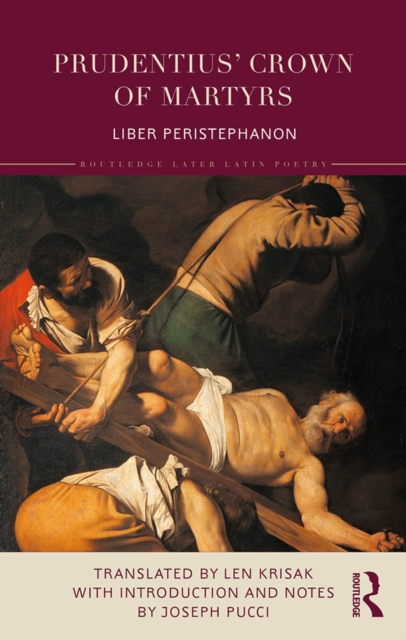
Prudentius' Crown of Martyrs offers an English translation, with introduction and commentary, of the Liber Peristephanon, Prudentius' vivid collection of lyric hymns in honor of Christian martyrs.
Ausonius provides translations of the key works of Ausonius, an important later Latin poet whose poems detail the social and cultural life of Gaul and its environment.
Latin Lyric and Elegiac Poetry, first published almost 25 years ago, offered students accurate and poetic translations of poems from the sudden flowering of lyric and elegy in Rome at the end of the Republic and in the first decades of the Augustan principate.
Combining faithfulness to the Latin with sensitivity to Prudentius' poetic qualities, Nicholas Richardson offers a precise yet creative verse translation of a major work by one of the most important Christian Latin poets of late antiquity.
Combining faithfulness to the Latin with sensitivity to Prudentius' poetic qualities, Nicholas Richardson offers a precise yet creative verse translation of a major work by one of the most important Christian Latin poets of late antiquity.
In this new edition of Greek and Roman Technology, the authors translate and annotate key passages from ancient texts to provide a history and analysis of the origins and development of technology in the classical world.
In this new edition of Greek and Roman Technology, the authors translate and annotate key passages from ancient texts to provide a history and analysis of the origins and development of technology in the classical world.
Martha Malamud provides the only scholarly English translation of De Reditu Suo with significant notes and commentary that explore historical, literary, cultural, and mythical references, as well as commenting on literary allusions, the structure, diction, and style of the poem, and textual issues.
Martha Malamud provides the only scholarly English translation of De Reditu Suo with significant notes and commentary that explore historical, literary, cultural, and mythical references, as well as commenting on literary allusions, the structure, diction, and style of the poem, and textual issues.
Dreambooks in Byzantium offers for the first time in English translation and with commentary six of the seven extant Byzantine oneirocritica, or manuals on the interpretation of dreams.
Dreambooks in Byzantium offers for the first time in English translation and with commentary six of the seven extant Byzantine oneirocritica, or manuals on the interpretation of dreams.
Recent attacks on contemporary art have portrayed the erotic content of works by Robert Mapplethorpe and others as if it were a deviation from the Western artistic tradition.
Recent attacks on contemporary art have portrayed the erotic content of works by Robert Mapplethorpe and others as if it were a deviation from the Western artistic tradition.
Plato's Timaeus was his only cosmological dialogue and for almost thirteen hundred years it provided the basis in the West for educated people's general view of the natural world.
Plato's Timaeus was his only cosmological dialogue and for almost thirteen hundred years it provided the basis in the West for educated people's general view of the natural world.
Women on the Edge, a collection of Alcestis, Medea, Helen, and Iphegenia at Aulis, provides a broad sample of Euripides' plays focusing on women, and spans the chronology of his surviving works, from the earliest, to his last, incomplete, and posthumously produced masterpiece.
Women on the Edge, a collection of Alcestis, Medea, Helen, and Iphegenia at Aulis, provides a broad sample of Euripides' plays focusing on women, and spans the chronology of his surviving works, from the earliest, to his last, incomplete, and posthumously produced masterpiece.
This indispensable volume provides a complete course on Latin erotic elegy, allowing students to trace a coherent narrative of the genre's rise and fall, and to understand its relationship to the changes that marked the collapse of the Roman republic, and the founding of the empire.
This indispensable volume provides a complete course on Latin erotic elegy, allowing students to trace a coherent narrative of the genre's rise and fall, and to understand its relationship to the changes that marked the collapse of the Roman republic, and the founding of the empire.
The Epicureans were notorious in antiquity for denigrating most forms of civic participation and for rejecting those cultural activities (such as poetry, music, and rhetoric) which are broadly labelled paideia.
The Epicureans were notorious in antiquity for denigrating most forms of civic participation and for rejecting those cultural activities (such as poetry, music, and rhetoric) which are broadly labelled paideia.
In one volume, this book brings together a new English translation of Plato's Meno, a selection of illuminating articles on themes in the dialogue published between 1965 and 1985 and an introduction setting the Meno in its historical context and opening up the key philosophical issues which the various articles discuss.