Machine Learning has become a key enabling technology for many engineering applications, investigating scientific questions and theoretical problems alike.
This volume contains the proceedings of the Latin American Theoretical Inf- matics (LATIN) conference that was held in Buenos Aires, Argentina, April 5-8, 2004.
In a dynamic computing environment, such as the Grid, resource management plays a crucial role for making distributed resources available on-demand to anyone from anywhere at any time without undermining the resource autonomy; this becomes an art when dealing with heterogeneous resources distributed under multiple trust domains spanning across the Internet.
Technology is taking us to a world where myriads of heavily networked devices interact with the physical world in multiple ways, and at many levels, from the globalInternetdowntomicroandnanodevices.
This volume contains all the papers presented at the Ninth International Con- rence on Algorithmic Learning Theory (ALT'98), held at the European education centre Europ*aisches Bildungszentrum (ebz) Otzenhausen, Germany, October 8{ 10, 1998.
TheexplosivegrowthoftheInternetandtheWebhavecreatedanever-growing demand for information systems, and ever-growing challenges for Information Systems Engineering.
Knowledge discovery and data mining have become areas of growing significance because of the recent increasing demand for KDD techniques, including those used in machine learning, databases, statistics, knowledge acquisition, data visualization, and high performance computing.
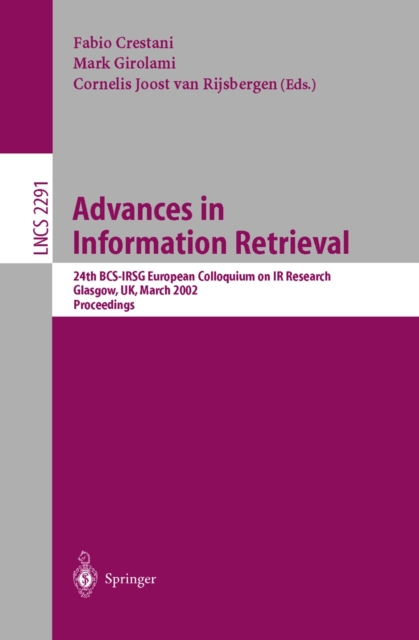
The annual colloquium on information retrieval research provides an opportunity for both new and established researchers to present papers describing work in progress or ?
We are proud to introduce the proceedings of the Sixth International Conference on Parallel Problem Solving from Nature, PPSN VI, held in Paris, Prance, on 18-20 September 2000.
The Fifth International Conference on Implementation and Application of - tomata (CIAA 2000) was held at the University of Western Ontario in London, Ontario, Canada on July 24-25, 2000.
Crypto 2001, the 21st Annual Crypto conference, was sponsored by the Int- national Association for Cryptologic Research (IACR) in cooperation with the IEEE Computer Society Technical Committee on Security and Privacy and the Computer Science Department of the University of California at Santa Barbara.
This volume of the Lecture Notes in Computer Science series provides a c- prehensive, state-of-the-art survey of recent advances in string processing and information retrieval.
This volume contains 29 submitted and 2 invited papers presented at the tenth East-European Conference on Advances in Databases and Information Systems (ADVIS 2003), which took place in Dresden, Germany, September 3-6, 2003.
A special mention for 2004 is in order for the new Doctoral Symposium Workshop where three young postdoc researchers organized an original setup and formula to bring PhD students together and allow them to submit their research proposals for selection.
Thepapersinthisvolumewereselectedforpresentationatthe10thInternational Computing and Combinatorics Conference (COCOON 2004), held on August 17-20, 2004 in Jeju Island, Korea.
The study of permutation complexity can be envisioned as a new kind of symbolic dynamics whose basic blocks are ordinal patterns, that is, permutations defined by the order relations among points in the orbits of dynamical systems.
Nowadays constraint satisfaction problems (CSPs) are ubiquitous in many different areas of computer science, from artificial intelligence and database systems to circuit design, network optimization, and theory of programming languages.
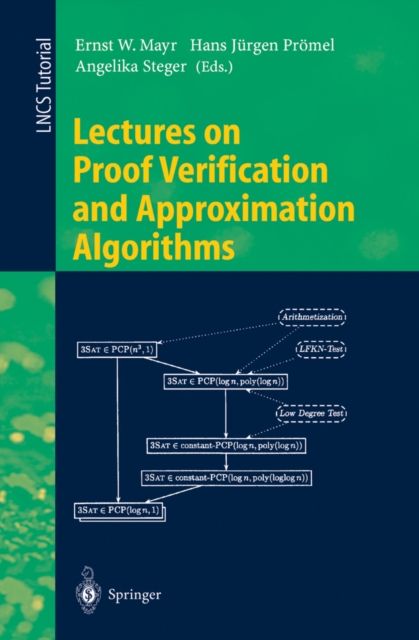
During the last few years, we have seen quite spectacular progress in the area of approximation algorithms: for several fundamental optimization problems we now actually know matching upper and lower bounds for their approximability.
Crypto 2002, the 22nd Annual Crypto Conference, was sponsored by IACR, the International Association for Cryptologic Research, in cooperation with the IEEE Computer Society Technical Committee on Security and Privacy and the Computer Science Department of the University of California at Santa Barbara.