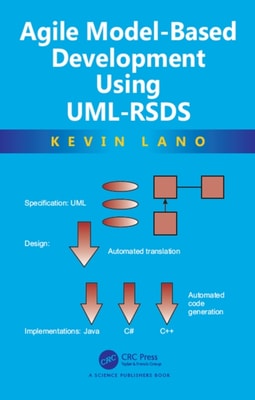
This book describes the concepts and application of model-based development (MBD), model transformations, and Agile MBD to a wide range of software systems.
Teach Your Students How to Use Computing to Explore Powerful and Creative IdeasIn the twenty-first century, computers have become indispensable in music making, distribution, performance, and consumption.
A student-friendly text, A Concise Introduction to Data Structures Using Java takes a developmental approach, starting with simpler concepts first and then building toward greater complexity.
Unlike other books about R, written from the perspective of statistics, this book is written from the perspective of programmers, providing a channel for programmers with expertise in other programming languages to quickly understand R.
Recursion is one of the most fundamental concepts in computer science and a key programming technique that allows computations to be carried out repeatedly.
Practical Guidance on the Efficient Development of High-Quality SoftwareIntroduction to Software Engineering, Second Edition equips students with the fundamentals to prepare them for satisfying careers as software engineers regardless of future changes in the field, even if the changes are unpredictable or disruptive in nature.
Understand advanced data analytics concepts such as time series and principal component analysis with ETL, supervised learning, and PySpark using Python.
Transition from a back-end developer to a full-stack developer with knowledge of all the dimensions of web application development, namely, front-end, back-end and server-side software.
Integrate MLOps principles into existing or future projects using MLFlow, operationalize your models, and deploy them in AWS SageMaker, Google Cloud, and Microsoft Azure.
Discover key information buried in the noise of data by learning a variety of anomaly detection techniques and using the Python programming language to build a robust service for anomaly detection against a variety of data types.
Get hands-on knowledge of how BERT (Bidirectional Encoder Representations from Transformers) can be used to develop question answering (QA) systems by using natural language processing (NLP) and deep learning.
Apply a methodology and practical solutions for monitoring the behavior of the Internet of Things (IoT), industrial control systems (ICS), and other critical network devices with the inexpensive Raspberry Pi.