Together, Big Data, high-performance computing, and complex environments create unprecedented opportunities for organizations to generate game-changing insights that are based on hard data.
Networked Control Systems (NCSs) are spatially distributed systems for which the communication between sensors, actuators and controllers is realized by a shared (wired or wireless) communication network.
Neural networks and neural dynamics are powerful approaches for the online solution of mathematical problems arising in many areas of science, engineering, and business.
Powerful, Flexible Tools for a Data-Driven WorldAs the data deluge continues in today's world, the need to master data mining, predictive analytics, and business analytics has never been greater.
Soft computing methods such as neural networks and genetic algorithms draw on the problem solving strategies of the natural world which differ fundamentally from the mathematically-based computing methods normally used in engineering.
Presenting a strong and clear relationship between theory and practice, Linear and Integer Optimization: Theory and Practice is divided into two main parts.
Healthcare Informatics: Improving Efficiency through Technology, Analytics, and Management supplies an understanding of the different types of healthcare service providers, corresponding information technologies, analytic methods, and data issues that play a vital role in transforming the healthcare industry.
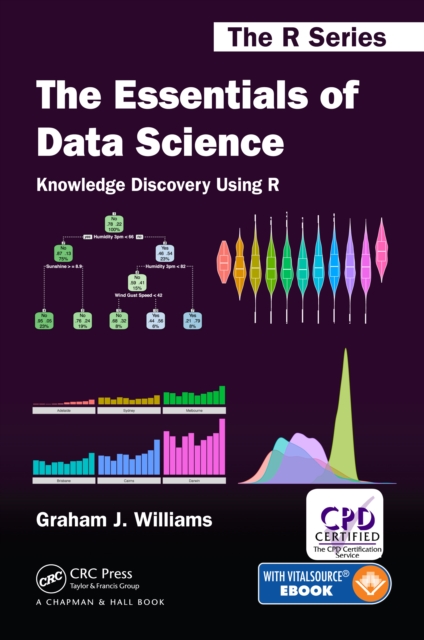
The Essentials of Data Science: Knowledge Discovery Using R presents the concepts of data science through a hands-on approach using free and open source software.
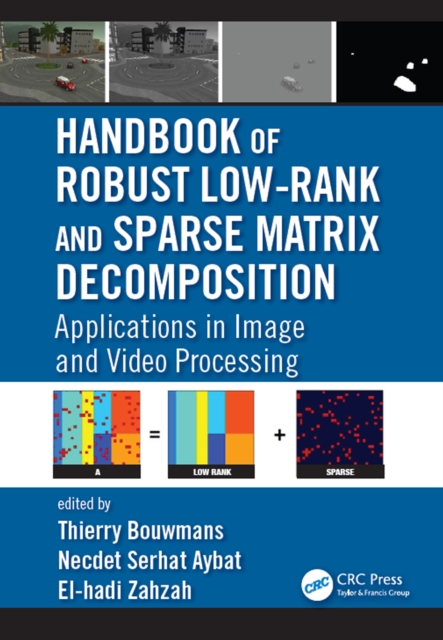
Handbook of Robust Low-Rank and Sparse Matrix Decomposition: Applications in Image and Video Processing shows you how robust subspace learning and tracking by decomposition into low-rank and sparse matrices provide a suitable framework for computer vision applications.
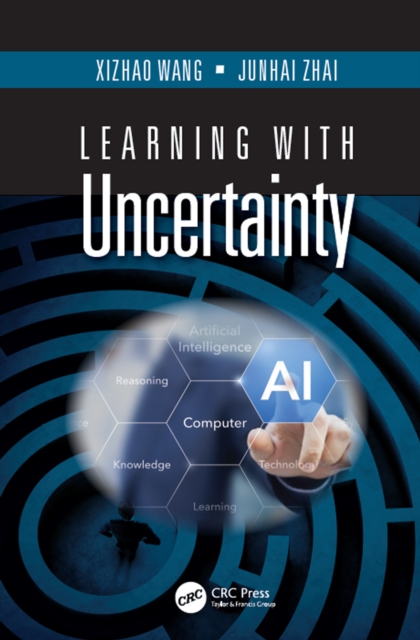
Learning with uncertainty covers a broad range of scenarios in machine learning, this book mainly focuses on: (1) Decision tree learning with uncertainty, (2) Clustering under uncertainty environment, (3) Active learning based on uncertainty criterion, and (4) Ensemble learning in a framework of uncertainty.
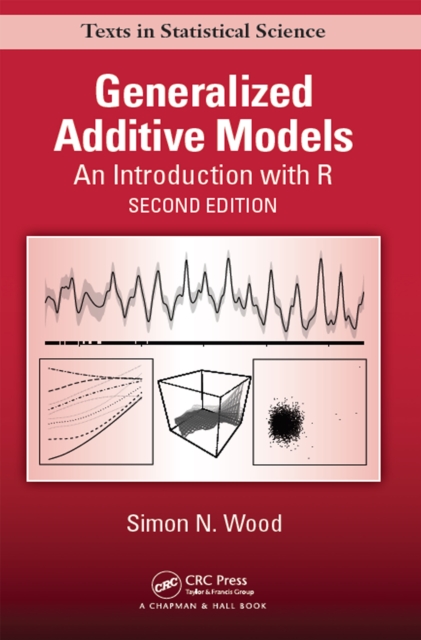
The first edition of this book has established itself as one of the leading references on generalized additive models (GAMs), and the only book on the topic to be introductory in nature with a wealth of practical examples and software implementation.
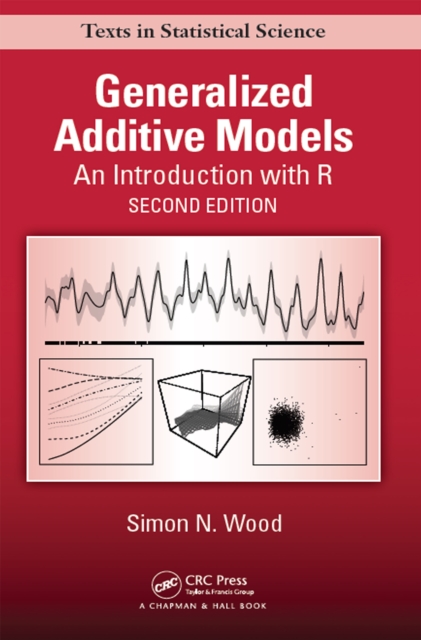
The first edition of this book has established itself as one of the leading references on generalized additive models (GAMs), and the only book on the topic to be introductory in nature with a wealth of practical examples and software implementation.
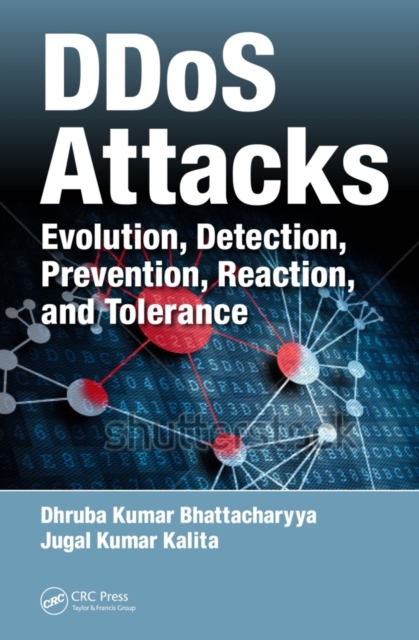
DDoS Attacks: Evolution, Detection, Prevention, Reaction, and Tolerance discusses the evolution of distributed denial-of-service (DDoS) attacks, how to detect a DDoS attack when one is mounted, how to prevent such attacks from taking place, and how to react when a DDoS attack is in progress, with the goal of tolerating the attack.
Big Data in Omics and Imaging: Association Analysis addresses the recent development of association analysis and machine learning for both population and family genomic data in sequencing era.
Discover New Methods for Dealing with High-Dimensional DataA sparse statistical model has only a small number of nonzero parameters or weights; therefore, it is much easier to estimate and interpret than a dense model.
This book explores the applicability of multiple remote sensors to acquire information relevant to restoration and conservation efforts in wetlands using data collected from airborne and space multispectral/hyperspectral sensors, light detection and ranging (LiDAR), Unmanned Aircraft Systems (UAS), and a hand-held spectroradiometer.
The first part of this book discusses institutions and mechanisms of algorithmic trading, market microstructure, high-frequency data and stylized facts, time and event aggregation, order book dynamics, trading strategies and algorithms, transaction costs, market impact and execution strategies, risk analysis, and management.
Understand advanced data analytics concepts such as time series and principal component analysis with ETL, supervised learning, and PySpark using Python.
Integrate MLOps principles into existing or future projects using MLFlow, operationalize your models, and deploy them in AWS SageMaker, Google Cloud, and Microsoft Azure.
So far, little effort has been devoted to developing practical approaches on how to develop and deploy AI systems that meet certain standards and principles.
Database developers and administrators will use this book to learn how to deploy machine learning models in Oracle Database and in Oracle's Autonomous Database cloud offering.
Get hands-on knowledge of how BERT (Bidirectional Encoder Representations from Transformers) can be used to develop question answering (QA) systems by using natural language processing (NLP) and deep learning.
Anomaly detection in video surveillance stands at the core of numerous real-world applications that have broad impact and generate significant academic and industrial value.
Data Science: A First Introduction with Python focuses on using the Python programming language in Jupyter notebooks to perform data manipulation and cleaning, create effective visualizations, and extract insights from data using classification, regression, clustering, and inference.
Mobile, wearable, and self-driving telephones are just a few examples of modern distributed networks that generate enormous amount of information every day.
Mobile, wearable, and self-driving telephones are just a few examples of modern distributed networks that generate enormous amount of information every day.
Understand the current and future research into technologies that underpin the increasing capabilities of automation technologies and their impact on the working world of the future.
As you move data to the cloud, you need to consider a comprehensive approach to data governance, along with well-defined and agreed-upon policies to ensure your organization meets compliance requirements.
As you move data to the cloud, you need to consider a comprehensive approach to data governance, along with well-defined and agreed-upon policies to ensure your organization meets compliance requirements.