Low Power Design in Deep Submicron Electronics deals with the different aspects of low power design for deep submicron electronics at all levels of abstraction from system level to circuit level and technology.
Dynamic power management is a design methodology aiming at controlling performance and power levels of digital circuits and systems, with the goal of extending the autonomous operation time of battery-powered systems, providing graceful performance degradation when supply energy is limited, and adapting power dissipation to satisfy environmental constraints.
High-Level Power Analysis and Optimization presents a comprehensive description of power analysis and optimization techniques at the higher (architecture and behavior) levels of the design hierarchy, which are often the levels that yield the most power savings.
Standardization of hardware description languages and the availability of synthesis tools has brought about a remarkable increase in the productivity of hardware designers.
Since the establishment of the CAAD Futures Foundation in 1985, CAAD experts from all over the world meet every two years to present and document the state of the art of research in Computer Aided Architectural Design.
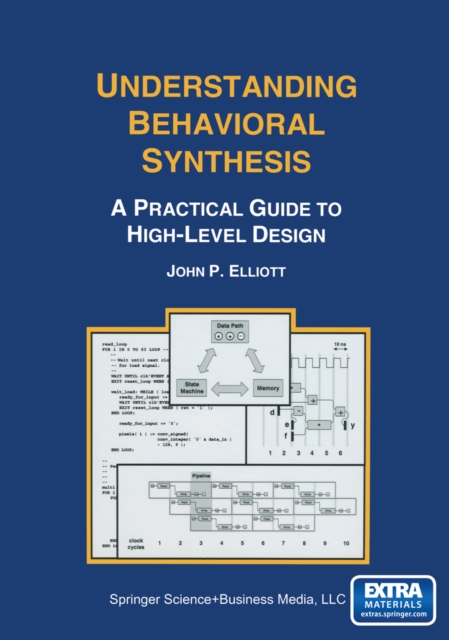
Behavioral Synthesis: A Practical Guide to High-Level Design includes details on new material and new interpretations of old material with an emphasis on practical information.
Formal Semantics and Proof Techniques for Optimizing VHDL Models presents a formal model of VHDL that clearly specifies both the static and dynamic semantics of VHDL.
Since their introduction in 1984, Field-Programmable Gate Arrays (FPGAs) have become one of the most popular implementation media for digital circuits and have grown into a $2 billion per year industry.
The Verilog language is a hardware description language which provides a means of specifying a digital system at a wide range of levels of abstraction.
For the near future, the recent predictions and roadmaps of silicon semiconductor technology all agree that the number of transistors on a chip will keep growing exponentially according to Moore's Law, pushing technology towards the system-on-a-chip (SOC) era.
system is a complex object containing a significant percentage of elec- A tronics that interacts with the Real World (physical environments, humans, etc.
This book presents an updated selection of the most representative contributions to the 2nd and 3rd IEEE Workshops on Signal Propagation on Interconnects (SPI) which were held in Travemtinde (Baltic See Side), Germany, May 13-15, 1998, and in Titisee-Neustadt (Black Forest), Germany, May 19-21, 1999.
Appropriate for use as a graduate text or a professional reference, Languages for Digital Embedded Systems is the first detailed, broad survey of hardware and software description languages for embedded system design.
Research on high-level synthesis started over twenty years ago, but lower-level tools were not available to seriously support the insertion of high-level synthesis into the mainstream design methodology.
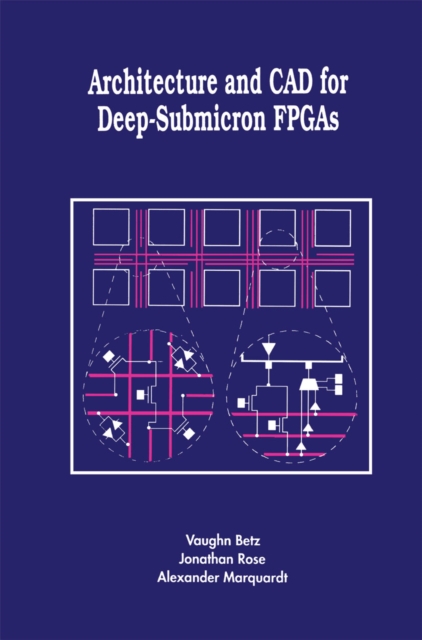
Field-Programmable Gate Arrays (FPGAs) have emerged as an attractive means of implementing logic circuits, providing instant manufacturing turnaround and negligible prototype costs.
As MOS devices are scaled to meet increasingly demanding circuit specifications, process variations have a greater effect on the reliability of circuit performance.
The ever-increasing miniaturization of digital electronic components is hampering the conventional testing of Printed Circuit Boards (PCBs) by means of bed-of-nails fixtures.