Interconnect Technology and Design for Gigascale Integration is the cumulative effort from academic researchers at Georgia Tech, MIT, and Stanford, as well as from industry researchers at IBM T.
Legacy Data: A Structured Methodology For Device Migration in DSM Technology deals with the migration of existing hard IP from one technology to another using repeatable procedures.
System-on-Chip for Real-Time Applications will be of interest to engineers, both in industry and academia, working in the area of SoC VLSI design and application.
Multi-Threshold CMOS Digital Circuits Managing Leakage Power discusses the Multi-threshold voltage CMOS (MTCMOS) technology, that has emerged as an increasingly popular technique to control the escalating leakage power, while maintaining high performance.
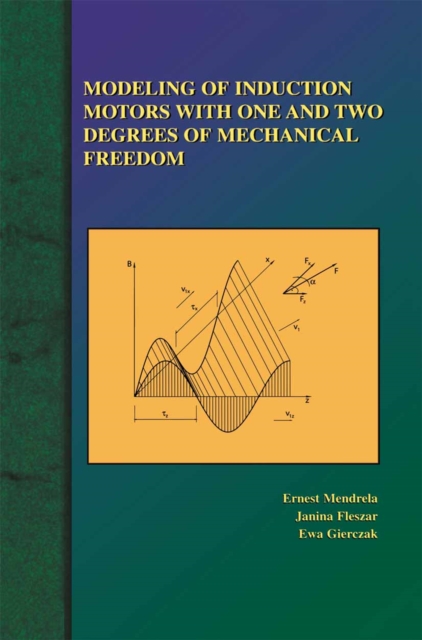
Modeling of Induction Motors with One and Two Degrees of Mechanical Freedom presents the mathematical model of induction motors with two degrees of mechanical freedom (IM-2DMF), formed in the electromagnetic field as well as in circuit theory, which allows analyzing the performance of these three groups of motors taking into account edge effects, winding and current asymmetry.
The application of CMOS circuits and ASIC VLSI systems to problems in medicine and system biology has led to the emergence of Bio/CMOS Interfaces and Co-Design as an exciting and rapidly growing area of research.
This book presents physical understanding, modeling and simulation, on-chip characterization, layout solutions, and design techniques that are effective to enhance the reliability of various circuit units.
As embedded systems become more complex, designers face a number of challenges at different levels: they need to boost performance, while keeping energy consumption as low as possible, they need to reuse existent software code, and at the same time they need to take advantage of the extra logic available in the chip, represented by multiple processors working together.
Technology computer-aided design, or TCAD, is critical to today's semiconductor technology and anybody working in this industry needs to know something about TCAD.
Based on the highly successful second edition, this extended edition of SystemVerilog for Verification: A Guide to Learning the Testbench Language Features teaches all verification features of the SystemVerilog language, providing hundreds of examples to clearly explain the concepts and basic fundamentals.
Since process variation and chip performance uncertainties have become more pronounced as technologies scale down into the nanometer regime, accurate and efficient modeling or characterization of variations from the device to the architecture level have become imperative for the successful design of VLSI chips.
This book presents novel research techniques, algorithms, methodologies and experimental results for high level power estimation and power aware high-level synthesis.
To satisfy the higher requirements of digitally converged embedded systems, this book describes heterogeneous multicore technology that uses various kinds of low-power embedded processor cores on a single chip.
This book presents innovative solutions for the implementation of Sigma-Delta Modulation (SDM) based Analog-to-Digital Conversion (ADC), required for the next generation of wireless hand-held terminals.
This book to offers a hands-on guide to designing, analyzing and debugging a communication infrastructure based on the Controller Area Network (CAN) bus.
The book covers the CMOS-based millimeter wave circuits and devices and presents methods and design techniques to use CMOS technology for circuits operating beyond 100 GHz.
The present volume contains the papers which were accepted for presentation at the 3rd International Symposium for Systems Analysis and Simulation held in Berlin (GDR), September 12-:-16, 1988.
The roots of the project which culminates with the writing of this book can be traced to the work on logic synthesis started in 1979 at the IBM Watson Research Center and at University of California, Berkeley.
This monograph represents a summary of our work in the last two years in applying the method of simulated annealing to the solution of problems that arise in the physical design of VLSI circuits.
This volume contains the proceedings of a workshop on Analog Integrated Neural Systems held May 8, 1989, in connection with the International Symposium on Circuits and Systems.
The advent of computer aided design and the proliferation of computer aided design tools have been instrumental in furthering the state-of-the- art in integrated circuitry.
The summer school on VLSf GAD Tools and Applications was held from July 21 through August 1, 1986 at Beatenberg in the beautiful Bernese Oberland in Switzerland.
Very large scale integration (VLSI) technologies are now maturing with a current emphasis toward submicron structures and sophisticated applications combining digital as well as analog circuits on a single chip.
Recently there has been increased interest in the development of computer-aided design programs to support the system level designer of integrated circuits more actively.
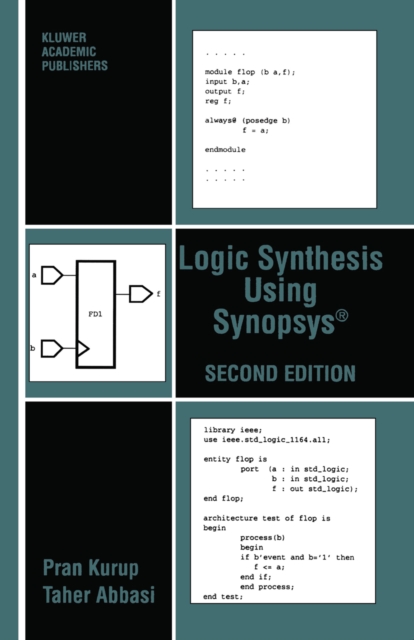
Logic Synthesis Using Synopsys(R), Second Edition is for anyone who hates reading manuals but would still like to learn logic synthesis as practised in the real world.
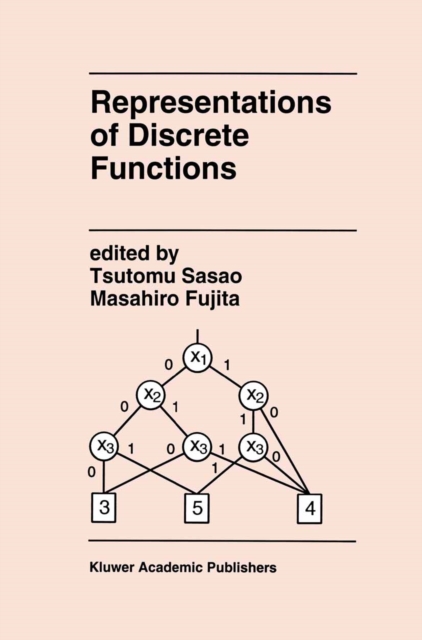
Representations of Discrete Functions is an edited volume containing 13 chapter contributions from leading researchers with a focus on the latest research results.
Symbolic Boolean manipulation using binary decision diagrams (BDDs) has been successfully applied to a wide variety of tasks, particularly in very large scale integration (VLSI) computer-aided design (CAD).
Software Synthesis from Dataflow Graphs addresses the problem of generating efficient software implementations from applications specified as synchronous dataflow graphs for programmable digital signal processors (DSPs) used in embedded real- time systems.