Results from Census 2000 have confirmed that American cities and metropolitan areas lie at the heart of the nation's most pronounced demographic and economic changes.
A Brookings Institution Press and Harvard University Joint Center for Housing Studies publicationA generation ago little attention was focused on low-income homeownership.
As urbanization of the world's population grows at an ever-increasing pace, the need to understand the effects of globalization on cities is at the forefront of urban studies.
The contributors of Policy, Planning, and People argue for the promotion of social equity and quality of life by designing and evaluating urban policies and plans.
In light of concerns about food and human health, fraying social ties, economic uncertainty, and rampant consumerism, some people are foregoing a hurried, distracted existence and embracing a mindful way of living.
In light of concerns about food and human health, fraying social ties, economic uncertainty, and rampant consumerism, some people are foregoing a hurried, distracted existence and embracing a mindful way of living.
The application of internet of things (IoT) technologies and artificial intelligence (AI)-enabled IoT solutions has gradually become accepted by business and production organizations as an effective tool for automating several activities effectively and efficiently and developing and distributing products to the global market.
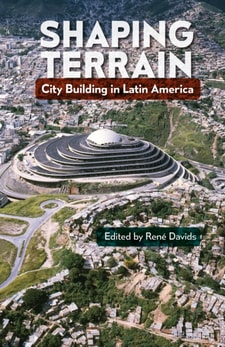
Shaping Terrain shows how the physical landscape and local ecology have influenced human settlement and built form in Latin America since pre-Columbian times.
Losing It All to Sprawl is the poignant chronicle of award-winning nature writer Bill Belleville and how he came to understand and love his historic Cracker farmhouse and "e;relic"e; neighborhood in central Florida, even as it was all wiped out from under him.
Beyond Health Capacity: Spatial Practices in Inclusive Design sheds light on the systemic challenges communities with limited access to medical support and health maintenance have endured.
In the twenty-first century, cities in the United States that had suffered most the shift to a postindustrial era entered a period widely proclaimed as an urban renaissance.
Whether struggling in the wake of postindustrial decay or reinventing themselves with new technologies and populations, cities have once again moved to the center of intellectual and political concern.
Small and midsized cities played a key role in the Industrial Revolution in the United States as hubs for the shipping, warehousing, and distribution of manufactured products.
As the only American city under direct congressional control, Washington has served historically as a testing ground for federal policy initiatives and social experimentswith decidedly mixed results.
Nineteenth-century landscape architect Frederick Law Olmsted described his most famous project, the design of New York's Central Park, as "e;a democratic development of highest significance.
Urban transportation problems abound across America, including jammed highways during rush-hours, deteriorating bus service, and strong pressures to build new rail systems.
Engineering Swarms for Cyber-Physical Systems covers the whole design cycle for applying swarm intelligence in Cyber-Physical Systems (CPS) and guides readers through modeling, design, simulation, and final deployment of swarm systems.
Urban Mobility Development in Northeast India theoretically and empirically explores the interrelationship between and among city, transportation, economic growth and environment to contribute towards engendering green urbanization for green growth.
In essays that capture the multiple aspects of urban life, contributors examine European cities through the lenses of history, literature, art, architecture, and music.
Samuel Koteliansky (1880-1955) fled the pogroms of Russia in 1911 and established himself as a friend of many of Britain's literati and intellectuals, who were fascinated by his homeland's more civilized side: the Ballets Russes, Tolstoy, Dostoevsky, and Chekhov.
Policies promoting Toronto as a global city and provincial economic engine have been seen as beneficial to the development of all of Ontario, yet much of the province has borne significant environmental, social, economic, and political costs as a result of one city's growth.