This doctoral thesis presents a novel approach to landslide risk assessment that explores the various dimensions of landslide risk in an integrated perspective.
This edited volume emphasizes risk and crisis communication principles and practices within the up-to the minute context of new technologies, a new focus on resiliency, and global environmental change.
This book introduces a new way of analyzing, measuring and thinking about mega-risks, a "e;paradigm shift"e; that moves from single-solutions to multiple competitive solutions and strategies.
More than a simple monograph, the authors present a comprehensive geomorphic overview of a large tropical region where they show how deciphering the long-term landform evolution helps understanding the present set of landscapes and morphodynamic environments.
This book examines the reasons behind the resonant amplification of seismic and ocean waves that have the capacity to destroy cities and ocean-going vessels.
This book introduces a methodology for solving the seismic inverse problem using purely numerical solutions built on 3D wave equations and which is free of the approximations or simplifications that are common in classical seismic inversion methodologies and therefore applicable to arbitrary 3D geological media and seismic source models.
This book presents geomorphological and sedimentological aspects of Holocene boulder ridges along the coastline of western Ireland (the Aran Islands and Galway Bay).
The subject of tropical cyclones in Southern Africa, also known as hurricanes or typhoons in other regions of the world, has been growing over the past few decades.
This book assists the reader in determining storm risks, focussing on sandy coasts and cliff coasts in the context of expected sea level rise from littoral transformation and climate change.
This book examines old and new data on some of the 18th and 19th century earthquakes that either occurred or were clearly felt in southern regions of Poland.
This book presents a multiregional input-output model for the metropolitan area of Southern California, which helps to estimate the economic impact of simulated terrorist attacks on seaports, malls etc.
This book is devoted to current advances in the field of nonlinear mathematical physics and modeling of critical phenomena that can lead to catastrophic events.
This book offers a high-level summary of shallow magmatic systems (dykes, sills and laccoliths) to support geoscience master and PhD students, scientists and practicing professionals.
The book encompasses a set of papers on meteorological tsunamis covering various aspects on this rare but potentially destructive multiresonant phenomenon.
This book describes the iterative steps that were successfully undertaken to develop adaptation measures to climate change in two Vietnamese provinces.
Presented here is the story of the mining and sale of uranium and radium ore through biographical vignettes, chemistry, physics, geology, geography, occupational health, medical utilization, environmental safety and industrial history.
This book contains the refereed proceedings of the First International Conference on Information Systems for Crisis Response and Management in Mediterranean Countries, ISCRAM-med 2014, held in Toulouse, France, in October 2014.
This book offers a broad perspective on important topics in earthquake geotechnical engineering and gives specialists and those that are involved with research and application a more comprehensive understanding about the various topics.
This book is a compilation of papers contributed by researchers and scientists from SAARC nations and deals with high-impact weather conditions, their prediction and potential consequences for populations in the SAARC region.
This book brings together in a single volume a grand overview of solutions - political, economic, and scientific - to social and environmental problems that are related to the growth of human populations in areas that can least cope with them now.
The present work will discuss relevant theoretical frameworks and applications pertaining to enabling resilience within the risk, crisis and disaster management domain.
This volume discusses the general physics of debris flows and various approaches to modeling - including the SEGMENT-Landslide approach - as well as the pros and cons of these approaches and how other approaches are sub-sets of the SEGMENT-Landslide approach.
This book explores economic concepts related to disaster losses, describes mechanisms that determine the economic consequences of a disaster, and reviews methodologies for making decisions regarding risk management and adaptation.
This volume contains peer-reviewed papers from the Third World Landslide Forum organized by the International Consortium on Landslides (ICL) in June 2014.
This volume contains peer-reviewed papers from the Third World Landslide Forum organized by the International Consortium on Landslides (ICL) in June 2014.
This book documents the outcomes of a study designed to explore ways of increasing resilience in a complex city system against disasters by focusing on the transportation system in London.
This book offers a systematic, empirical examination of the concepts of disasters and sustainable economic development applied to many cases around the world.
This book presents the latest research developments in geoinformation science, which includes all the sub-disciplines of the field, such as: geomatic engineering, GIS, remote sensing, digital photogrammetry, digital cartography, etc.
The book is mainly addressed to young graduate students in engineering and natural sciences who start to face numerical simulation, either at a research level or in the field of industrial applications.
Geophysical mass flows, such as landslides, avalanches or debris flows, are frequent mass movement processes in mountain areas and often cause disastrous damage.
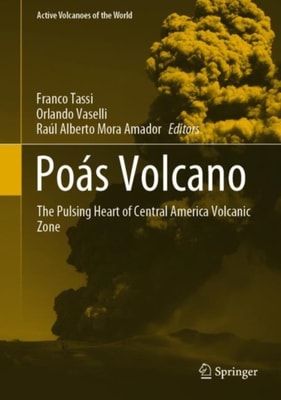
This book provides a comprehensive description of the volcanological, petrological and geochemical features of the Poas Volcano (Costa Rica), one of the most active volcanic systems in Central America and part of the Central America Volcanic Arc (CAVA).