Corporate sustainability, corporate social responsibility, corporate citizenship and corporate reputation are without a doubt 'hot topics' for today's business.
Risk communication helps companies, governments and institutions minimise disputes, resolve issues and anticipate problems before they result in an irreversible breakdown in communications.
The Role of Business Ethics in Economic Performance is a major edited collection of papers on why and how the conduct of business behaviour effects its commercial success.
A critical perspective on the foundations of economic theory showing the importance of ethical considerations and focusing in particular on altruism, cooperation and equity.
In this new collection of articles on talent acquisition and retention, Adrian Furnham, author of The Elephant in the Boardroom , offers an engaging and witty look into the world of the talented manager.
The recent financial crisis has awakened a renewed sensibility to ethics in business and management, and an increasing interest in a better understanding of how ethics and economics are intertwined.
Corporations in conflict zones and their provision of security are particularly relevant for understanding whether private actors are increasingly sources of governance contributions that regulate public goods.
Patricia Illingworth's short, powerful and passionate book argues that "e;social capital"e; should be an essential ethical concept guiding our actions, and explains how one might go about implementing this idea in a positive way.
An exploration of the interplay between social responsibility, entrepreneurship and the common good which is organized into four sections: business and the common good; educating responsible entrepreneurs; corporate social responsibility (CSR) challenges and the common good; and CSR and entrepreneurship in emerging economies
Corporate strategy expert Prakash Sethi takes an in-depth look at global structures and how regulation works from a corporate perspective, providing case studies of several industries and governments who have begun implementing voluntary codes of conducts, including Equator Principles, ICMM, and The Kimberly Process.
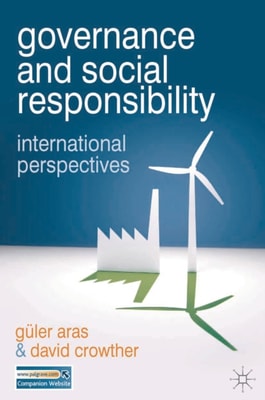
Recent corporate failures have attracted the attention of managers, governments and the general public to the role of governance and social responsibility.
Making the Invisible Visible is a study of Asian Americans in the workplace and provides a framework through which to transform the same qualities that are contributing to this invisibility phenomenon into a positive leadership approach that provides a counterweight to balance the showmanship approach to leadership.
Explores how companies engage in CSR activities, how their corporate identity determines the way in which they perceive the stakeholders and, as a result, engage in dialogue-based relations with them.
The Global Financial Crisis is acknowledged to be the most severe economic downturn since the 1930s, and one that is unique in its underlying causes, its scope, and its wider social, political and economic implications.
This book focuses on the concepts of social capital, corporate social responsibility, and economic development in relation to economic theory of institutions and behavioural economics.
Servant-leadership may be the answer to the current demand for a more ethical, people-centred leadership where humility, servitude and contribution are key elements.
This business law course offers a comprehensive introduction to the fundamental legal principles and ethical considerations essential for any business professional.
Written in the European tradition of Kant's philosophical trilogy on critique and Hegel's concept of ethical life it outlines the great traditions in ethical philosophy: Aristotelian virtue ethics, Kantian ethics, and utilitarianism.