Our prosperity requires the enterprise of innumerable individuals and businesses who exercise their imagination and judgment-and bear responsibility for outcomes.
Our prosperity requires the enterprise of innumerable individuals and businesses who exercise their imagination and judgment-and bear responsibility for outcomes.
Originally written for a conference of the Federal Reserve, Gary Gorton's "e;The Panic of 2007"e; garnered enormous attention and is considered by many to be the most convincing take on the recent economic meltdown.
"e;Of all the economic bubbles that have been pricked,"e; the editors of The Economist recently observed, "e;few have burst more spectacularly than the reputation of economics itself.
"e;Of all the economic bubbles that have been pricked,"e; the editors of The Economist recently observed, "e;few have burst more spectacularly than the reputation of economics itself.
Originally written for a conference of the Federal Reserve, Gary Gorton's "e;The Panic of 2007"e; garnered enormous attention and is considered by many to be the most convincing take on the recent economic meltdown.
International institutions, from the International Monetary Fund to the International Olympic Committee, are perceived as bastions of sclerotic mediocrity at best and outright corruption at worst, and this perception is generally not far off the mark.
In The Global Financial Crisis, contributors argue that the complexity of the Global Financial Crisis challenges researchers to offer more comprehensive explanations by extending the scope and range of their traditional investigations.
Risk and Hyperconnectivity brings together for the first time three paradigms: new risk theory, neoliberalization theory, and connectivity theory, to illuminate how the kaleidoscope of risk events in the opening years of the new century has recharged a neoliberal battlespace of media, economy, and security.
Risk and Hyperconnectivity brings together for the first time three paradigms: new risk theory, neoliberalization theory, and connectivity theory, to illuminate how the kaleidoscope of risk events in the opening years of the new century has recharged a neoliberal battlespace of media, economy, and security.
The Great Financial Crisis that began in 2007 reminds us with devastating force that financial instability and crises are endemic to capitalist economies, and that it is only strong and dynamically-changing financial regulations that can keep the damage caused by these crises within bounds.
The Great Financial Crisis that began in 2007 reminds us with devastating force that financial instability and crises are endemic to capitalist economies, and that it is only strong and dynamically-changing financial regulations that can keep the damage caused by these crises within bounds.
In recent years, the world has been rocked by major economic crises, most notably the devastating collapse of Lehman Brothers, the largest bankruptcy in American history, which triggered the breathtakingly destructive sub-prime disaster.
In recent years, the world has been rocked by major economic crises, most notably the devastating collapse of Lehman Brothers, the largest bankruptcy in American history, which triggered the breathtakingly destructive sub-prime disaster.
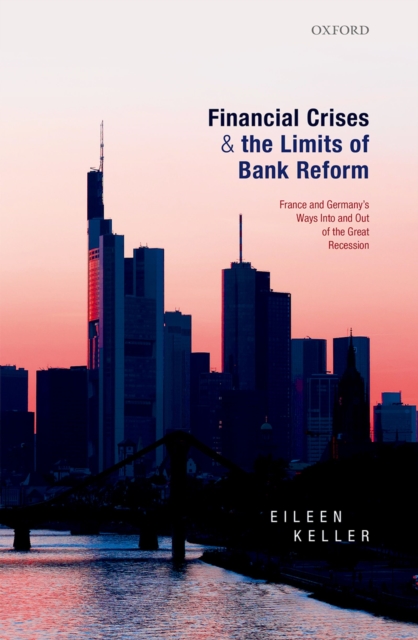
Financial Crises and the Limits of Bank Reform examines the responses that were implemented in France and Germany, two comparable European economies, in the aftermath of the global financial crisis from 2007/2008 with respect to the future economic role of the banks.
Financial Crises and the Limits of Bank Reform examines the responses that were implemented in France and Germany, two comparable European economies, in the aftermath of the global financial crisis from 2007/2008 with respect to the future economic role of the banks.
This book provides the first comprehensive account of post-crisis international regulation of derivatives by bringing together the international relations literature on regime complexity and the international political economy literature on financial regulation.
This book provides the first comprehensive account of post-crisis international regulation of derivatives by bringing together the international relations literature on regime complexity and the international political economy literature on financial regulation.
Democracy in a Time of Misery: From Spectacular Tragedy to Deliberative Action investigates how democratic politics can unfold in creative and unexpected of ways even at the most trying of times.
Democracy in a Time of Misery: From Spectacular Tragedy to Deliberative Action investigates how democratic politics can unfold in creative and unexpected of ways even at the most trying of times.
Barely two decades after the Asian financial crisis Asia was suddenly confronted with multiple challenges originating outside the region: the 2008 global financial crisis, the European debt crisis, and finally developed economies' implementation of unconventional monetary policies.
Barely two decades after the Asian financial crisis Asia was suddenly confronted with multiple challenges originating outside the region: the 2008 global financial crisis, the European debt crisis, and finally developed economies' implementation of unconventional monetary policies.
The UK and Multi-level Financial Regulation examines the role of the United Kingdom (UK) in shaping post-crisis financial regulatory reform, and assesses the implications of the UK's withdrawal from the European Union (EU).