In international commentary and debate on the effects of the Great Recession and austerity, Ireland has been hailed as the poster child for economic recovery and regeneration out of deep economic and fiscal contraction.
As the world's political and economic leaders struggle with the aftermath of the Financial Debacle of 2008, this book asks the question: have financial crises presented opportunities to rebuild the financial system?
The so-called Great Recession that followed the global financial crisis at the end of 2007 was the largest economic downturn since the 1930s for most rich countries.
This volume uses state of the art models from the frontier of macroeconomics to answer key questions about how the economy functions and how policy should be conducted.
The quality of working life has been central to the sociological agenda for several decades, and has also been increasingly salient as a policy issue, and for companies.
Economics and political economy lack the analytical tools to explain the differing impact of the recent international financial crisis that erupted in 2007 on developed economies.
By 2000, Ireland had achieved a remarkable macroeconomic performance: 10% economic growth annually, a budget surplus, and a very low debt to GDP ratio.
This book aims to identify and analyze the impact of the 2007-09 global financial crisis on Asian economies and to assess the short-term and longer-term policy responses to the crisis in terms of their effectiveness and sustainability.
The worldwide financial crisis has wrought deep changes in capital and labor markets, old-age retirement systems, and household retirement and consumption patterns.
The financial crisis of 2008 aroused widespread interest in banking and financial history among policy makers, academics, journalists, and even bankers, in addition to the wider public.
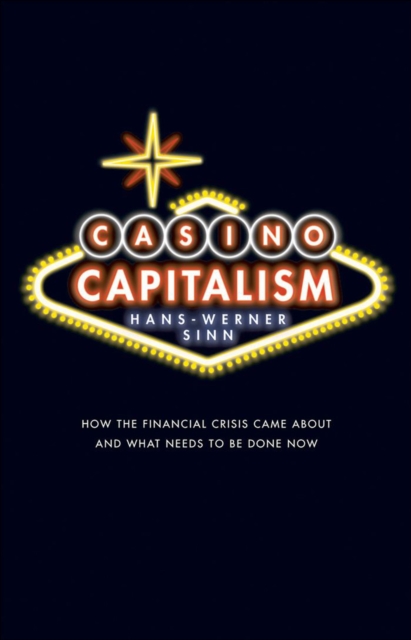
In Casino Capitalism Hans-Werner Sinn examines the causes of the banking crisis, points out the flaws in the economic rescue packages, and presents a master plan for the reform of financial markets.
The 1997 Asian Crisis principally affected Thailand, Indonesia, Malaysia, and Korea, as well as other East Asian countries heavily dependent on intra-regional trade.
Offering an analytical perspective on the design and reform of the international financial architecture, this book stresses the important role played by creditor co-ordination problems in the origin and management of crises by relating the insights of the new literature on global games to earlier work on currency crises, bank runs, and sovereign debt default.
Stochastic volatility is the main concept used in the fields of financial economics and mathematical finance to deal with time-varying volatility in financial markets.
This book revisits John Kenneth Galbraith's classic text The Affluent Society in the context of the background to, and causes of, the global economic crisis that erupted in 2008.
In London, the world's foremost financial centre, the week before the outbreak of the First World War saw the breakdown of the markets, culminating with the closure for the first time ever of the London Stock Exchange on Friday 31 July.
The interventions of crisis management during the 2007 to 2011 financial crisis were not simply responses to a set of given developments in markets, banking or neo-liberal capitalism.
After the Crisis reassesses the twin projects of structural reform and European integration in the wake of the Great Recession and the European Sovereign Debt Crisis.
This volume provides an accessible and up-to-date account of the difficulties that the Zimbabwean economy and its population experienced during the crisis which peaked in 2008.
The 2008 global financial crisis, together with the experience of de-industrialization across Western Europe over the last three decades, has focussed attention on financial regulation and industrial policy.