The new research method presented in this book ensures that all economic theories are falsifiable and that irrefutable theories are scientifically sound.
This book is the result of recent research by contemporary scientists on topics which were discussed at the conference of the same name in Volgograd, Russia in April 2017.
This book links the philosophical perception of time and Einstein's theory of special relativity to economic processes, showing that the phenomena of time dilation and length contraction seen in physics can be identified within - and adapted to - an economic framework.
Since the days of Lev Pontryagin and his associates, the discipline of Optimal Control has enjoyed a tremendous upswing - not only in terms of its mathematical foundations, but also with regard to numerous fields of application, which have given rise to highly active research areas.
This second volume, Basics of a Liberal Psychological, Social and Moral Order, overviews developments in the theory of spontaneously ordered complex phenomena, the psychology of inference and expectation, the nature of anticipatory systems in the psychological and economic domains, and the evolution of scientific thought and knowledge.
This book takes readers on a journey through the wide universe of bioethics, raising the following question: what is the proper attitude towards health, life, and death from the perspective of contemporary behavioral economics?
When we talk about clusters, it's the fabulous destiny of Silicon Valley that first comes to mind - the place where entrepreneurs and policymakers alike flock.
This book presents an authoritative collection of contributions reporting on fuzzy logic and decision theory, together with applications and case studies in economics and management science.
Common wealth dividends are universal cash payments funded by fees on the private use of common resources like land, minerals, and the atmosphere as a carbon sink.
This book is at the cutting edge of the ongoing research in bioeconomy and encompasses both technological and economic strategies to master the transformation towards a knowledge- and bio-based production system.
This book, the second of two volumes, is inspired by the famous philosopher of India, Kautilya, author of the first book on economics in the world, Arthashashtra.
This edited volume proposes that the phenomenon of private sector, financialized higher education expansion in the United States benefits from a range of theoretical and methodological treatments.
This book covers the proceedings from the 2016 International Symposium on Chaos, Complexity and Leadership, and reflects current research results of chaos and complexity studies and their applications in various fields.
This important textbook has been revised and updated to continue its focus on the link between ethics and economic policy analysis, whilst ensuring that perspectives addressing the moral limits of the market, latest behavioural economics literature, and the changes in inequality over the years are included.
This handbook presents emerging research exploring the theoretical and practical aspects of econometric techniques for the financial sector and their applications in economics.
In this book - the first of three volumes - Franco Archibugi sets out to create an epistemology of economics, arguing for a radical overturning of the conventional analysis from a "e;positive"e; approach to a "e;programming"e; approach.
This book presents the best papers from the 2nd International Conference on Mathematical Research for Blockchain Economy (MARBLE) 2020, held in Vilamoura, Portugal.
This first volume, History and its Betrayal, traces the development of major themes of liberalism from the increase in human population beyond the limits of the face-to-face society of tribalism and small groups up until the present day.
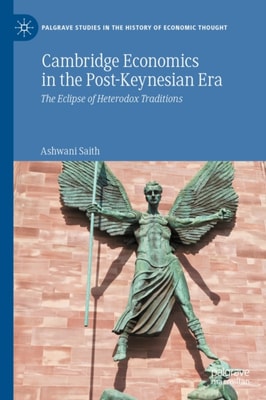
This book chronicles the rise and especially the demise of diverse revolutionary heterodox traditions in Cambridge theoretical and applied economics, investigating both the impact of internal pressures within the faculty as also the power of external ideological and political forces unleashed by the global dominance of neoliberalism.
This timely book debates the economic and political logic of the austerity policies that have been implemented in the UK and in the Eurozone since 2010 and asks whether there is any alternative for these countries in the years ahead.
This book describes and refutes thirteen ideas involving free market principles and the US economic system, arguing that these (mostly familiar) ideas are myths.