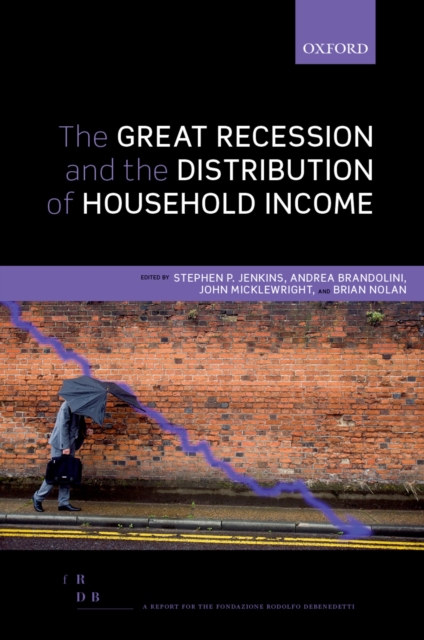
The so-called Great Recession that followed the global financial crisis at the end of 2007 was the largest economic downturn since the 1930s for most rich countries.
There is growing dissatisfaction with the economic policies advocated by the IMF and other international financial institutions - policies that have often resulted in stagnating growth, crises, and recessions for client countries.
This volume uses state of the art models from the frontier of macroeconomics to answer key questions about how the economy functions and how policy should be conducted.
By 2000, Ireland had achieved a remarkable macroeconomic performance: 10% economic growth annually, a budget surplus, and a very low debt to GDP ratio.
This book aims to identify and analyze the impact of the 2007-09 global financial crisis on Asian economies and to assess the short-term and longer-term policy responses to the crisis in terms of their effectiveness and sustainability.
The Oxford Handbook of Pricing Management is a comprehensive guide to the theory and practice of pricing across industries, environments, and methodologies.
The Oxford Handbook of Pricing Management is a comprehensive guide to the theory and practice of pricing across industries, environments, and methodologies.
Environmental challenges, and the potential solutions to address them, have a direct effect on living standards, the organization of economies, major infrastructures, and modes of urbanization.
Fixed Income Modelling offers a unified presentation of dynamic term structure models and their applications to the pricing and risk management of fixed income securities.
There is growing dissatisfaction with the economic policies advocated by the IMF and other international financial institutions - policies that have often resulted in stagnating growth, crises, and recessions for client countries.
Grounding its analysis in the historical evolution of financial regulation, this book addresses a range of public policy issues that concern the design of financial regulation and its enforcement, and contributes several new ideas to the debate in this field.
Dynamic Approaches to Macroeconomics provides the advanced student with key methodological tools for the dynamic analysis of a core selection of macroeconomic phenomena, including consumption and investment choices, employment and unemployment outcomes, and economic growth.
Stochastic volatility is the main concept used in the fields of financial economics and mathematical finance to deal with time-varying volatility in financial markets.
Macroeconometric models, in many ways the flagships of the economist's profession in the 1960s, came under increasing attack from both theoretical economist and practitioners in the late 1970s.
Japan's tax system, which has changed notably through periods of war, post-war reconstruction, rapid economic development, and moderated economic growth, provides outstandingly rich material for in-depth study.
This book is an applications-orientedtext designed for individuals who desire a hands-on approach to analyzing theeffects of fiscal and monetary policies.
Now that the process of full implementation of European Monetary Union has begun, it is time to shift attention away from the process of introduction to the implications that the common currency will have for a wide range of institutions and policy areas.
This book provides an indispensable guide to the economic, political and diplomatic process that led to the creation of the European single market and the signing of the Maastricht Treaty.
Macro Markets puts forward a unique and authoritative set of detailed proposals for establishing new markets for the management of the biggest economic risks facing society.